
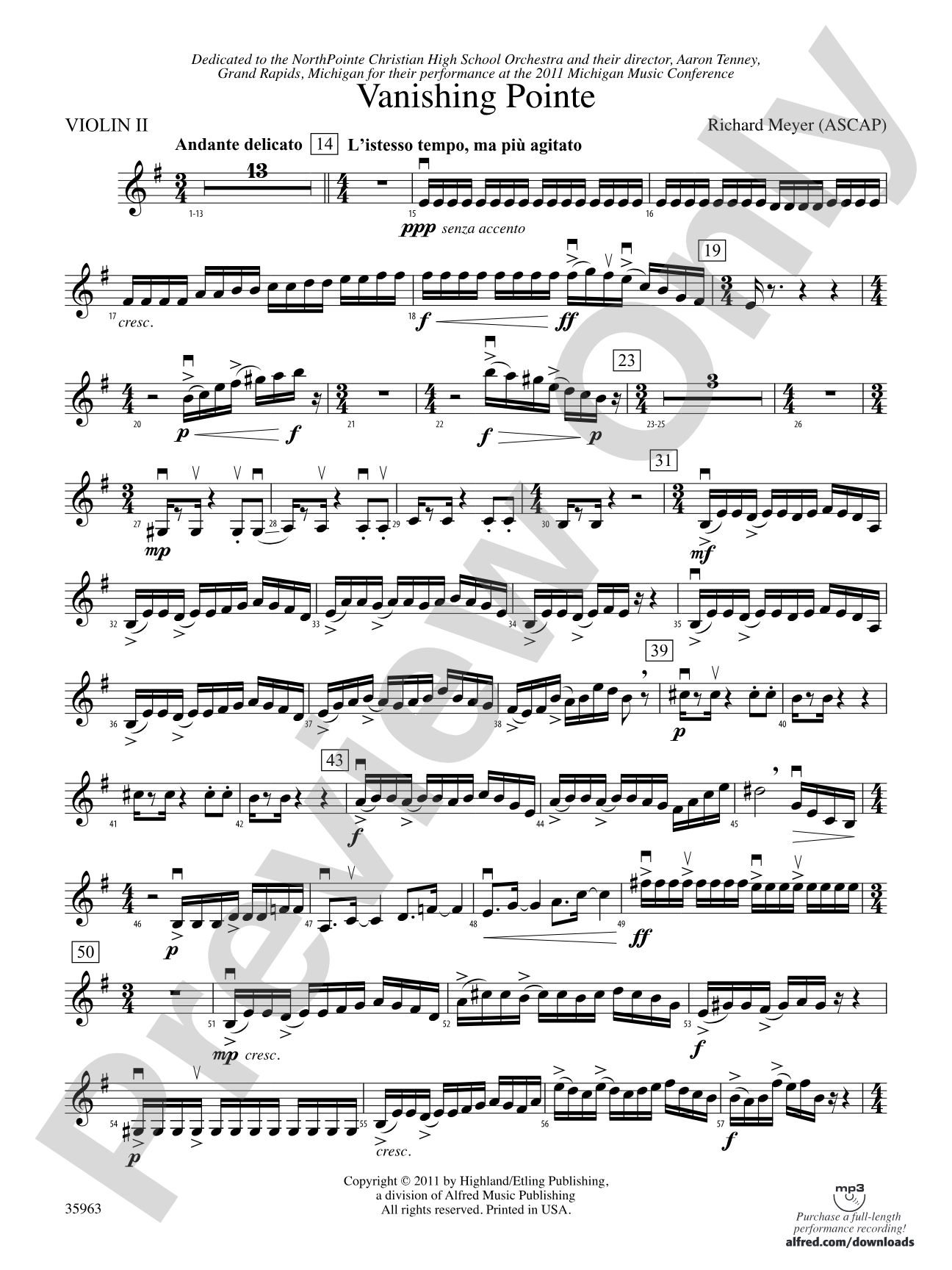

Vanishing Pointe: 2nd Violin
By Richard Meyer
Grade: 4
Item: 00-PC-0015038_VN2
$5.99
Pickup currently not available
Description
This original selection will challenge every section of your high school string orchestra both musically and technically. A jazzy, rhythmically intense mood dominates much of the piece, but makes way briefly for a lyrical middle section featuring lush, hauntingly beautiful harmonies. Contrary motion, crescendos and decrescendos are used throughout to depict vanishing points, and a solo section for two violins adds to the interest. A great way to show off your orchestra's "chops" and sensitive side. This title is available in MakeMusic Cloud.


Don't just read it, hear it, play along with it, and watch your students grow with it. In MakeMusic Cloud, Vanishing Pointe: 2nd Violin comes alive with professional accompaniment, adjustable tempo, and built-in practice tools that turn solo practice into real progress.
Open in the Player
Jump straight in and assign it today.
Start Your Free Trial
Open this title and explore the full library in minutes.
Sample Audio
1
Audio File
--:--
0:00
0:00
Sample Video
No sample videos found.
Additional Details
Series:
Highland/Etling String Orchestra
Publisher:
Alfred Music
Page Count:
124
SKU:
00-PC-0015038_VN2
Instrumentation:
string
More about this title
About the Composer: Richard Meyer

Richard Meyer brings three decades of string teaching experience into his compositions, having spent 22 years building the orchestra program at Oak Avenue Intermediate School from 29 students to 200. Beyond the classroom, he shaped the Pasadena Youth Symphony Orchestra for 16 years, leading them on international performance tours, and founded the nationally recognized "Giving Bach" program, which uses interactive concerts to reach special needs and underserved students across Southern California.
As a prolific composer with nearly 200 published works and arrangements, Meyer also served as string editor for Alfred Publishing and co-authored the String Explorer Series and Sight-read It for Strings method books. His dual expertise in pedagogy and composition means his writing speaks directly to what student musicians need to grow technically and artistically.
Why we love this
Meyer balances showpiece ambition with real accessibility. The piece gives your advanced high school orchestra genuine technical challenges and a chance to demonstrate sophisticated musicianship, but the jazzy rhythmic language and contrasting lyrical section prevent it from feeling academic or dry. Your students will remember playing this.
What to expect
A piece that moves confidently between two distinct personalities. The jazzy, rhythmically driven passages feel modern and energetic, propelled by syncopation and dramatic dynamic shifts. When the lush middle section arrives, the mood becomes introspective and dreamlike, with harmonies that linger in the ear long after the performance ends.
Who it's for
High school string orchestras ready to tackle Grade 4 repertoire that demands both technical facility and musical maturity. This works equally well for groups preparing for festival competition or concert programming that needs to showcase range and sophistication.
How to get the most out of it
- Lock the rhythmic precision during the jazzy sections by subdividing the beat internally. The intensity depends entirely on that rhythmic clarity.
- Shape the violins' solo passage with careful attention to phrase breathing. The hauntingly beautiful quality only emerges when they resist the urge to push through it.
- Use the contrary motion textures to clarify your conducting. Show the independence of the lines so players understand they're creating the vanishing point effect, not just following you.
How to use it
Program this as the anchor piece on a concert that pairs classical or Romantic works with contemporary string writing. It's substantial enough (124 pages) to anchor a full program and distinctive enough to give your orchestra clear identity at festivals. The dual character also makes it valuable for demonstrating range to parents and prospective students.
Skills your students will build
- Managing contrasting articulation styles (jazz rhythms versus sustained legato phrases)
- Reading and executing contrary motion writing across sections
- Executing dynamic control through crescendos and diminuendos as compositional devices
- Balancing ensemble sound during rapid rhythmic figures
- Supporting and blending with featured soloists