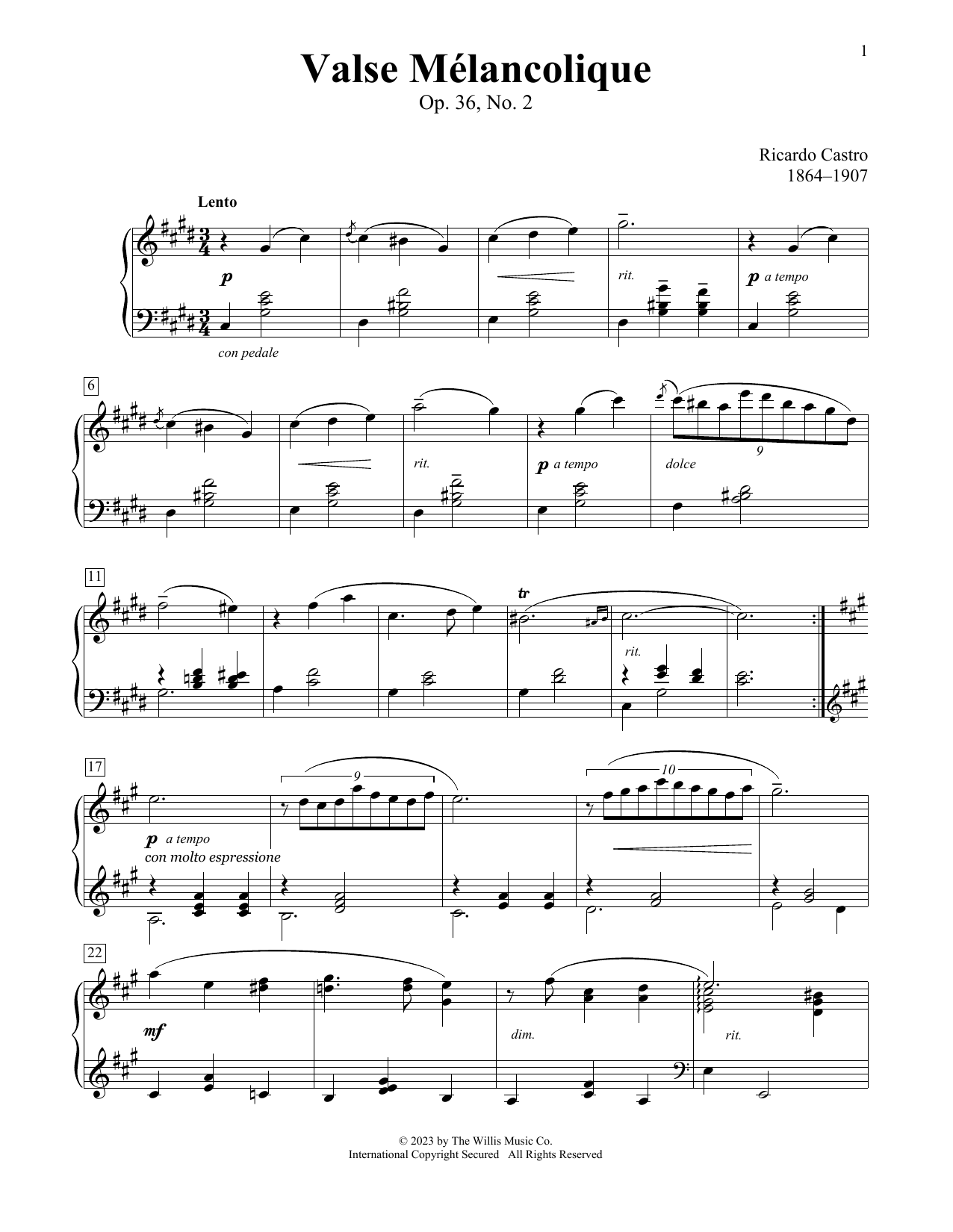
Valse Melancolique, Op. 36, No.2 Sheet Music Preview

Valse Melancolique, Op. 36, No.2: Educational Piano

Edited by Charmaine Siagian / Edited by Sonya Schumann

Item: 35-DS01339669

Digital Download
$4.99
One moment…
Description

Discover MakeMusic Cloud: thousands of interactive titles your students can play along with today.

Sample Audio
No sample audio found.
Sample Video
Additional Details
Publisher: Hal Leonard
Page Count: 6
SKU: 35-DS01339669

More about this title

About the Creator: Sergei Lyapunov

Sergei Lyapunov was a Russian composer and pianist whose technical command and lyrical sensibility shaped the late-Romantic repertoire. Working through the late 19th century, he built a substantial catalog of piano works that balance virtuosic demands with emotional depth, earning respect across concert halls and conservatories.

Lyapunov's output reveals a composer comfortable in both ambitious large-scale forms and intimate character pieces. His twelve Transcendental Etudes represent one pinnacle of his achievement, yet his gentler salon works and dance-inspired compositions show equal craft. This duality makes his music particularly valuable for students navigating between technical aspiration and artistic expression.

Why we love this

A waltz that wears melancholy like an elegant garment, this piece rewards students who understand how a graceful form can express complex emotion. The six pages offer substantial musical content without overwhelming intermediate players, making it both accessible and artistically satisfying to perform.

What to expect

Wistful and composed, like a memory visited on a quiet afternoon. The waltz form moves steadily forward, yet the harmonic language carries an undertone of longing, creating a piece that dances while it contemplates.

Who it's for

Intermediate to early advanced pianists seeking repertoire beyond typical Baroque and early Classical pedagogical standards. This piece belongs in the hands of students ready to explore Russian Romantic idiom and develop interpretive independence within established forms.

How to get the most out of it

  • Shape the melody line with subtle dynamic swells; the piece breathes through its phrases rather than pushing forward relentlessly.
  • Attend to the harmonic color in the left hand accompaniment. These voices carry emotional weight and shouldn't become background noise.
  • Let rubato emerge naturally from the waltz rhythm rather than imposing it artificially. The pulse remains clear even as the top line bends slightly.
  • Balance resonance with clarity in the middle section. Pedal changes prevent the texture from muddying while sustaining the reflective mood.

How to use it

Program this alongside other late-Romantic salon pieces to create a sophisticated recital section that showcases student maturity. It pairs naturally with other Russian composers from the same era, or stands effectively as a contrasting lyrical moment between larger structural works.

Skills your students will build

  • Balancing lyrical melody against accompaniment texture
  • Reading Romantic-era harmonic language and voice leading
  • Sustaining emotional tone across a consistent dance form
  • Controlling pedal for resonance without muddiness
  • Shaping phrasing within triple meter

You May Also Like