
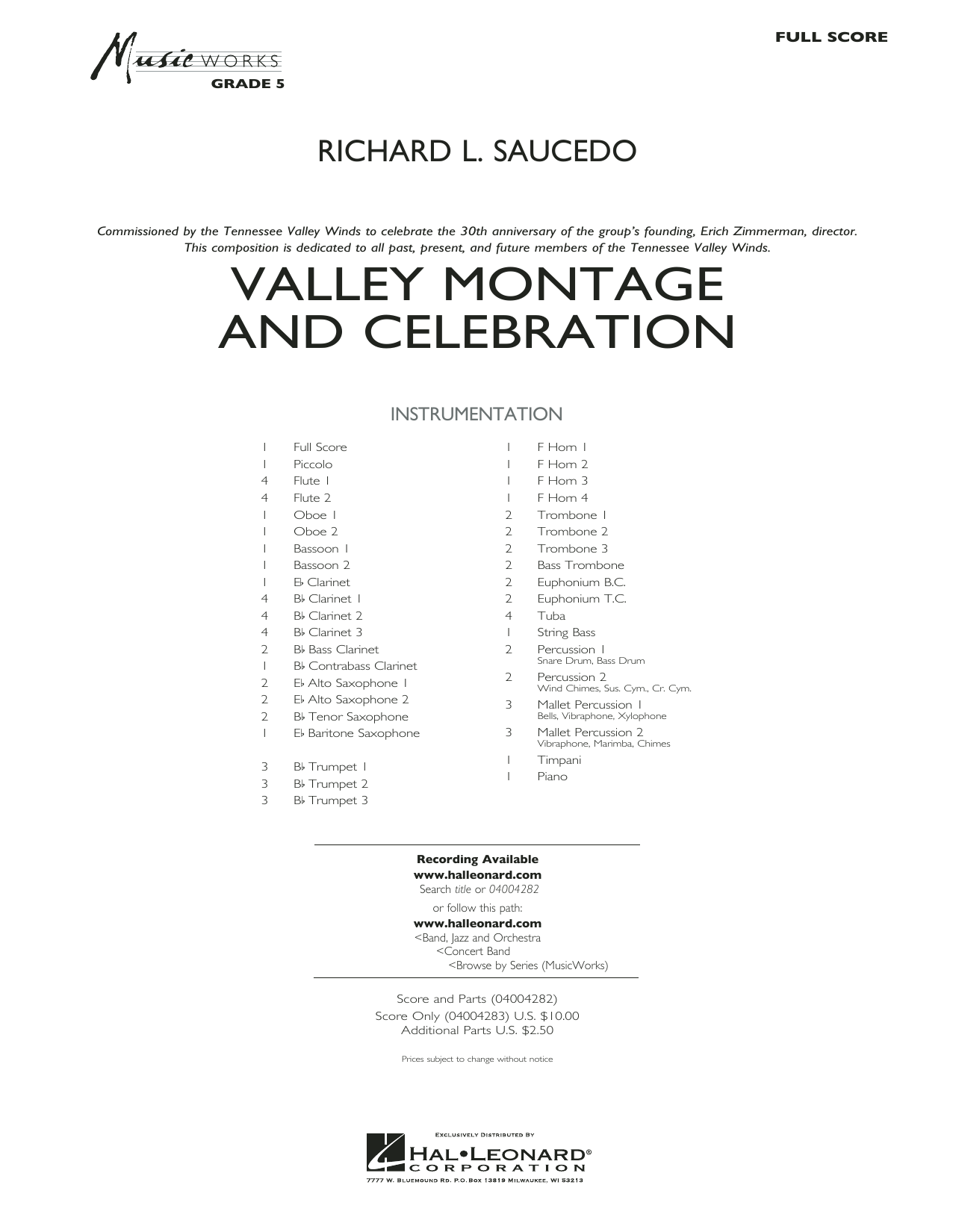

Valley Montage and Celebration: Concert Band Conductor Score & Parts
By Richard L. Saucedo
Grade: 5
Item: 35-PK00310075
$95.00
Pickup currently not available
Buy Extra Parts (Digital PDF Download)
Parts Added to Cart!
Description
This work for advanced band was commissioned by the Tennessee Valley Winds to celebrate the group's 30th anniversary. The piece begins calmly with a clarinet solo but quickly moves to a celebratory section in 12/8 meter. The main melody is stated in many different voices as it steadily builds to a moment of controlled frenzy. A brief lyrical section features an expressive style and also a moment of glory for the entire woodwind choir. The work concludes with a return to the vibrant and enthusiastic flavor of the opening. Powerful and impressive writing for mature groups! Dur: 5:10


Valley Montage and Celebration: Concert Band Conductor Score & Parts isn't in MakeMusic Cloud just yet...but it could be. Let us know you'd like to see it, and you'll help shape what comes next. In the meantime, start a free trial and dive into thousands of interactive titles your students can play along with today.
Request This Title
Tell us you want it.
Start Your Free Trial
Explore everything that's ready to play right now.
Sample Audio
No sample audio found.
Sample Video
No sample videos found.
Additional Details
Publisher:
Hal Leonard
SKU:
35-PK00310075
More about this title
About the Composer: Richard L. Saucedo

Richard L. Saucedo shaped the Carmel High School bands program over three decades into a powerhouse that earned state, regional, and national recognition across concert, jazz, and marching ensembles. His tenure produced three appearances by Carmel's Wind Symphony at the Music for All National Concert Band Festival, a 2013 Indiana State Championship title, and a Marching Greyhounds program that claimed BOA National Championships in 2005 and 2012 while finishing in the top ten for 17 consecutive years.
Saucedo's contributions to music education earned him Indiana's Bandmaster of the Year honor in 1998-99 and induction into both the Music for All Hall of Fame (2015) and the Drum Corps International Hall of Fame (2022). Beyond the classroom, he served as brass arranger and composer for the Cavaliers Drum and Bugle Corps during five DCI world championship seasons and currently coordinates music ensembles for the Blue Devils. His portfolio as a freelance composer and arranger spans marching bands, concert bands, choral works, and orchestral music.
Why we love this
Saucedo knows exactly what advanced bands can accomplish, and this piece demands the technical precision and musical maturity that separates Grade 5 from pretenders. The structural arc from introspection to controlled celebration mirrors the kind of programming challenge that makes a strong concert feel coherent rather than scattered, and the scoring writes idiomatically for what your ensemble actually does well.
What to expect
The piece opens in quiet reflection before erupting into infectious celebration, building momentum through layered orchestration until it reaches a moment of deliberate chaos. A tender woodwind passage interrupts the festivities, offering lyrical breathing room, before the piece returns to its original exuberance and concludes with unmistakable joy.
Who it's for
Advanced concert bands seeking a substantial festival work that balances technical demands with emotional range. The piece suits ensembles comfortable with mixed meters and able to articulate quick rhythmic figures without sacrificing musicality.
How to get the most out of it
- Establish the clarity of that opening clarinet solo in early rehearsals; it sets the emotional foundation before the energy shifts, so resist rushing into the 12/8 celebratory section too soon.
- Balance the melodic distribution across voices during the buildup passage. Each choir needs to hear how their line connects to the overall phrase arc, not just hit their notes.
- The controlled frenzy before the lyrical section works only if your rhythm section locks the pulse tight. Rhythmic security here prevents the moment from feeling chaotic rather than exhilarating.
- Feature the full woodwind choir moment with deliberate care. This is your ensemble's reward for the work that precedes it, so give them space to breathe and resonate.
How to use it
Program this as your festival opener or closer depending on whether you want to set an uplifting tone at the start or leave judges and audience members smiling as they file out. At just over five minutes, it pairs well with either a serious pedagogical work or an entertaining novelty piece without overwhelming a concert's runtime.
Skills your students will build
- Executing rapid rhythmic figures and articulation patterns
- Maintaining ensemble cohesion through meter changes (12/8 and implied duple meters)
- Balancing melodic lines when the theme passes through multiple choirs
- Controlling dynamic intensity during accelerating passages
- Sustaining ensemble focus through extended builds and textural layering