
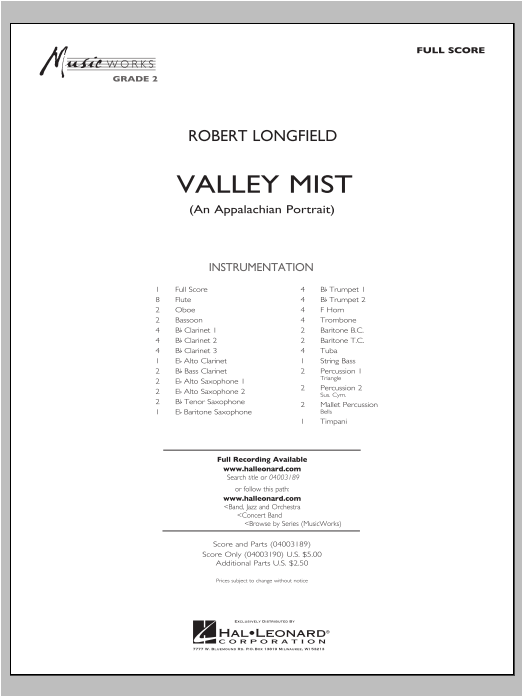

Valley Mist (An Appalachian Portrait): Concert Band Conductor Score & Parts
By Robert Longfield
Grade: 2
Item: 35-PK00245698
$55.00
Pickup currently not available
Buy Extra Parts (Digital PDF Download)
Parts Added to Cart!
Description
Inspired by the mountains of West Virginia, "Valley Mist" portrays a beautiful scene of cloud-like mist as it flows gently around the hills encompassing the entire valley in an atmosphere of peace and tranquility. Quoting the Appalachian folk song "Down in the Valley", this sensitively scored work includes an optional gentle rain effect with the use of finger snaps. Sure to be an enjoyable change of pace for any program. Dur: 3:35


Valley Mist (An Appalachian Portrait): Concert Band Conductor Score & Parts isn't in MakeMusic Cloud just yet...but it could be. Let us know you'd like to see it, and you'll help shape what comes next. In the meantime, start a free trial and dive into thousands of interactive titles your students can play along with today.
Request This Title
Tell us you want it.
Start Your Free Trial
Explore everything that's ready to play right now.
Sample Audio
No sample audio found.
Sample Video
No sample videos found.
Additional Details
Publisher:
Hal Leonard
SKU:
35-PK00245698
More about this title
Why we love this
Longfield captures something genuinely atmospheric here without resorting to cheap effects or overwrought orchestration. The integration of the "Down in the Valley" folk melody feels organic rather than quoted, and the optional finger snap rain keeps the piece grounded in simplicity while giving students a concrete, playable texture to control.
What to expect
Quiet and expansive, like standing in a valley as fog rolls through. There's melancholy without being mournful, and a kind of reverent stillness that comes from folk tradition without pastiche. The occasional mist clears enough to hear the landscape breathe.
Who it's for
Intermediate concert bands looking for a piece that demonstrates musical maturity without technical pyrotechnics. Works equally well for groups developing ensemble sound and balance, or as a palette cleanser in a program of heavier works.
How to get the most out of it
- Balance the melody line across sections; this piece lives or dies on the singing quality of whoever carries the folk song. Make sure your principal players understand they're shaping a landscape, not just playing notes.
- If you use the finger snaps, assign them deliberately and rehearse the rhythmic precision separately. Sloppy rain is worse than no rain.
- Take the tempo flexibly where the score allows. Mist doesn't move at a metronomic pace; breath and phrase direction matter far more than strict pulse here.
- Pay attention to dynamic shaping in the background parts. The surrounding figures support the main melody, so players need to hear themselves as atmospheric color, not rhythmic accompaniment.
How to use it
Pair this with something more energetic to create real contrast on a concert. It's the piece that lets audiences settle in and listen closely, so program it where your band can sustain focus and the hall itself feels less like an event space and more like a place for reflection.
Skills your students will build
- Sustaining even tone across a slow, lyrical line
- Listening to and blending with surrounding ensemble colors
- Rhythmic precision in accompaniment figures that support rather than drive
- Dynamic control and shaping in passages with minimal written marking
- Managing intonation in low-density scoring where each player is exposed