
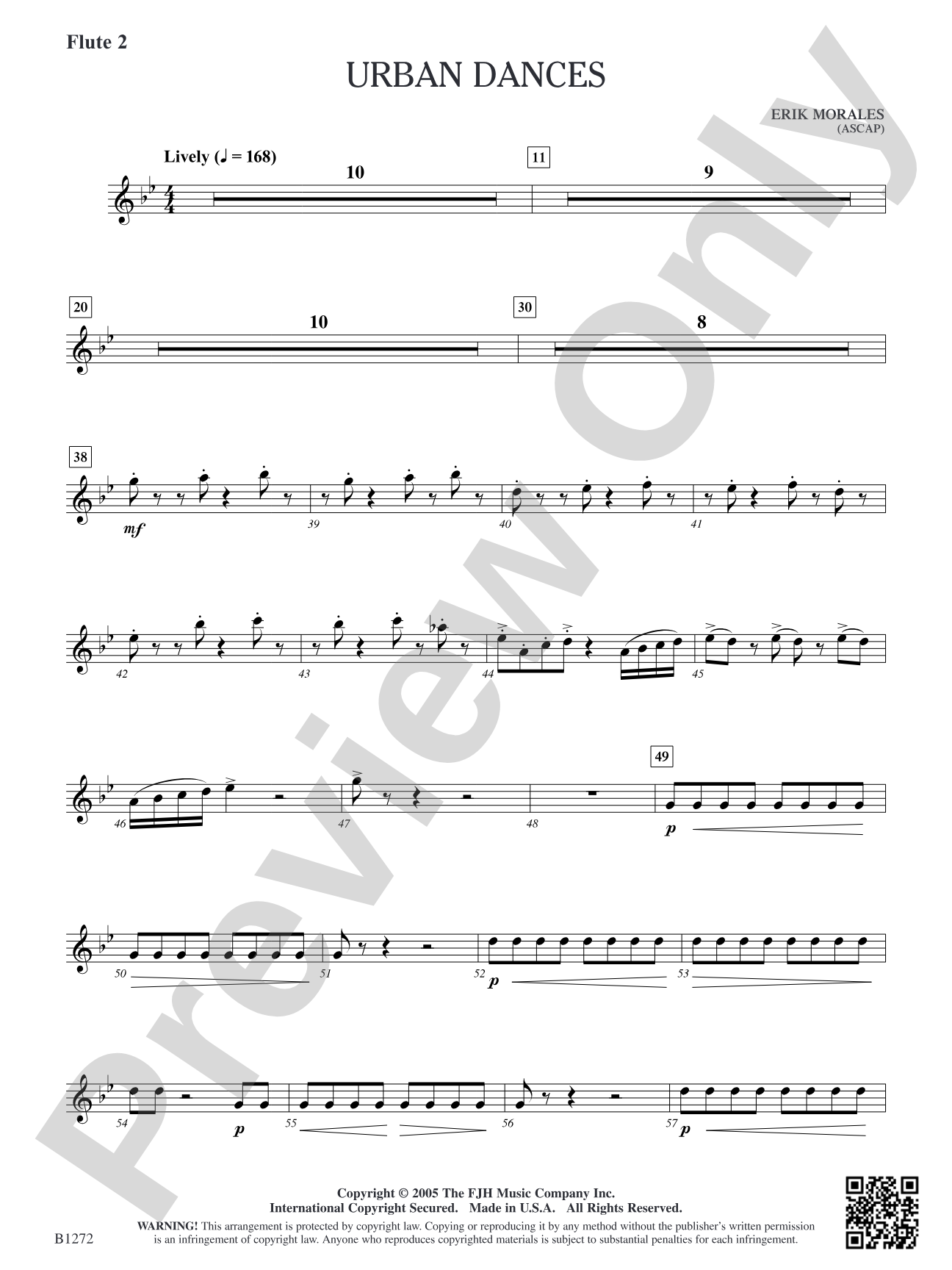

Urban Dances: Flute 2
By Erik Morales
Grade: 4
Item: 98-PC-DB1272_F2
$7.00
Pickup currently not available
Description
Drawing inspiration from elements of today's popular music, this serious concert piece focuses on rhythm as the primary developmental tool. Featuring a large battery of percussion, the piece uses the full gamut of colors available to the concert band. Heroic figures in the brass soar over the rhythmic pulses as the piece continues to build to a dynamic conclusion. Innovative and fresh!


Don't just read it, hear it, play along with it, and watch your students grow with it. In MakeMusic Cloud, Urban Dances: Flute 2 comes alive with professional accompaniment, adjustable tempo, and built-in practice tools that turn solo practice into real progress.
Open in the Player
Jump straight in and assign it today.
Start Your Free Trial
Open this title and explore the full library in minutes.
Sample Audio
1
Audio File
--:--
0:00
0:00
Sample Video
No sample videos found.
Additional Details
Series:
FJH Concert Band
Publisher:
The FJH Music Company, Inc.
SKU:
98-PC-DB1272_F2
More about this title
About the Composer: Erik Morales

Erik Morales brings a distinctive compositional voice shaped by deep roots in both classical and commercial music traditions. Born in New York City in 1966, he began arranging for marching band while still in high school, a formative experience that set him on a prolific path. He earned his bachelor's degree from the University of Louisiana, Lafayette (1989) and studied composition at Florida International University. Over more than 150 published works, Morales has built a reputation for balancing artistic substance with educational accessibility across wind, orchestral, jazz, and chamber settings.
His trumpet writing is particularly noteworthy; his ensemble works have earned first place awards at the 2006 and 2008 National Trumpet Competitions, and his Concerto for Trumpet in C and Piano received its premiere at the 2009 International Trumpet Guild conference. In 2012, a consortium-commissioned Concerto for Two Trumpets had its debut at the 2013 ITG conference in Michigan. Morales has been regularly commissioned by schools and organizations across the United States and was inducted into the Louisiana Association for Jazz Education's Hall of Fame in 2016.
Why we love this
Morales constructs this piece around rhythm as the engine, which means your ensemble will develop real ensemble cohesion and internal pulse through the performance. The interplay between a massive percussion battery and soaring brass creates genuine musical drama that audiences feel immediately, and the Grade 4 writing respects student musicians' intelligence while remaining technically achievable.
What to expect
The piece pulses with the energy of contemporary music; syncopated rhythmic figures ground the sound while brass lines soar with heroic confidence above. By the conclusion, the full band's dynamic build creates genuine excitement, pulling the audience into the momentum rather than inviting passive listening.
Who it's for
Directors of Grade 4 concert bands seeking a contemporary piece that challenges ensemble cohesion without requiring advanced technical facility. Students benefit from experiencing modern composition that takes their musicianship seriously while remaining performance-accessible for festival and concert contexts.
How to get the most out of it
- Lock the rhythm section (percussion and lower winds) early in rehearsals; once that foundation is solid, the brass figures will sit naturally on top of the rhythmic foundation.
- Balance the percussion colors carefully during full-band runs. With a large battery, individual strikes and mallets can easily obscure the melodic figures above, so mark dynamic and articulation adjustments in the conductor parts.
- Let the brass soloists know where their heroic figures sit in the harmonic landscape. These aren't independent runs; they need to understand how they rise against and resolve with the rhythmic pulses beneath them.
- Build the dynamic arc through sectional work on the conclusion. Morales has written to a climax, and it requires disciplined crescendos from all sections working together, not one section overpowering the rest.
How to use it
This works exceptionally well as a festival or competition selection where the distinctive orchestration and modern language stand out on a program of traditional repertoire. It also serves as a strong centerpiece for a concert exploring contemporary approaches to band writing, especially if paired with other pieces that showcase percussion or rhythmic innovation.
Skills your students will build
- Rhythmic precision and ensemble cohesion through complex, layered rhythmic figures
- Balancing independent percussion parts while supporting brass melodic content
- Reading and performing contemporary concert band idioms
- Dynamic control and phrasing within a modern harmonic and rhythmic context
- Understanding how rhythm functions as a primary compositional element