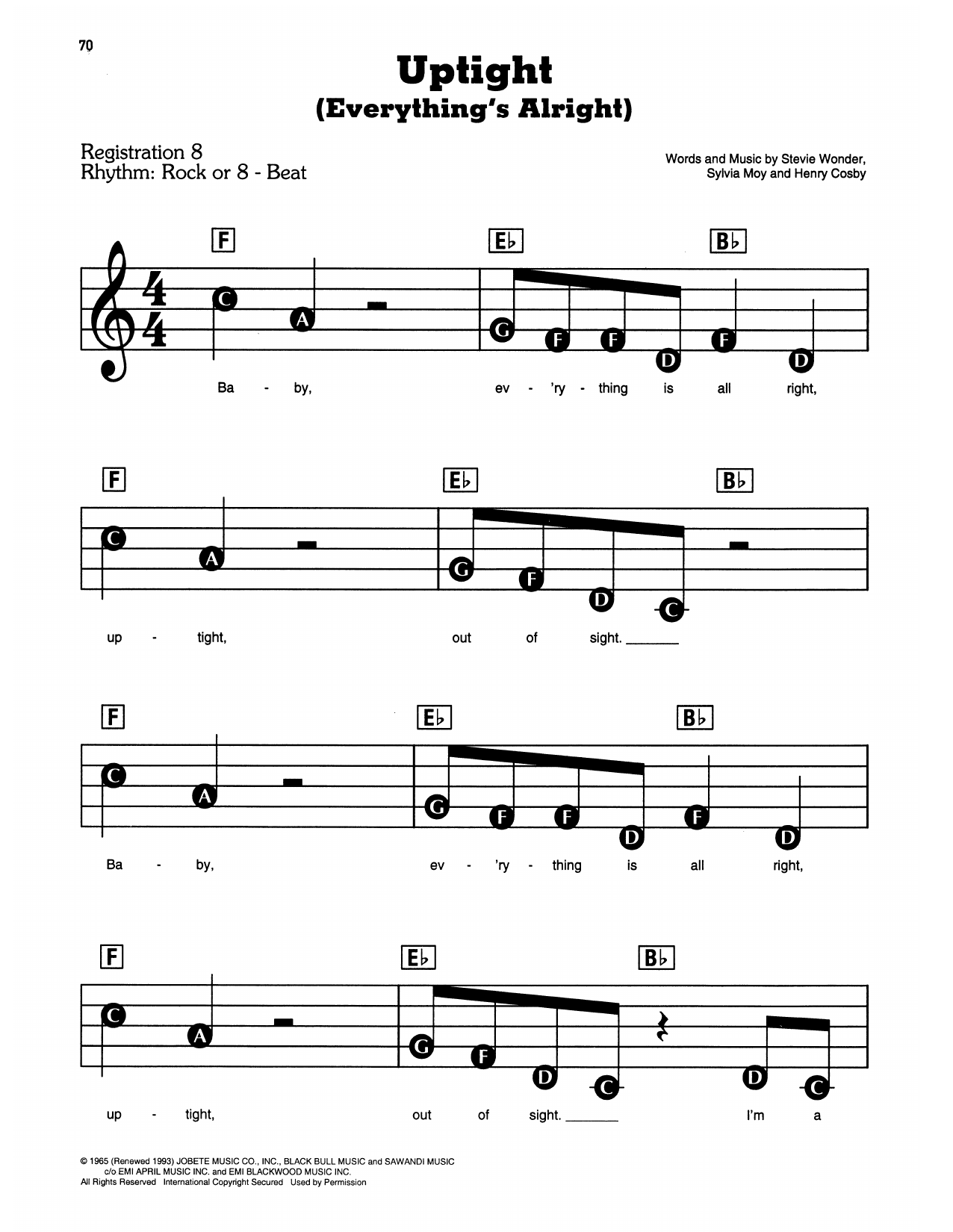
Uptight (Everything's Alright) Sheet Music Preview

Uptight (Everything's Alright): E-Z Play Today

As performed by Stevie Wonder

Item: 35-DS01318886

Digital Download
$4.99
Description

Uptight (Everything's Alright): E-Z Play Today isn't in MakeMusic Cloud just yet...but it could be. Let us know you'd like to see it, and you'll help shape what comes next. In the meantime, start a free trial and dive into thousands of interactive titles your students can play along with today.

Sample Audio
No sample audio found.
Sample Video
Additional Details
Publisher: Hal Leonard
Page Count: 4
SKU: 35-DS01318886

More about this title

About the Artist: Stevie Wonder

Stevie Wonder stands as one of the most influential musicians of the late 20th century, a keyboardist and composer whose harmonic sophistication and rhythmic innovation shaped popular music across decades. Blind since infancy, he mastered multiple instruments and developed a production approach that integrated jazz harmonies, soul grooves, and pop sensibility into commercially accessible yet artistically substantial songs. His work remains essential listening for any musician seeking to understand how classical training, improvisation, and accessibility can coexist in the same piece.

Why we love this

Wonder's "Uptight" showcases exactly why his keyboard writing has influenced generations of players. The song balances a buoyant, radio-friendly melody with jazz chord substitutions that keep advanced pianists engaged while remaining playable for students still building harmonic literacy.

What to expect

The piece radiates optimism and momentum. Bright, major-key chord changes suggest movement and resolution even when the harmony ventures into unexpected territory. Playing it feels like channeling the energy of a live band captured in solo piano form.

Who it's for

Students comfortable with jazz voicings and syncopated rhythms will find this arrangement rewarding without being overwhelming. Teachers can use it to introduce the harmonic language of 1960s Motown while reinforcing rhythm section fundamentals.

How to get the most out of it

  • Anchor the groove in the left hand; this song lives and breathes in the pocket, and a locked bass line gives the melody room to breathe and land with precision.
  • Treat the horn and string parts marked for piano as textural layers rather than literal transcriptions. You can voice them on the keyboard or strip them back depending on whether you're accompanying a vocalist or playing solo.
  • Let the natural swing inherit from the original recording. These four pages work best when the eighth notes breathe rather than lock into a rigid grid.

How to use it

This works beautifully in a jazz or pop history concert, where it can anchor a set exploring the evolution of keyboard writing. It also pairs well with other Motown standards for a themed evening that celebrates soul and early pop innovation.

Skills your students will build

  • Reading jazz chord symbols and implied voicings
  • Executing syncopated rhythms in both hands independently
  • Balancing melody and accompaniment texture in a single voice
  • Interpreting swing feel and rhythmic nuance from a lead sheet

You May Also Like