Unwritten (Incorporates English Suite IV) (arr. Vince Peterson) Sheet Music Preview

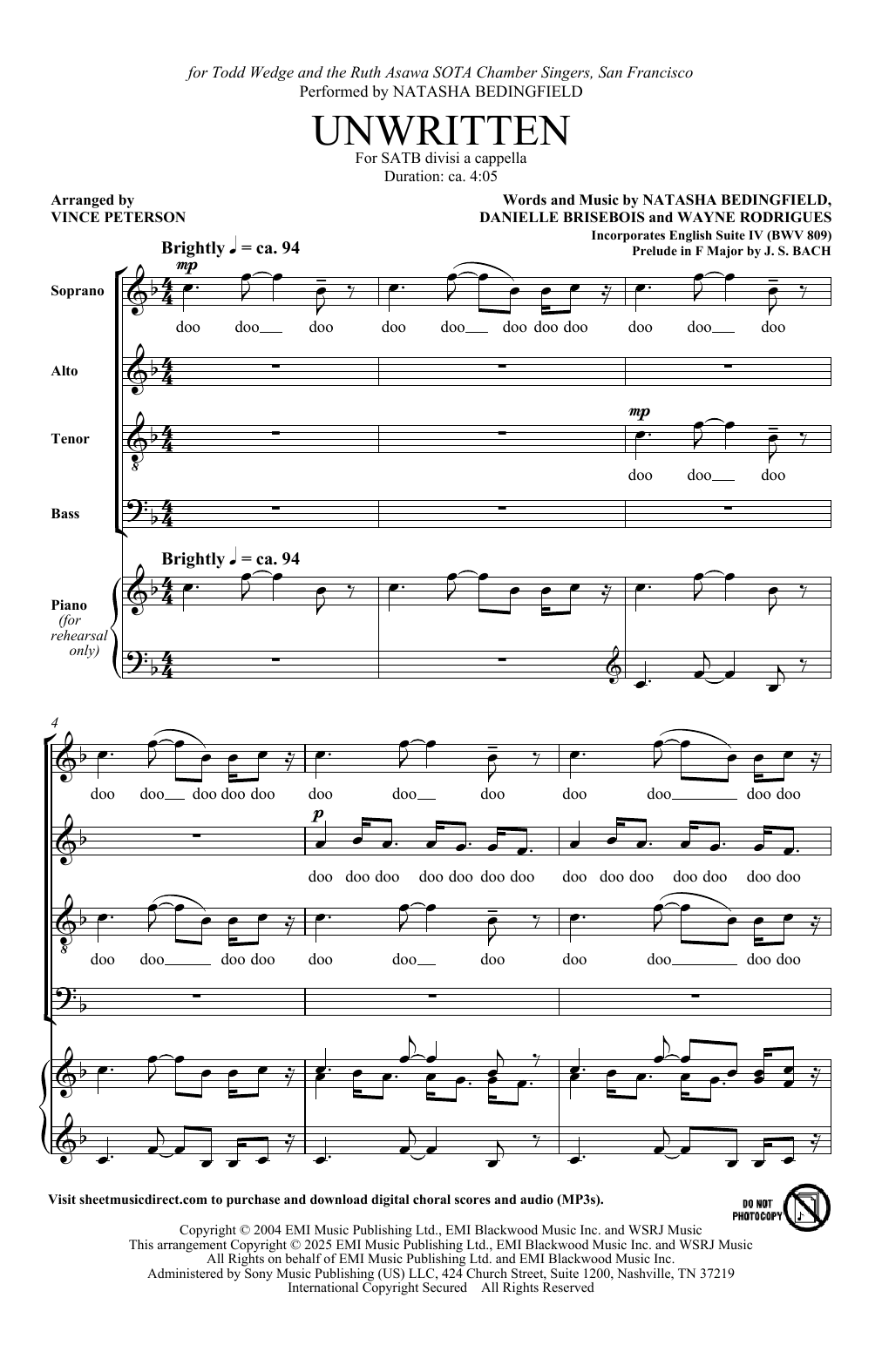
Unwritten (Incorporates English Suite IV) (arr. Vince Peterson): SATB Divisi Choral Octavo

As performed by Natasha Bedingfield / Arranged by Vince Peterson

Item: 35-DS01717792

Digital Download
$3.25
Description

Unwritten (Incorporates English Suite IV) (arr. Vince Peterson): SATB Divisi Choral Octavo isn't in MakeMusic Cloud just yet...but it could be. Let us know you'd like to see it, and you'll help shape what comes next. In the meantime, start a free trial and dive into thousands of interactive titles your students can play along with today.

Sample Audio
No sample audio found.
Sample Video
Additional Details
Publisher: Hal Leonard
Page Count: 22
SKU: 35-DS01717792

More about this title

About the Artist: Natasha Bedingfield

Natasha Bedingfield broke through as a pop vocalist in the mid-2000s with her introspective songwriting and conversational vocal delivery. Her 2004 hit "Unwritten" became an anthem of self-determination and personal agency, establishing her as a voice for authenticity in pop music. Her work has consistently explored themes of identity and empowerment, making her catalog particularly rich material for choral adaptation.

Why we love this

Vince Peterson's arrangement weaves Bach's English Suite IV into the fabric of a contemporary pop hit, creating something genuinely hybrid rather than simply layering old and new. The divisi writing gives your singers permission to explore richer harmonic color while the melodic hooks remain instantly recognizable, which means your audience stays engaged even as your ensemble stretches musically. It's the kind of arrangement that works equally well in a spring concert or a show choir competition.

What to expect

Introspective yet confident, with moments of unexpected harmonic richness beneath a melody most people already know by heart. The arrangement inhabits both the vulnerability of a pop confessional and the architectural elegance of Baroque keyboard writing, shifting between those worlds across its 22 pages.

Who it's for

Show choirs seeking contemporary material with genuine artistic weight will find this arrangement particularly valuable. It also serves concert choirs wanting to program something that bridges classical tradition and modern songwriting without feeling gimmicky.

How to get the most out of it

  • Balance the divisi voices carefully in the sections where SATB splits into multiple parts; the arrangement's strength lies in how those layers interact, so each voice needs presence without any one dominating.
  • The pop sensibility of the original demands rhythmic precision and pocket consciousness; treat rhythmic unisons with the kind of lock you'd expect in a rhythm section rather than as vocal texture.
  • Lean into the contrast between the Bach-derived passages and the contemporary melodic moments by adjusting your vowel space subtly; let the classical sections live a bit more formally, then relax into the pop idiom when the original song material returns.
  • The recorded accompaniment can anchor your ensemble's intonation in the more complex harmonic sections, but pull away from it during full divisi passages so singers develop independence within the arrangement's expanded voicings.

How to use it

This arrangement creates a natural bridge between a classical first half and contemporary second half. It also works beautifully as a spring concert centerpiece where you want to showcase your ensemble's range, or as a show choir opener that signals sophistication before diving into your competitive repertoire.

Skills your students will build

  • Reading divisi voicing across four parts with independent rhythmic lines
  • Balancing baroque harmonic language with pop sensibility
  • Ensemble intonation in extended chord structures
  • Rhythmic precision in contemporary idiom
  • Stylistic code-switching between classical and pop vocal production

You May Also Like