
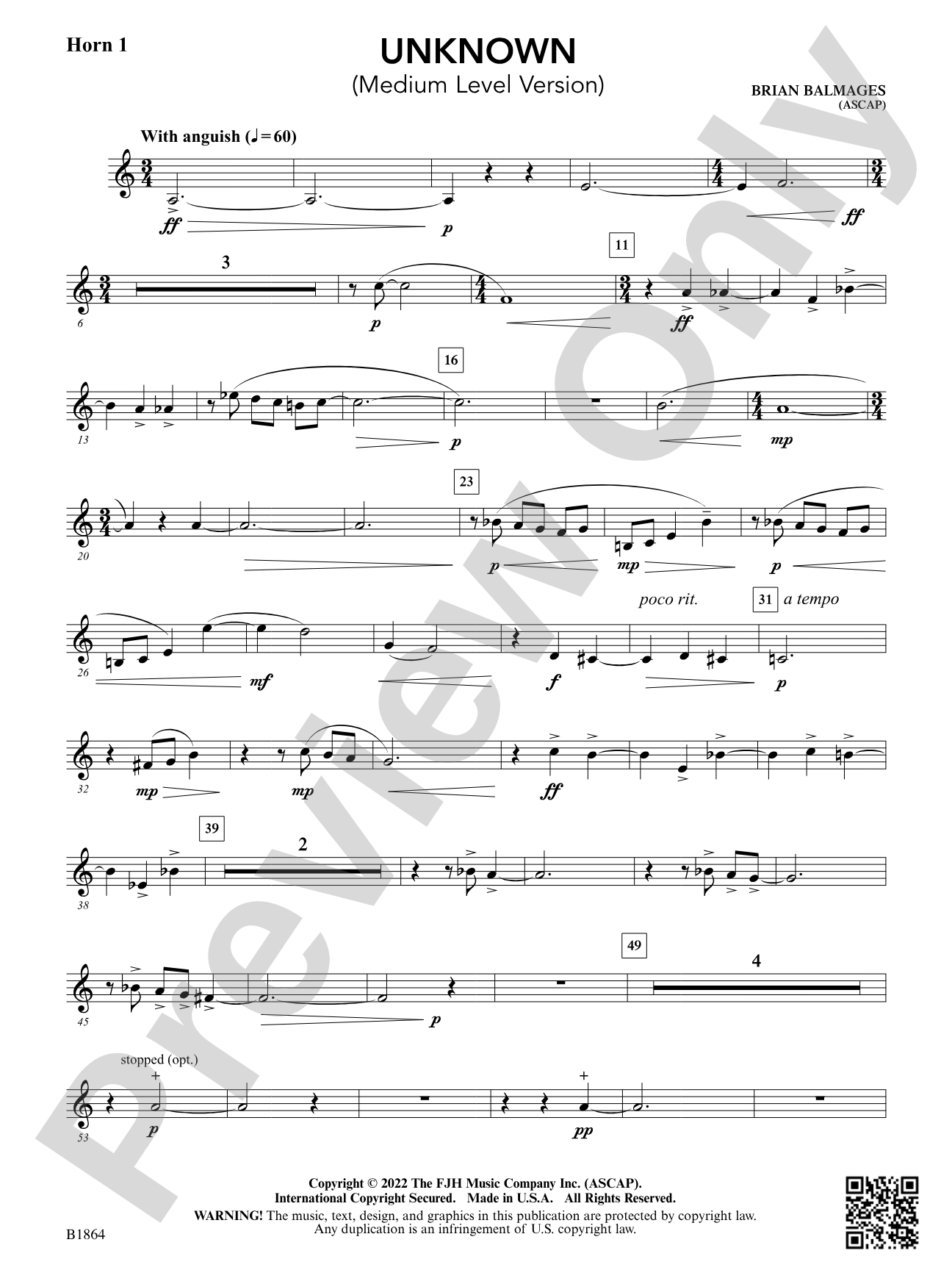

Unknown: F Horn 1
By Brian Balmages
Grade: 3.5
Item: 98-PC-DB1864_H1
$7.00
Pickup currently not available
Description
Composed during a time when everything was uncertain, this poignant work finds inspiration in anger, beauty, hope, sorrow and determination. Written to be performable by various levels of bands, the piece is playable as a medium-level version alone, a medium-easy version alone, or both versions combined (Medium-level version sold separately). A complete score of both versions combined is available as a download.


Don't just read it, hear it, play along with it, and watch your students grow with it. In MakeMusic Cloud, Unknown: F Horn 1 comes alive with professional accompaniment, adjustable tempo, and built-in practice tools that turn solo practice into real progress.
Open in the Player
Jump straight in and assign it today.
Start Your Free Trial
Open this title and explore the full library in minutes.
Sample Audio
1
Audio File
--:--
0:00
0:00
Sample Video
Additional Details
Series:
FJH Concert Band
Publisher:
The FJH Music Company, Inc.
SKU:
98-PC-DB1864_H1
More about this title
About the Composer: Brian Balmages

Brian Balmages has built a prolific career across orchestral, band, and chamber music, earning recognition from major venues including Carnegie Hall, the Kennedy Center, and the Sydney Opera House. His accolades include the A. Austin Harding Award from the American School Band Directors Association, the 2020 NBA William D. Revelli Composition Contest for Love and Light, and membership in the American Bandmasters Association. His work has appeared at the 2013 Presidential Inaugural Prayer Service and in commissions from major universities.
As a conductor, Balmages regularly guests with all-state ensembles, university groups, and professional orchestras worldwide, with notable appearances at the Midwest Clinic, Western International Band Clinic, and numerous regional and national conferences. He currently serves as Director of MakeMusic Publications and Digital Education for Alfred and MakeMusic.
Why we love this
Balmages crafts music that meets bands where they are without sacrificing emotional depth. The ability to program either version independently or layer them together gives you genuine flexibility in rehearsal planning, and the Grade 3.5 level sits in that sweet spot where students can access real musical substance without drowning in technical demands. A contest-viable work that genuinely moves listeners.
What to expect
The work moves through contrasting emotional territories, beginning in uncertainty and building through moments of raw anger and fragile beauty before settling into quiet determination. Listeners experience a journey rather than a single mood, with each section revealing new layers of the composer's response to an uncertain time.
Who it's for
Band directors working with Grade 3.5 ensembles who want repertoire with genuine emotional resonance and programming flexibility. This score serves groups preparing for contests and festivals as well as conductors looking for music that balances accessibility with artistic integrity.
How to get the most out of it
- Balance the expressive architecture across all sections. The piece draws from anger, beauty, hope, and sorrow; make sure each emotional shift lands clearly without rushing the transitions.
- When combining both versions, rehearse them separately first so students internalize their own material before learning how the parts interact.
- Pay attention to dynamic control in the mid-range dynamics (mezzo-forte through mezzo-piano). This piece relies on nuance more than extremes to convey its emotional arc.
- Let the determination in the final sections build naturally from what came before rather than forcing intensity at the end.
How to use it
Program this as a contest selection where emotional maturity and control matter as much as technical precision. It also works effectively as a centerpiece in a concert program pairing with lighter fare, or as the anchor for a thematic program exploring how composers respond to contemporary challenges.
Skills your students will build
- Dynamic control and sustaining soft dynamics across full ensemble
- Emotional expression through phrasing and timing rather than technical display
- Sectional balance during lyrical passages and sustained chords
- Responding to shifting harmonic and textural colors
- Building tension and release across longer musical phrases