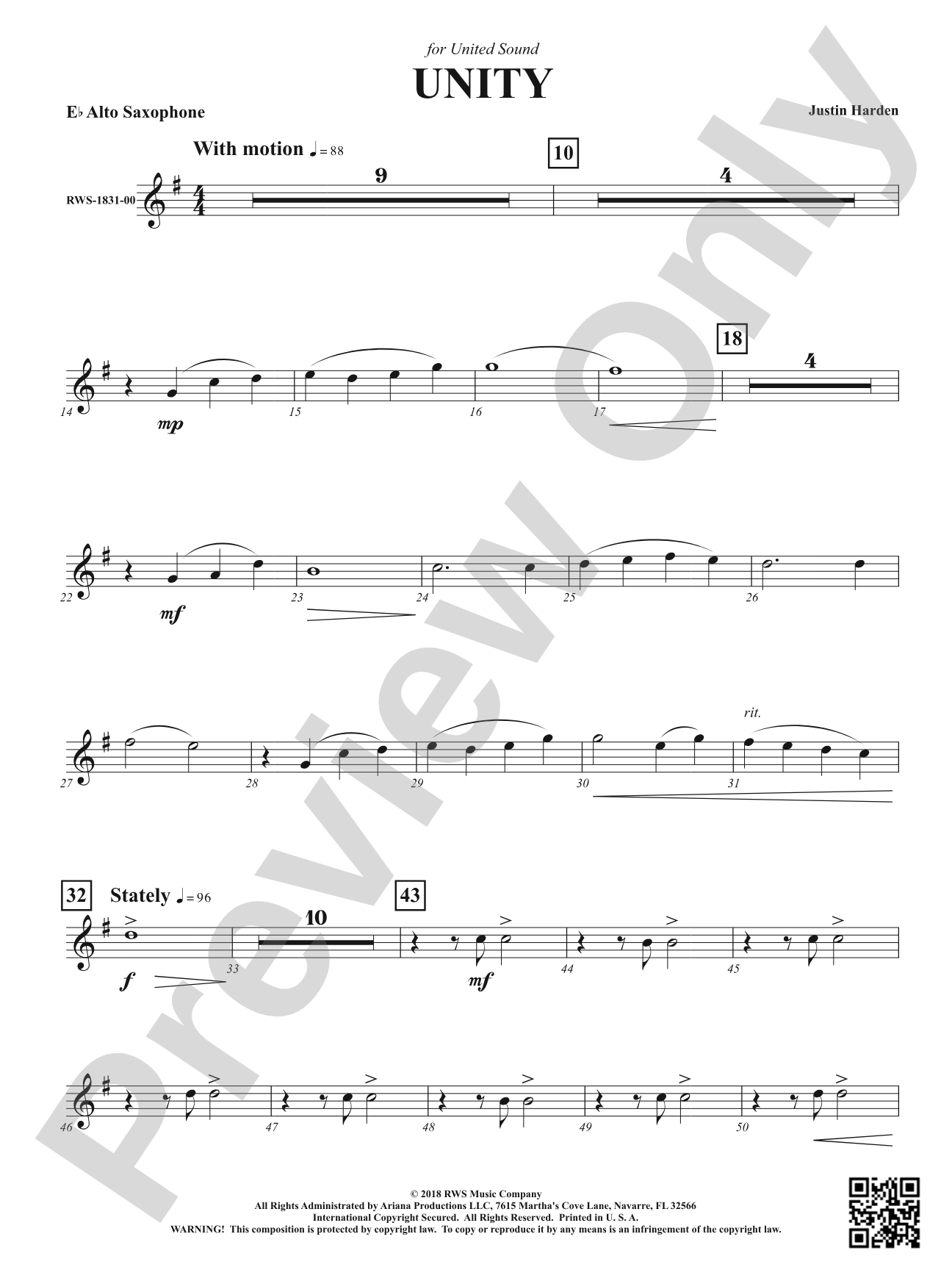
Inspired by the late Martin Luther King Jr's "I Have A Dream" speech, this new composition by Justin Harden conveys images of promise, solidarity, and triumph. Written for United Sound, the work begins with a beautiful and lush lyrical statement. A heralding trumpet foreshadows the glorious development leading to a glorious conclusion. Appropriate for concert/festival as well as ceremonial use, Unity may very well find a place in your band's standard repertoire.
Original Item#: RWS-1831-00
Discover MakeMusic Cloud: thousands of interactive titles your students can play along with today.
Unity accomplishes what programmatic band music should do: it tells a story through orchestration and phrasing rather than relying on gimmicks or excessive complexity. The trumpet fanfare earns its moment because Harden builds toward it methodically, and that payoff makes the piece rewarding to conduct and hear. At Grade 3, it sits at the sweet spot where students handle real musical ideas without drowning in technical demands.
What to expect
Unity begins with serene promise, almost intimate, as if inviting you into a shared vision. The trumpet fanfare breaks through like a moment of clarity and triumph, transforming the musical landscape. By the conclusion, the band's voices converge into something greater than the sum of their parts—a sound that feels both earned and inevitable.
Who it's for
Concert bands at the Grade 3 level looking for a piece with genuine emotional substance and clear dramatic arc. Directors seeking repertoire with meaning beyond technique, especially for concerts paired with ceremonial or commemorative programming.
How to get the most out of it
Balance the opening lyrical section carefully so the melodic voices sing above the harmonic foundation; resist the urge to let the band swell too early.
Shape the trumpet fanfare as a real event, not just a loud moment. Give the trumpets space to breathe and let the heralding quality shine through clear articulation.
Use the ceremonial context to your advantage in rehearsal. Frame the piece as a moment of dignity and purpose, which helps students commit to the lyrical opening with genuine expression.
Lock the ensemble's transition into the glorious development section; this is where individual parts blend into a unified statement, so clarity of the structural moment matters.
How to use it
This work serves beautifully as a concert centerpiece, especially when programmed alongside patriotic or social awareness themes. Its dual life as both concert and ceremonial music makes it ideal for spring festivals, graduation celebrations, or programs honoring civic values and community. Consider pairing it with a lighter opener and a contrasting finale to frame its emotional weight effectively.
Skills your students will build
Sustaining lyrical lines with consistent tone and breath support
Balancing inner voices while maintaining forward momentum
Responding to conductor gesture for dramatic shape and structural transitions
Executing sustained chords with unified dynamics and intonation
Understanding programmatic intent as a guide to expressive playing
You May Also Like
Scan to Complete Your Purchase
Use your phone's camera to scan the code below
You'll log in on your phone and the order will be added to your account