
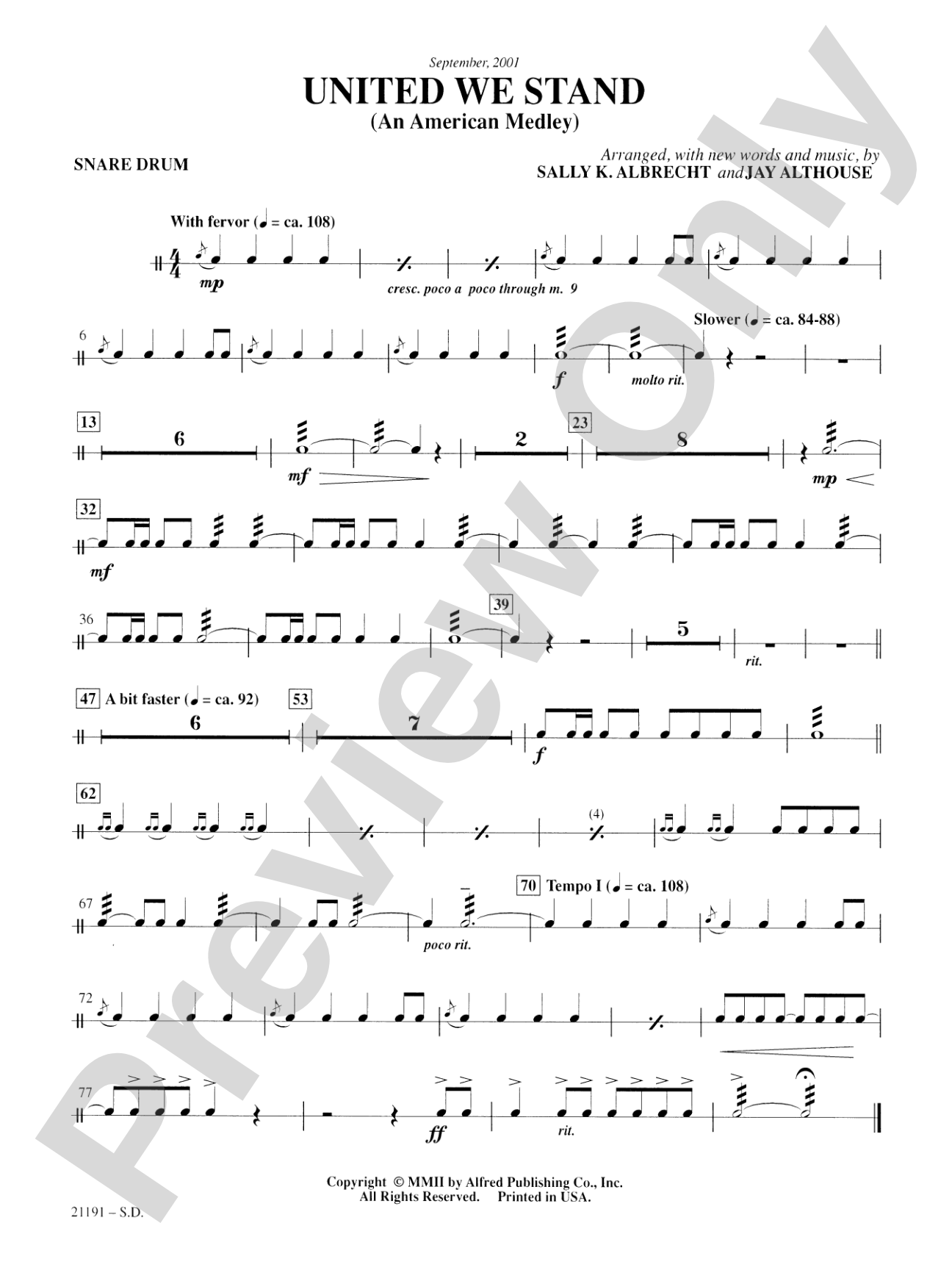

United We Stand (An American Medley): Snare Drum: Choral SoundPax
Arr. Sally K. Albrecht and Jay Althouse
Item: 00-PC-0000470_SD
$3.00
Pickup currently not available
Description
This stirring tribute to America is the perfect finale for your upcoming concert. After a stunning opening fanfare, excerpts of "Simple Gifts," "America, the Beautiful," "America," and the chorus of "Battle Hymn" are presented, leading up to a big final statement of the fanfare. The audience may also sing along on two sections of the choral. All three voicings are compatible, making this the perfect choice for a festival or joint finale. Add the full Concert Band arrangement and/or the StringPax and get your entire school involved. A SoundPax for brass and percussion is also available.


Don't just read it, hear it, play along with it, and watch your students grow with it. In MakeMusic Cloud, United We Stand (An American Medley): Snare Drum: Choral SoundPax comes alive with professional accompaniment, adjustable tempo, and built-in practice tools that turn solo practice into real progress.
Open in the Player
Jump straight in and assign it today.
Start Your Free Trial
Open this title and explore the full library in minutes.
Sample Audio
1
Audio File
--:--
0:00
0:00
Sample Video
No sample videos found.
Additional Details
Series:
Alfred Choral Designs
Publisher:
Alfred Music
Page Count:
22
SKU:
00-PC-0000470_SD
Instrumentation:
SoundPax
More about this title
About the Arranger: Sally K. Albrecht

Sally K. Albrecht has built a career as a choral composer, conductor, and clinician with particular expertise in movement integration. Since 1987, she has received annual ASCAP Special Music Awards and amassed over 600 choral publications alongside 75 larger works for stage and concert. She has conducted honor choirs at major venues including Lincoln Center, Carnegie Hall, and The Kennedy Center, and spent more than three decades directing school choral, vocal, and elementary publications for leading educational music publishers, including Alfred Music.
Albrecht holds degrees from Rollins College (B.A. in Music and Theater, 1976), the University of Miami (M.A. in Drama, 1977), and the University of Miami Frost School of Music (M.M. in Accompanying, 1979). She has taught at Oakland University, Jersey City State College, and Meredith College. A native of Cleveland, she currently resides in Wake Forest, North Carolina, with her husband, composer and arranger Jay Althouse. In 2021, she received the Distinguished Alumna Award from both the University of Miami Frost School of Music and Rollins College, where she serves on the Board of Trustees.
Why we love this
This medley works as both a crowd-pleasing finale and a genuine musical experience, threading together beloved American hymns and patriotic songs without resorting to bombast. The flexibility to layer in band, strings, brass, and even audience participation means you can build this to match the scope of your concert and the forces you have available. Audiences recognize these melodies instantly, which creates immediate connection, but the arrangement's sophistication keeps the singing engaging for your choir.
What to expect
The piece opens with ceremonial brightness, then settles into the gentle lilt of "Simple Gifts" before sweeping through the majestic scope of "America, the Beautiful." Familiar melodies unfold in succession, each one deepening the emotional resonance, until the return of the opening fanfare brings everything home with full conviction and joy.
Who it's for
This works for choirs at the high school and college level, as well as advanced middle school ensembles with confident sight readers. It's equally suited to concert choirs, festival choirs, and community choruses that want a patriotic finale with substance and showmanship.
How to get the most out of it
- Begin rehearsals by learning the opening fanfare as a unified moment; its energy sets the tone for everything that follows and provides a clear musical anchor for the medley transitions.
- Work the audience participation sections early in your rehearsal process so singers feel confident in their cueing and pacing, especially if you plan to sing those portions multiple times or with varying dynamics.
- If using accompaniment or coordinating with band or strings, lock in the tempo and transitions between medley sections during sectional rehearsals before full ensemble runs.
- Shape the final fanfare statement with intention; build momentum through the preceding medley segments so the conclusion feels earned and celebratory rather than sudden.
How to use it
Program this as your finale for Fourth of July concerts, patriotic spring pops programs, or end-of-year celebrations where community participation elevates the moment. The medley's length and emotional arc also make it a strong choice for festival or joint concert closes, especially when you coordinate with band or orchestra partners who may perform complementary arrangements.
Skills your students will build
- Transitioning smoothly between multiple melodic themes and key areas within a single piece
- Responding to audience engagement cues and maintaining musical integrity during participatory sections
- Balancing ensemble blend while featuring recognizable melodies that carry emotional weight
- Coordinating with instrumental forces (band, strings, brass) and following clear sectional landmarks