
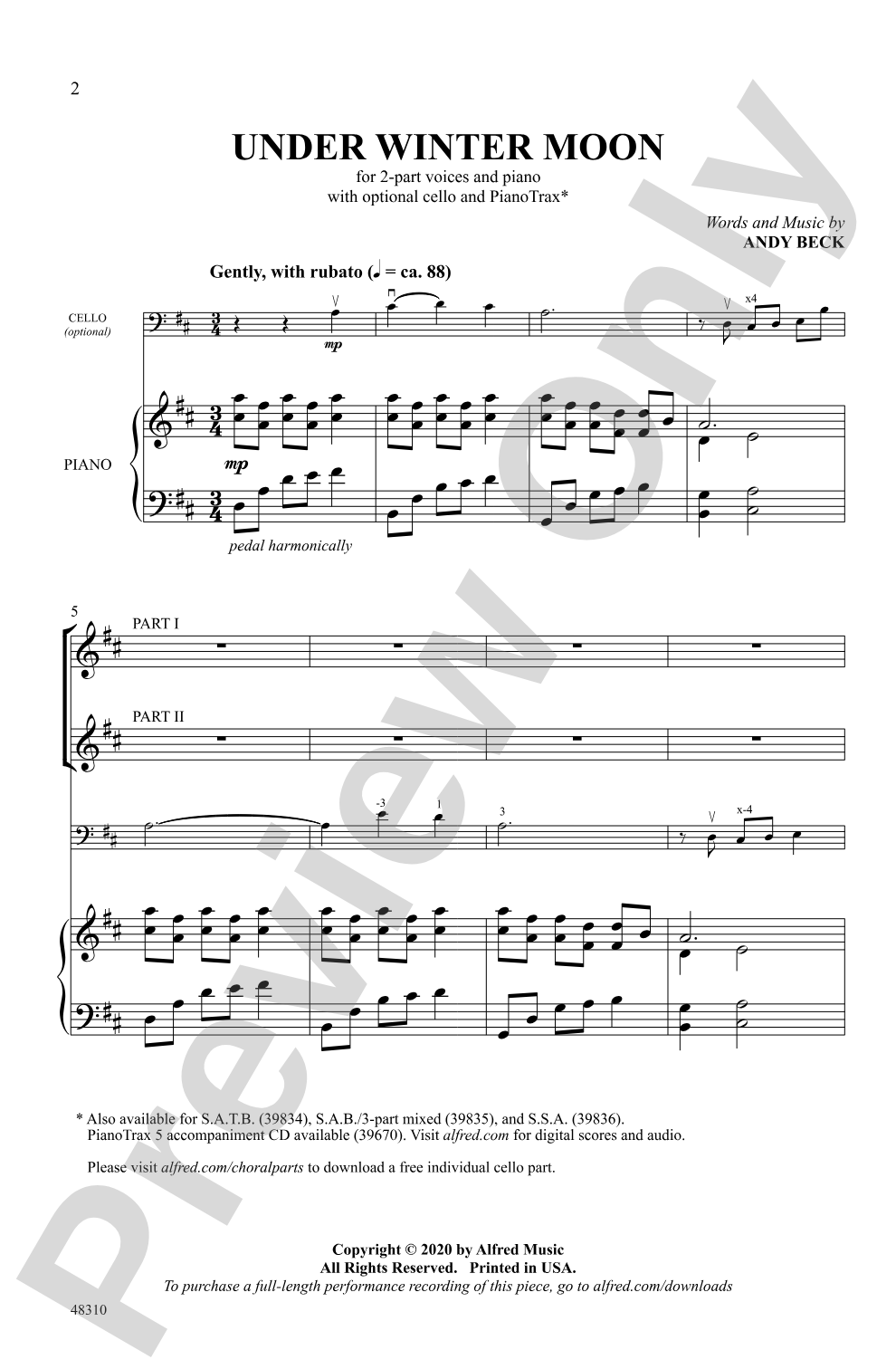
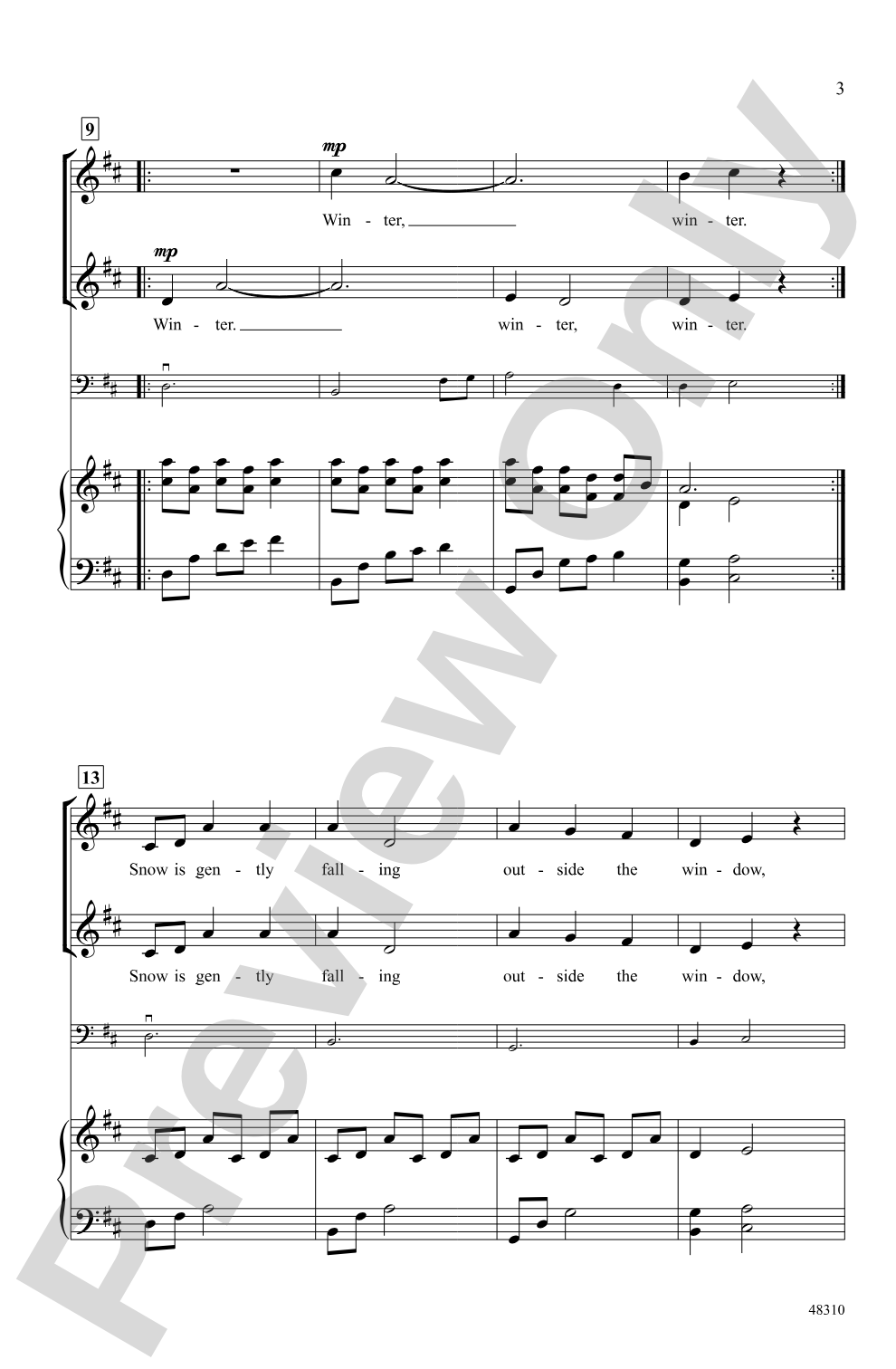
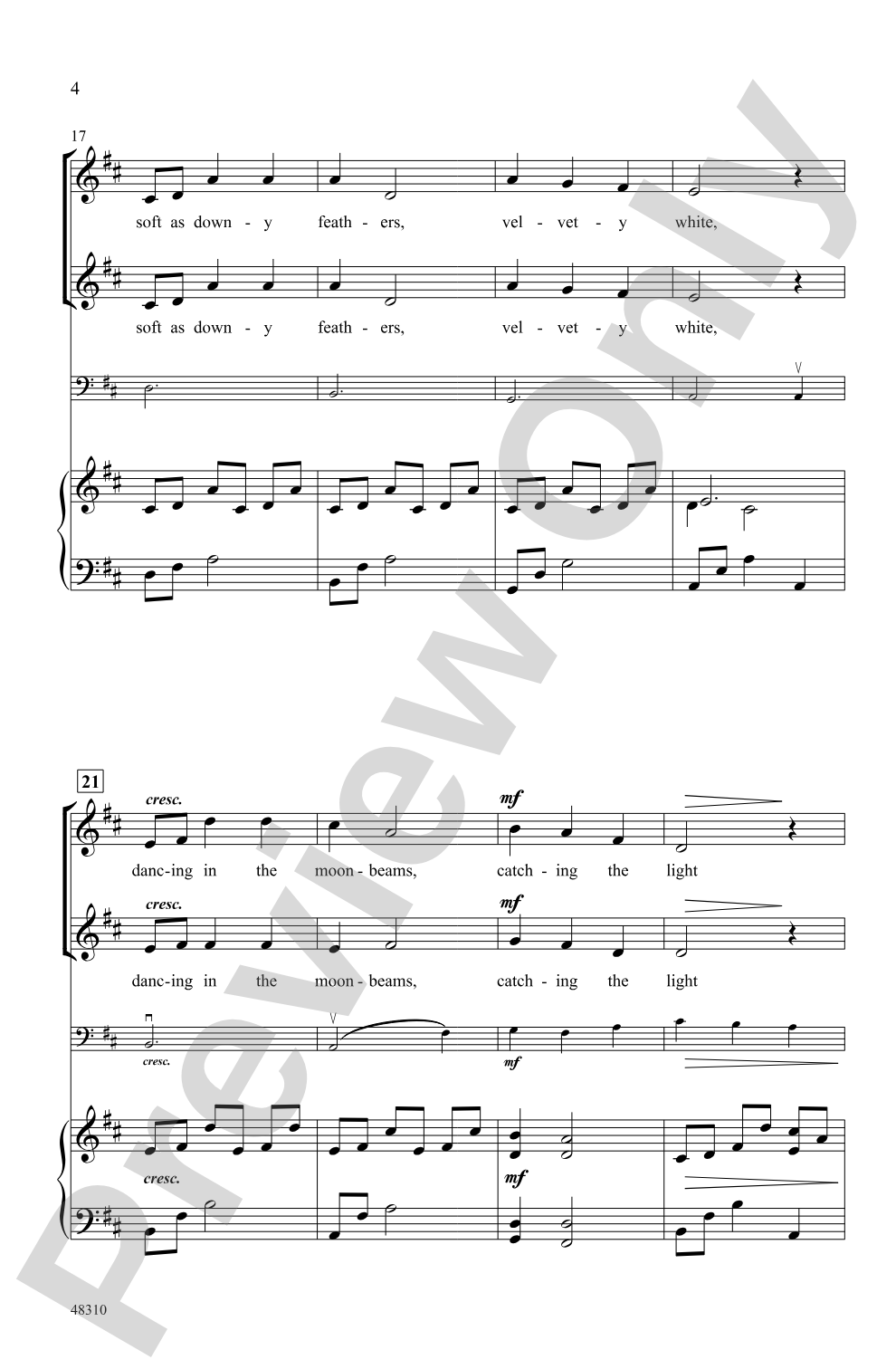

Under Winter Moon: 2-Part Choral Octavo
Words and music by Andy Beck
Item: 00-PO-0006308
$2.05
Minimum order quantity: 20 copies
Pickup currently not available
Related Items
Under Winter Moon: PianoTrax Digital Audio Download |
$9.99
|
View | |
Under Winter Moon: PianoTrax Digital Download |
$9.99
|
View | |
Under Winter Moon: SATB Choral Octavo |
$2.05
|
View | |
Under Winter Moon: 3-Part / SAB Choral Octavo |
$2.05
|
View | |
Under Winter Moon: SSA Choral Octavo |
$2.05
|
View | |
Under Winter Moon: SATB Choral Octavo |
$2.05
|
View | |
Under Winter Moon: 3-Part / SAB Choral Octavo |
$2.05
|
View | |
Under Winter Moon: SSA Choral Octavo |
$2.05
|
View |
Description
Accompanied by a delicate piano (symbolizing falling snow) and an optional cello (the lustrous moon), expressively rich choral parts capture the beauty of a winter night. It quiets the mind and touches the soul. Visit alfred.com/choralparts for the free cello part. This title is available in MakeMusic Cloud.


Under Winter Moon: 2-Part Choral Octavo isn't in MakeMusic Cloud just yet...but it could be. Let us know you'd like to see it, and you'll help shape what comes next. In the meantime, start a free trial and dive into thousands of interactive titles your students can play along with today.
Request This Title
Tell us you want it.
Start Your Free Trial
Explore everything that's ready to play right now.
Sample Audio
1
Audio File
--:--
0:00
0:00
Sample Video
1 / 2
Additional Details
Series:
Alfred Choral Designs
Publisher:
Alfred Music
Page Count:
12
SKU:
00-PO-0006308
Instrumentation:
Cello
More about this title
About the Composer: Andy Beck

Andy Beck directs choral publications at Alfred Music and has composed and arranged over 450 choral works now in print. His catalog spans secular and sacred pieces, children's musicals, and foundational choral resources including Sing at First Sight and Vocalize! 45 Vocal Warm-Ups That Teach Technique. His music reaches singers across the globe, as evidenced by countless performances shared online.
Beyond the page, Beck is an active presence in American music education, serving as guest conductor, adjudicator, and clinician for educators and students nationwide. He has been commissioned to conduct honor choirs and all-state ensembles, particularly throughout the Southeast. A trained tenor with degrees from Ithaca College and Northwest Missouri State University, Beck performs with the North Carolina Master Chorale Chamber Choir and brings his musical theatre experience to both conducting and singing. Since 1992, he has contributed as a studio singer for Alfred Music, grounding his publishing work in the practical realities of rehearsal and performance.
Why we love this
Beck's sensitivity to texture and restraint makes this piece memorable in a season crowded with Christmas repertoire. The optional cello transforms a simple accompaniment into something luminous, and singers respond to text painting that asks for introspection rather than volume. Directors consistently report this one stays with their singers long after the concert ends.
What to expect
A hush falls over the rehearsal space. The music drifts like snowfall under moonlight, intimate and unhurried. Singers feel invited into a private moment rather than asked to perform, and the optional cello deepens that sense of being held by something vast and still.
Who it's for
This piece suits treble or mixed choral groups at the secondary or adult level who are developing control over tone and phrase shape. It works especially well for singers who benefit from introspective material and a chance to explore dynamics below forte.
How to get the most out of it
- Balance the piano accompaniment to remain a supportive shimmer; the falling snow image should never overwhelm the choral line. Let the singers anchor the emotional center.
- If you include the cello, rehearse the choir with it present from early on. The lower register will naturally guide tempo choices and phrase shapes.
- Shape phrases toward moments of rest rather than climax. Winter's quiet demands singers listen to each other across rests and hold space in the silence.
How to use it
Anchor a winter or holiday concert with this piece, positioning it near the program's end to settle the audience into reflection. It pairs beautifully with more energetic seasonal material and provides breathing room in longer concerts. Consider pairing it with another Beck composition for thematic coherence.
Skills your students will build
- Singing with minimal vibrato and controlled release
- Responding to subtle dynamic contrast within a narrow range
- Balancing choral sound with instrumental accompaniment
- Sustaining legato phrasing across longer note values
- Reading and interpreting expressive markings that convey mood rather than virtuosity