
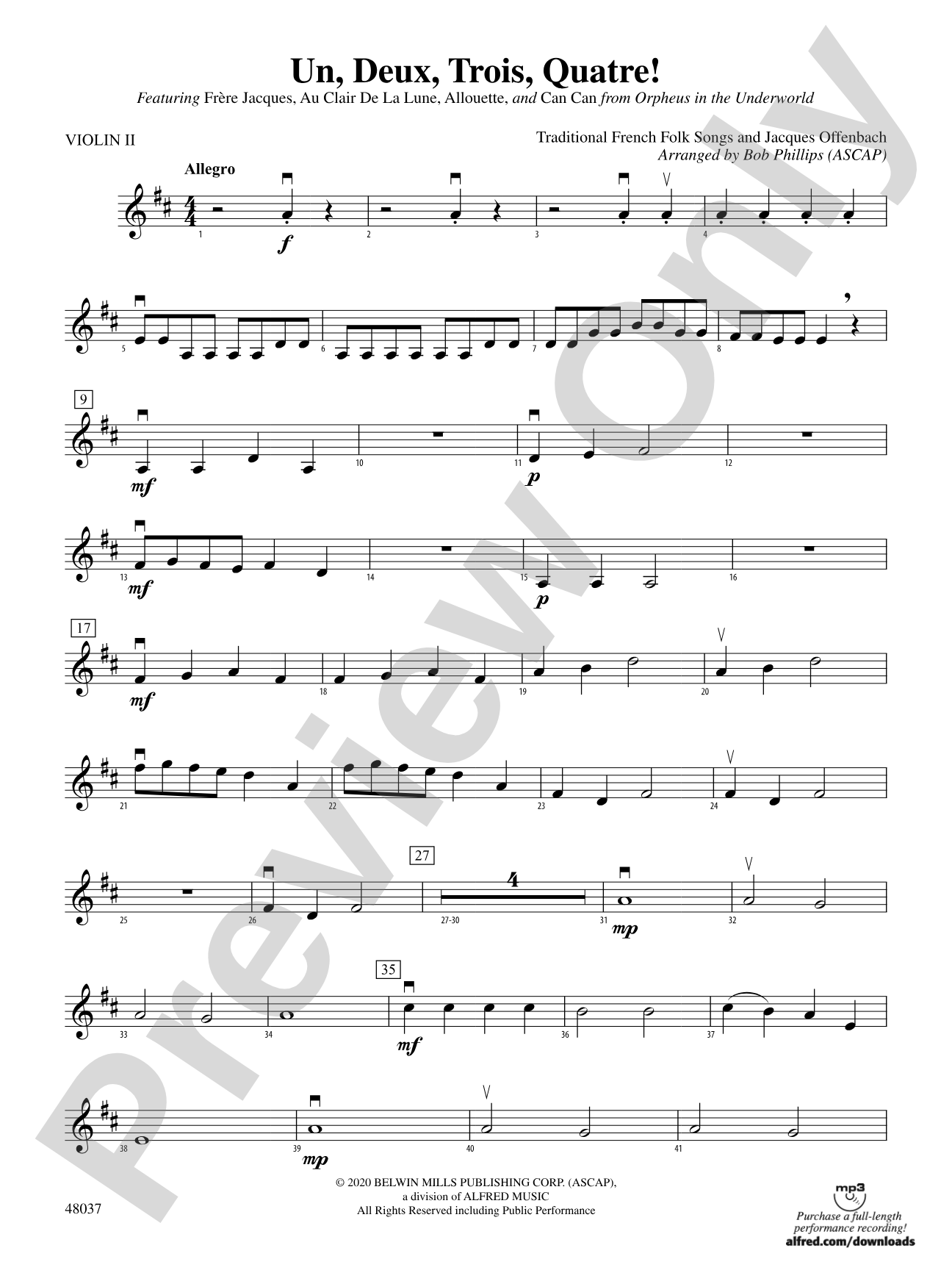

Un, Deux, Trois, Quatre!: 2nd Violin
Traditional French Folk Songs and Jacques Offenbach / arr. Bob Phillips
Grade: 1.5
Item: 00-PC-0018421_VN2
$5.99
Pickup currently not available
Description
This piece arranged by Bob Phillips is a cute, fun, and easy medley of French music that uses four (quatre) well-known songs and builds to an exciting finish with the famous "Can Can." It will also provide the opportunity for cross-cultural study. The melodies lie well on all the instruments, so it can be a great way to feature any section. Challenge your orchestra to see how fast they can play the ending! (2:50) This title is available in MakeMusic Cloud.


Don't just read it, hear it, play along with it, and watch your students grow with it. In MakeMusic Cloud, Un, Deux, Trois, Quatre!: 2nd Violin comes alive with professional accompaniment, adjustable tempo, and built-in practice tools that turn solo practice into real progress.
Open in the Player
Jump straight in and assign it today.
Start Your Free Trial
Open this title and explore the full library in minutes.
Sample Audio
1
Audio File
--:--
0:00
0:00
Sample Video
Additional Details
Series:
Belwin Beginning String Orchestra
Publisher:
Alfred Music
Page Count:
148
SKU:
00-PC-0018421_VN2
More about this title
About the Composer: Bob Phillips

Bob Phillips is a composer, arranger, and string pedagogue who has shaped music education through innovative large-group teaching and eclectic repertoire development. Since the 1970s, he has authored more than 25 instructional series for string programs, including Sound Innovations and genre-crossing publications like Jazz Philharmonic, Rock Philharmonic, and Mariachi Philharmonic. Over 200 of his works have been published for orchestras and bands, and he holds ASCAP recognition as an award-winning composer.
For 27 years, Phillips built the Saline, Michigan string program into a nationally recognized model with over 700 students performing across classical and contemporary styles. He founded the Saline Fiddlers Philharmonic, which gained international prominence through performances at the White House and The Midwest Clinic. Phillips has also served as guest conductor for all-state orchestras across the country, resident conductor for Wintergrass Festival in Seattle, and arranger for the professional ensemble Barrage 8.
Why we love this
Phillips has a gift for making multicultural repertoire accessible without sacrificing musicality or fun. This medley demonstrates his understanding of what engages young string players: recognizable melodies that lie comfortably on every instrument, clear structural momentum, and a finale exciting enough to energize even a beginning orchestra. The Can Can finale gives students an immediate, concrete goal to work toward.
What to expect
The piece opens with gentle, recognizable French melodies that feel inviting and approachable, then builds playful momentum as familiar tunes emerge one after another. By the time the Can Can arrives, the energy becomes infectious and celebratory—a moment where students experience the satisfaction of accelerating through exciting material together.
Who it's for
String orchestras at the beginning levels (Grade 1.5) looking for concert and festival repertoire that builds cross-cultural awareness without demanding advanced technique. This arrangement works equally well for orchestras with newly trained students and those preparing for performance assessments where accessibility and engagement matter.
How to get the most out of it
- Balance the section features by rotating which instruments lead each melody; this keeps all players invested and prevents fatigue in accompanying lines.
- Establish the tempo for the Can Can section early and rehearse it at performance speed so students understand the target before the final week of preparation.
- Support the excitement of the finale by keeping tone open and resonant; students often tense when playing fast, so build the speed while maintaining full sound.
- Use the clear medley structure as a rehearsal roadmap by breaking the piece into four discrete melodies first, then connecting them without losing energy between sections.
How to use it
Program this early in a concert to establish a lighthearted tone and build audience rapport, or use it as a festival entry that showcases accessibility and musicianship at an introductory level. It pairs well with more substantial repertoire on the same program because it gives young players a successful, joyful performance experience while also demonstrating that beginning orchestras can tackle authentic cross-cultural music.
Skills your students will build
- Playing sustained melodies while maintaining accurate rhythm in accompanying parts
- Responding to tempo changes and accelerations with ensemble control
- Balancing the sound across sections when different instruments carry the melody
- Building stamina and rhythmic precision in faster passages
- Recognizing and executing melodic phrasing in well-known tunes