Uist Tramping Song Sheet Music Preview

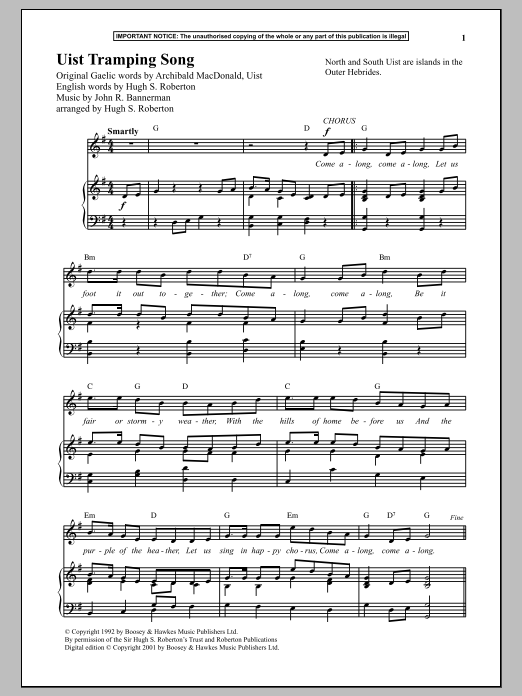
Uist Tramping Song: Piano Vocal

As performed by John R. Bannerman

Item: 35-DS00237188

Digital Download
$5.99
Description

Uist Tramping Song: Piano Vocal isn't in MakeMusic Cloud just yet...but it could be. Let us know you'd like to see it, and you'll help shape what comes next. In the meantime, start a free trial and dive into thousands of interactive titles your students can play along with today.

Sample Audio
No sample audio found.
Sample Video
Additional Details
Publisher: Hal Leonard
Page Count: 2
SKU: 35-DS00237188

More about this title

About the Artist: John R. Bannerman

John R. Bannerman was a Scottish composer and arranger with deep roots in traditional music of the Hebrides and broader Scottish culture. His work preserves and reimagines folk melodies, translating them into accessible vocal and instrumental arrangements that respect the character of their source material.

Why we love this

Bannerman's arrangement captures the steady, propulsive energy of a walking song without overshadowing the melody itself. The piano writing sits comfortably beneath the voice, creating an intimate setting that works equally well in recital or as part of a thematic concert exploring Scottish traditions.

What to expect

The song carries the weathered authenticity of a folk melody that has traveled generations, yet Bannerman's piano accompaniment grounds it in something contemplative and assured. It feels like a familiar voice telling a story you need to hear.

Who it's for

Solo singers preparing recital or concert material, voice students exploring art song and traditional repertoire, and anyone seeking accessible Scottish vocal literature. Directors programming folk or heritage concerts will find this piece both singable and dramatically engaging.

How to get the most out of it

  • Keep the tempo even and unfussy. The 'tramping' rhythm suggests forward motion, not rushing; let the steady pulse carry the narrative.
  • Shape phrases naturally across the bar lines rather than stopping at every barline. The text and melody should feel conversational.
  • Balance the vocal line so it sits clearly above the accompaniment without forcing volume. Legit tone and good diction do the work.
  • Explore the subtle dynamic shifts Bannerman provides in the piano part; they illuminate the harmonic movement without cluttering the texture.

How to use it

Pair this with other Scottish or Celtic vocal works to build a thematic set, or program it in a concert exploring the intersection of folk tradition and art song. Its two-page length makes it an ideal transition piece or encore in a longer recital.

Skills your students will build

  • Sustaining legit tone through longer phrase structures
  • Interpreting rhythm and phrasing that derives from folk language rather than written notation
  • Ensemble balance between voice and piano accompaniment
  • Lyrical clarity in dialect or non-English text

You May Also Like