
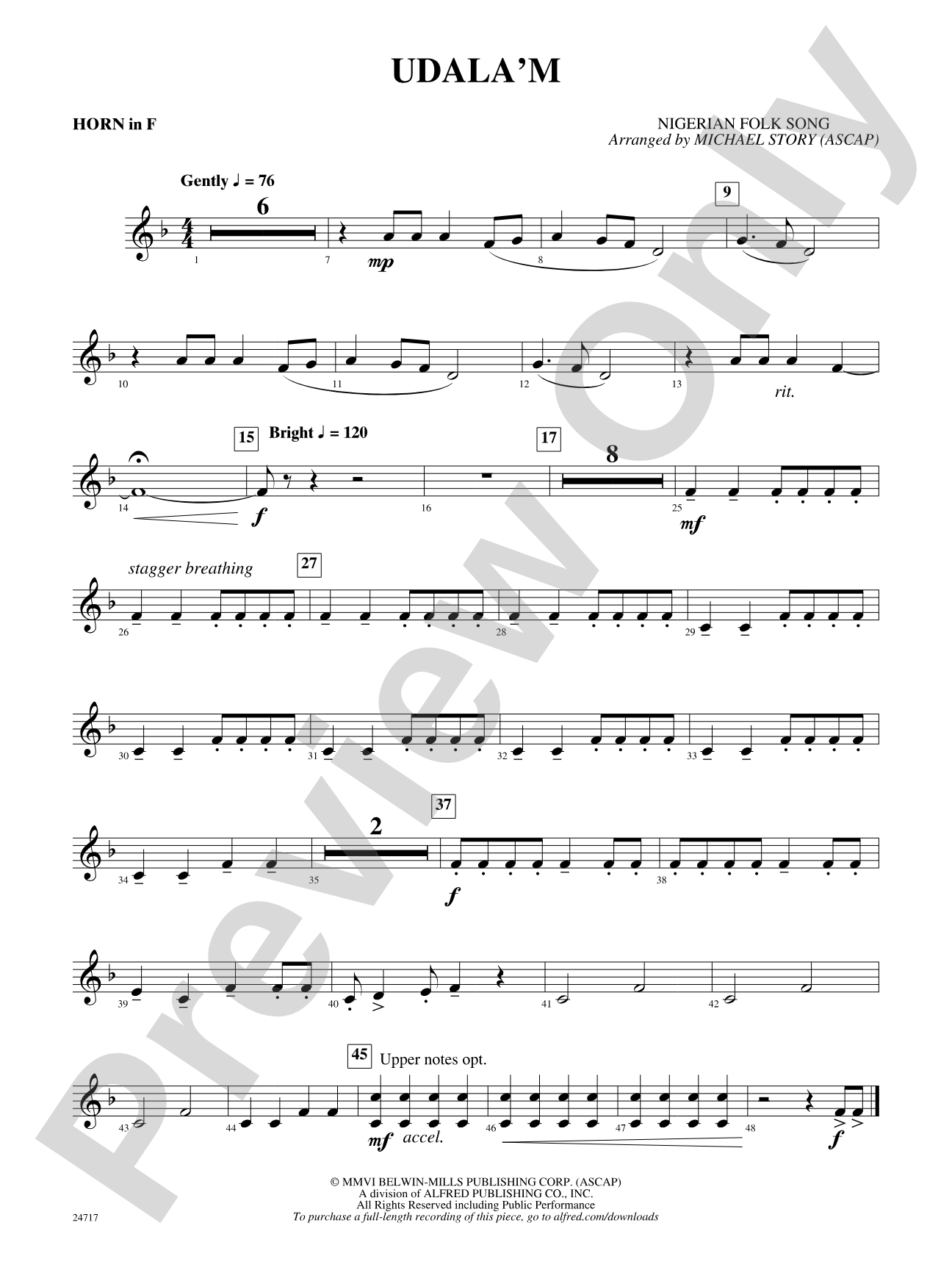

Udala'm: 1st F Horn
Nigerian Folk Song / arr. Michael Story
Grade: 1 (Very Easy)
Item: 00-PC-0000875_H1
$3.00
Pickup currently not available
Description
"Udala'm" is a traditional Nigerian folk song that tells the story of Chinyere. The story has a happy ending which is reflected musically in this dynamic work for beginning band. Michael Story has captured the essense of this stirring multicultural melody. This title is available in MakeMusic Cloud.


Don't just read it, hear it, play along with it, and watch your students grow with it. In MakeMusic Cloud, Udala'm: 1st F Horn comes alive with professional accompaniment, adjustable tempo, and built-in practice tools that turn solo practice into real progress.
Open in the Player
Jump straight in and assign it today.
Start Your Free Trial
Open this title and explore the full library in minutes.
Sample Audio
1
Audio File
--:--
0:00
0:00
Sample Video
No sample videos found.
Additional Details
Series:
Belwin Beginning Band
Publisher:
Alfred Music
Page Count:
176
SKU:
00-PC-0000875_H1
More about this title
About the Arranger: Michael Story
Michael Story is a prolific composer and arranger whose work spans concert band, wind ensemble, and orchestra. His arrangements for beginning and intermediate bands have become staples in music education, known for their musicality, accessibility, and respect for the source material. Story has a gift for taking traditional melodies from around the world and crafting them into engaging learning experiences that don't sacrifice artistic integrity for pedagogical simplicity.
With hundreds of published works, Story has established himself as a trusted voice in band education. His pieces consistently balance technical achievability with musical substance, making them favorites for festival programming and concert performance alike.
Why we love this
Grade 1 repertoire rarely sounds this compelling. Story's arrangement takes a genuine Nigerian folk melody and shapes it into something that moves listeners while remaining entirely within reach for beginning players. The happy ending of the Chinyere story translates into music that energizes without overwhelming, making this a strong choice for festivals, community concerts, or the moment in your year when you want to celebrate cultural music that students can actually play with confidence.
What to expect
Udala'm carries the warmth and narrative drive of an oral tradition while sounding fresh and alive in arrangement. The happy ending comes through in the music as an open, forward-moving energy that feels celebratory without being showy. Even with beginning players, there's real musicality here—a sense that the band is telling something that matters.
Who it's for
Beginning band directors seeking high-interest concert repertoire that introduces students to world music traditions. Your players will find the notes accessible while encountering a melody with genuine cultural significance and an arc that tells a story. This works equally well for festival entries, holiday concerts, or any program where you want to expand your ensemble's musical horizons without adding technical strain.
How to get the most out of it
- Find the rhythmic pulse beneath the melody. Even at Grade 1, the arrangement benefits from a conductor who conducts the groove rather than just the time signature, helping players feel the forward momentum of the piece.
- Balance the melody between sections carefully. The piece likely passes the tune between parts; make sure the leading voice always sits slightly forward so the story stays audible.
- Use dynamic contrast to shape phrases. Grade 1 doesn't mean static dynamics. Mark your own score with specific crescendos and releases that help the band shape musical sentences rather than playing block by block.
- Spend rehearsal time on the cultural context. Playing Udala'm well means understanding what the music is expressing, not just hitting the right notes.
How to use it
Program this as a cultural centerpiece in a concert focused on world music, or use it to open a program and establish an inclusive, welcoming tone for the evening. It also pairs beautifully with other multicultural selections at similar levels, allowing you to build a themed concert around folk traditions from different parts of the world.
Skills your students will build
- Reading and performing steady rhythmic patterns in duple meter
- Balancing melody and accompaniment within a section
- Responding to dynamic markings and shaping musical phrases
- Sustaining tone and intonation in exposed positions
- Understanding folk melody and cultural music contexts