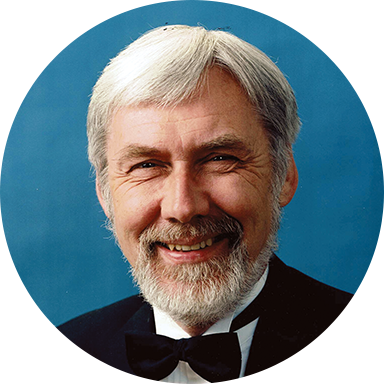
Imant Raminsh grew up in Latvia before his family relocated to Canada in 1948, where he developed his compositional voice through studies at the Royal Conservatory in Toronto, the University of Toronto, the Akademie Mozarteum in Salzburg, and the University of British Columbia. His catalog spans every major genre, from solo voice to opera, and his works have reached audiences across six continents in venues ranging from Carnegie Hall to the Forbidden City in Beijing.
Raminsh founded four ensembles including the Prince George Symphony and made his Carnegie Hall conducting debut in 2006. His honors include the Outstanding Choral Composition Award from the Association of Canadian Choral Communities and appointment as an Officer in the Order of the Three Stars of the Republic in Latvia. Beyond composition and conducting, his deep connection to the natural world (cultivated through years working as a park naturalist in British Columbia) enriches the environmental awareness that surfaces throughout his music.
Why we love this
This setting of the ancient Latin text carries the weight of genuine spiritual reflection without demanding elaborate technical pyrotechnics from your singers. Raminsh's harmonic language is accessible yet sophisticated, creating moments of real beauty that audiences recognize immediately as meaningful rather than merely competent.
What to expect
The music inhabits a quiet space of contemplation, with harmonies that shift gently like light through stained glass. Singers and listeners alike encounter a piece that values restraint and introspection, rewarding careful attention with moments of unexpected harmonic warmth.
Who it's for
This octavo suits intermediate to advanced choirs seeking repertoire with genuine liturgical substance. It works equally well for concert settings, sacred music festivals, and worship contexts where artistic depth matters as much as devotional purpose.
How to get the most out of it
Build the piece's emotional arc through dynamic control rather than tempo shifts; the text's contemplative nature benefits from steady pacing with carefully shaped phrase endings.
Attend closely to vowel consistency across all four voices, particularly during the sustained harmonies where any slight mismatch becomes audible.
Balance the voices so that sopranos and altos carry equal melodic weight in their passages; neither voice should dominate the texture.
Let the piece breathe at natural textual breaks rather than pushing toward the next phrase mechanically.
How to use it
Pair this with other sacred works to anchor a concert's spiritual centerpiece, or program it strategically in a longer choral concert where its meditative quality provides essential contrast to more extroverted selections. The piece also serves well as a festival selection for choirs seeking material that demonstrates interpretive maturity.
Skills your students will build
Sustaining pure vowels during extended harmonic passages
Shaping long phrases with minimal melodic variation
Balancing four independent lines without sacrificing blend
Responding to text expression in a Latin sacred idiom
You May Also Like
Scan to Complete Your Purchase
Use your phone's camera to scan the code below
You'll log in on your phone and the order will be added to your account