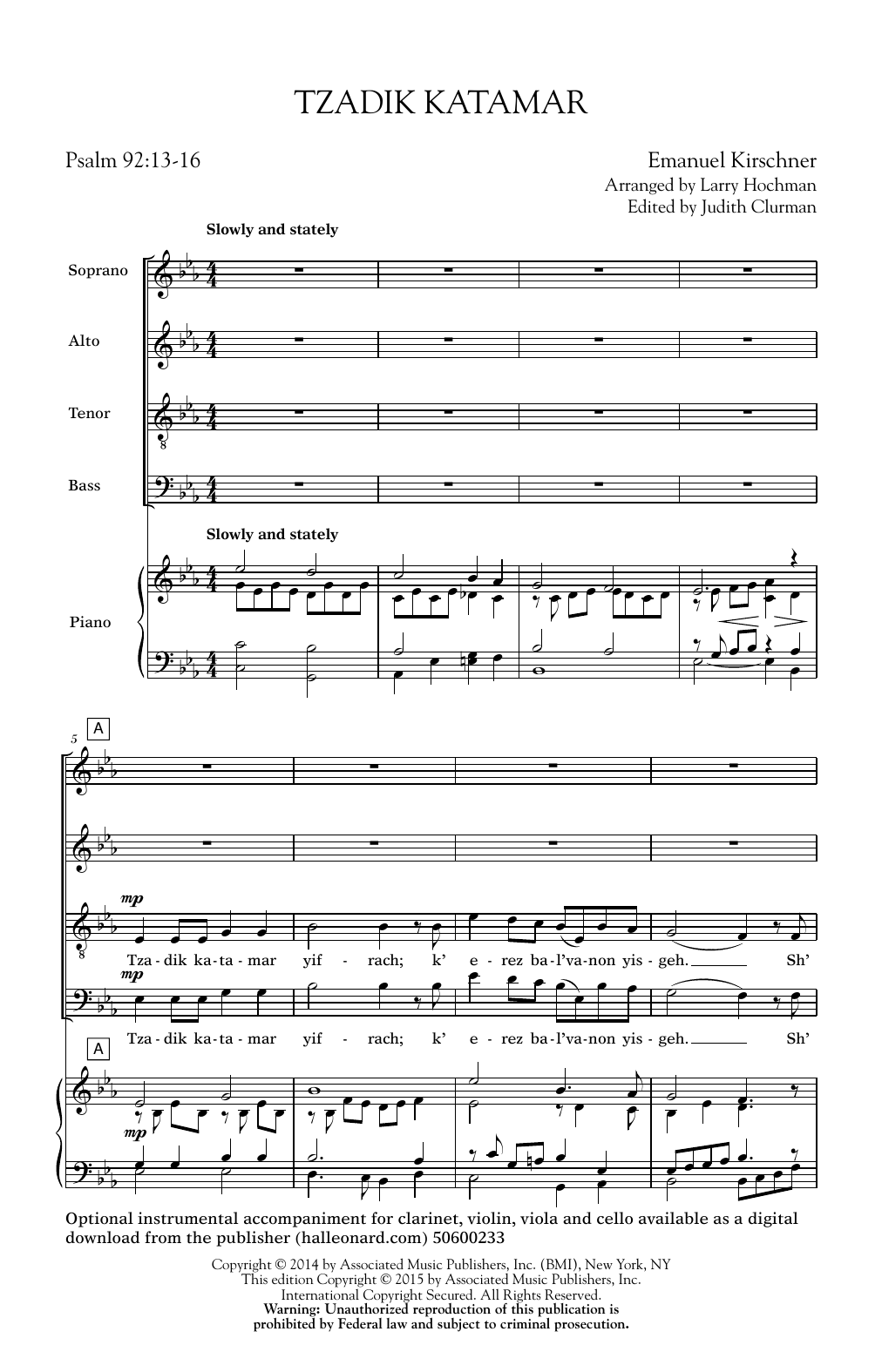
Tzadik Katamar Yifrach Sheet Music Preview

Tzadik Katamar Yifrach: SATB Choral Octavo

As performed by Emanuel Kirschner / Arranged by Judith Clurman

Item: 35-DS00310635

Digital Download
$2.99
Description

Tzadik Katamar Yifrach: SATB Choral Octavo isn't in MakeMusic Cloud just yet...but it could be. Let us know you'd like to see it, and you'll help shape what comes next. In the meantime, start a free trial and dive into thousands of interactive titles your students can play along with today.

Sample Audio
No sample audio found.
Sample Video
Additional Details
Publisher: Hal Leonard
Page Count: 6
SKU: 35-DS00310635

More about this title

About the Artist: Emanuel Kirschner

Emanuel Kirschner was a Polish Jewish composer and cantor whose work bridged liturgical and secular musical traditions. His compositions often drew from Jewish musical heritage while engaging with European harmonic language, creating pieces that resonated across religious and cultural contexts.

Why we love this

Judith Clurman's arrangement transforms this text into music that feels both reflective and grounded, giving singers a piece with genuine textural interest without excessive technical demands. The Hebrew text pairs naturally with the harmonic language, creating something that works equally well in secular concert settings or more thematically programmed events.

What to expect

The music unfolds with quiet dignity, balancing moments of lyrical warmth with passages that feel almost introspective. There's a sense of spiritual reflection woven throughout, even in a secular performance context.

Who it's for

This octavo suits choirs with some experience reading SATB voicing and a willingness to engage with Hebrew text. It works for directors seeking repertoire that adds cultural or thematic depth to a concert without requiring specialized vocal technique.

How to get the most out of it

  • Treat the text pronunciation as part of the musical phrasing; the Hebrew vowels and consonants shape how phrases breathe and land.
  • Balance the parts so inner voices support rather than compete with the melody; the arrangement depends on transparency to work.
  • Approach dynamics subtly; this piece benefits from restraint rather than dramatic contrast.
  • Lock in unison sections carefully, as they anchor the harmonic movement that surrounds them.

How to use it

Consider pairing this with other world music or multicultural repertoire to build a thematic concert program. It also works well as a thoughtful centerpiece when programming shorter, contrasting pieces around it.

Skills your students will build

  • Reading and pronouncing Hebrew text with musical accuracy
  • Balancing inner voice independence within SATB texture
  • Sustaining musical line through lyrical, slower-moving harmonic progressions
  • Blending and balance in unison sections

You May Also Like