
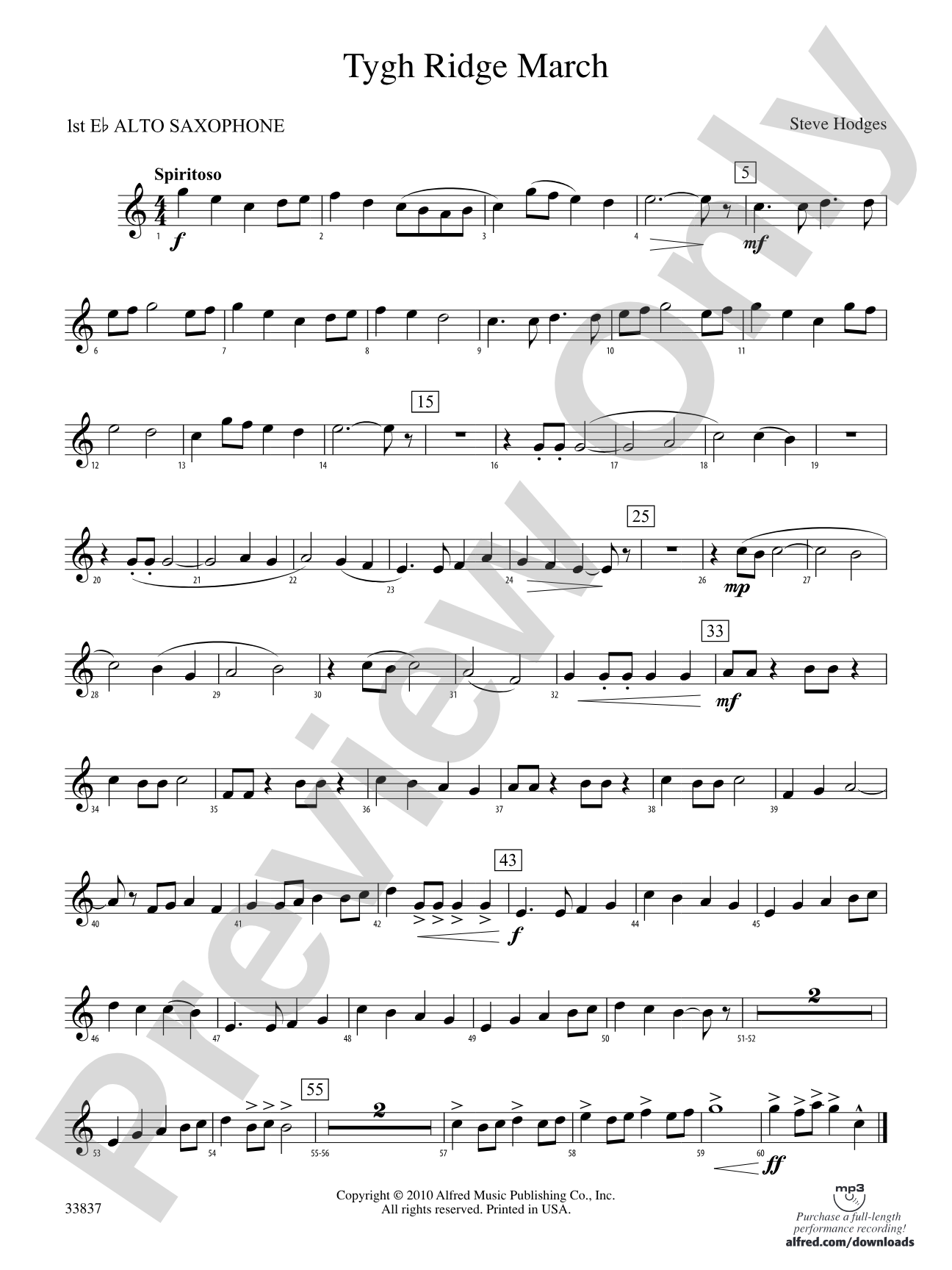

Tygh Ridge March: E-flat Alto Saxophone
By Steve Hodges
Grade: 1 (Very Easy)
Item: 00-PC-0014568_AX1
$3.00
Pickup currently not available
Description
This spirited march would be a perfect choice for a concert opener. Written well within the ranges of first year band students, each section has the opportunity to play the melody or the interesting harmonies. A solid foundation by the percussion section allows the piece to move at a brisk march tempo. With effective dynamic contrasts and articulation patterns, Tygh Ridge March is a great educational tool for the developing musician as well as a piece that is just fun to play!


Don't just read it, hear it, play along with it, and watch your students grow with it. In MakeMusic Cloud, Tygh Ridge March: E-flat Alto Saxophone comes alive with professional accompaniment, adjustable tempo, and built-in practice tools that turn solo practice into real progress.
Open in the Player
Jump straight in and assign it today.
Start Your Free Trial
Open this title and explore the full library in minutes.
Sample Audio
1
Audio File
--:--
0:00
0:00
Sample Video
No sample videos found.
Additional Details
Series:
Alfred Debut Series
Publisher:
Alfred Music
Page Count:
118
SKU:
00-PC-0014568_AX1
More about this title
About the Composer: Steve Hodges

Steve Hodges holds degrees from Western Oregon University (Bachelor of Science) and Central Washington University (Master of Music Education). Over four decades in public school music education, he directed bands, choirs, and chamber ensembles at every level before retiring from full-time teaching.
Since 1986, Hodges has composed more than 120 concert band works published by Alfred Music, along with choral arrangements through Staff Music and Shawnee Press. His music has traveled internationally, performed at festivals and state conventions, and commissioned by honor bands across Virginia, Iowa, Winnipeg, British Columbia, Oregon, Washington, and North Carolina. His compositions have also appeared in broadcasts for TBS and ESPN. An ASCAP member, Hodges resides in The Dalles, Oregon, and continues engaging in community music alongside his wife, Teddie. One of his greatest joys is hearing his grandchildren perform his pieces in their school bands.
Why we love this
Hodges designed this march specifically for first-year musicians without sacrificing a genuinely engaging piece. The melody gets passed around the ensemble so every section experiences that ownership moment, while the supporting harmonies are interesting enough to keep other students engaged and listening. It opens a concert with confidence and joy rather than apology.
What to expect
A spirited march that moves with purpose and good humor. The piece energizes a concert hall with the confidence of a developing ensemble while maintaining genuine musical substance and rhythmic drive.
Who it's for
First-year concert band students and conductors looking for an accessible opening piece that teaches real musicianship. Works equally well for programs mixing skill levels, since the accessible writing doesn't patronize more advanced players while remaining completely manageable for beginners.
How to get the most out of it
- Establish a solid march tempo by letting your percussion section lock in first; once they own the pulse, the band will follow naturally.
- Shape your dynamic contrasts intentionally to create forward motion. First-year players often play straight through at one volume, so mark clear crescendos and diminuendos in the parts.
- Pay attention to articulation patterns as written. Consistent tonguing across a section transforms a simple march into something clean and professional sounding.
- Use the variety of melodic sections to teach your ensemble about balance and blend. When different sections carry the tune, it's a perfect time to adjust who plays out and who supports.
How to use it
Open your concert with this march when you want to set an upbeat, professional tone without demanding a virtuosic ensemble. It works well paired after a slower opening piece in a longer program, or as a standalone opener for a young band concert where confidence matters as much as technical polish.
Skills your students will build
- Playing melodic and harmonic roles with equal confidence
- Matching articulation patterns across a section
- Responding to dynamic and tempo changes
- Listening to and blending with surrounding parts
- Maintaining consistent pulse in a march idiom
- Reading first-year appropriate ranges and rhythms