
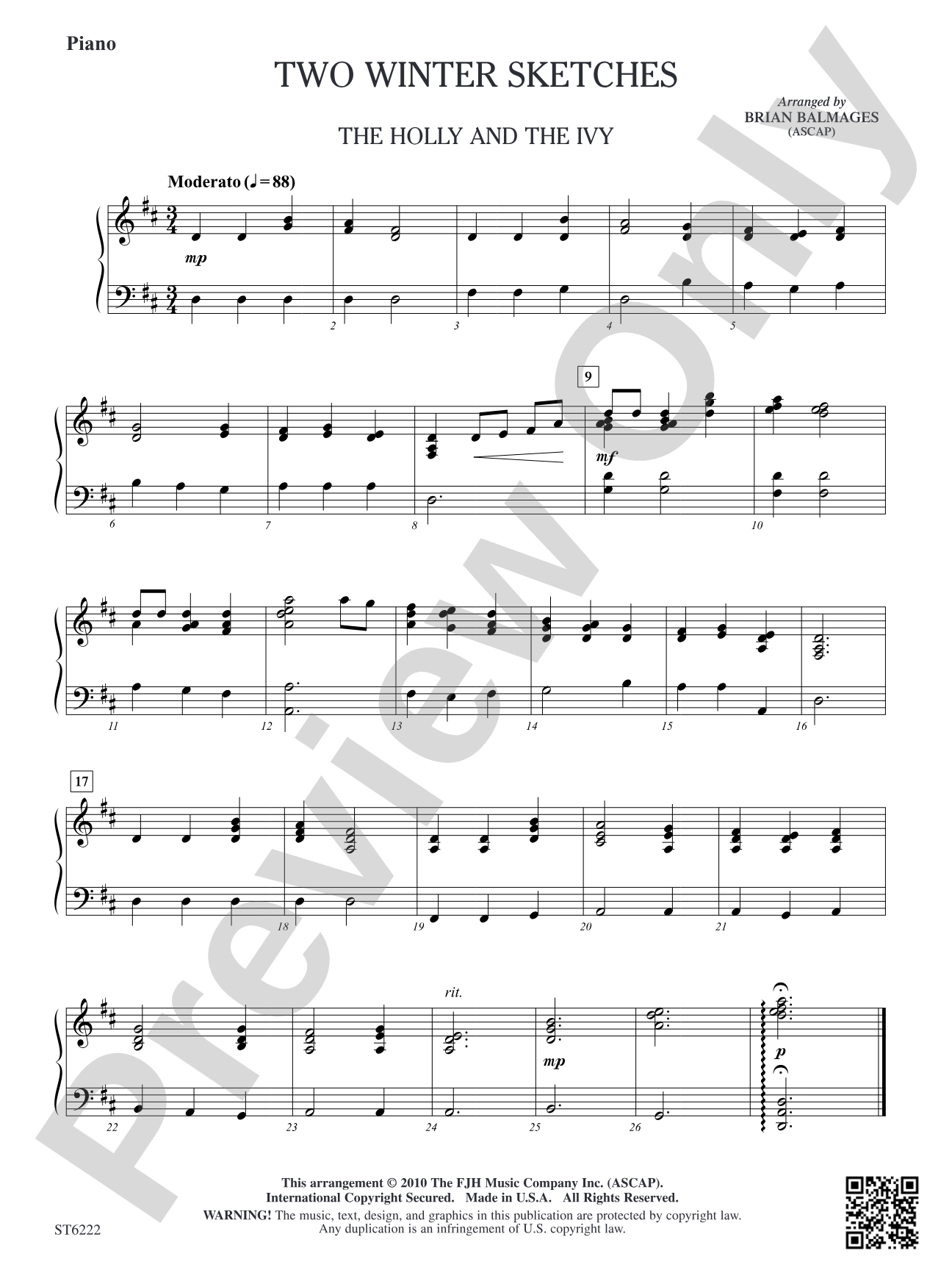

Two Winter Sketches: Piano
By Brian Balmages
Level:.5
Item: 98-PC-DST6222_K
$7.00
Pickup currently not available
Description
Using only six notes and no eighth notes, this classically inspired work was written for the very beginning string student. The first movement, The Holly and the Ivy, presents a lyrical treatment that also makes use of piano. The second movement is set in a Baroque style and highlights various motifs from Jingle Bells. Ideal for the first holiday concert and quite unique!


Two Winter Sketches: Piano isn't in MakeMusic Cloud just yet...but it could be. Let us know you'd like to see it, and you'll help shape what comes next. In the meantime, start a free trial and dive into thousands of interactive titles your students can play along with today.
Request This Title
Tell us you want it.
Start Your Free Trial
Explore everything that's ready to play right now.
Sample Audio
1
Audio File
--:--
0:00
0:00
Sample Video
No sample videos found.
Additional Details
Series:
FJH Beginning Strings
Publisher:
The FJH Music Company, Inc.
SKU:
98-PC-DST6222_K
More about this title
About the Composer: Brian Balmages

Brian Balmages has built a reputation as a composer and conductor whose work spans orchestral, band, and chamber music with equal fluency. His compositions have been performed worldwide by ensembles ranging from professional symphony orchestras to elementary school groups in spaces such as Carnegie Hall, the Kennedy Center, and Sydney Opera House. He received the A. Austin Harding Award from the American School Band Directors Association and won the 2020 NBA William D. Revelli Composition Contest for Love and Light.
Balmages holds elected membership in the American Bandmasters Association and was honored with the inaugural James Madison University Distinguished Alumni Award from the School of Visual and Performing Arts. He has been commissioned by the University of Miami to compose for presidential inauguration events and has had his music performed at the 2013 Presidential Inaugural Prayer Service. As a conductor, he regularly guests with all-state, regional, university, and professional ensembles worldwide, with notable appearances at the Midwest Clinic, Western International Band Clinic, and state ASTA conferences. Currently, he serves as Director of MakeMusic Publications and Digital Education for Alfred and MakeMusic.
Why we love this
This score respects the reality of beginning string students by building an entire meaningful piece from six notes and quarter notes only, yet it never sounds elementary. Balmages makes room for piano accompaniment in the first movement and weaves genuine Baroque architecture into the second, so your students play something with real musical substance, not just simplified drill material. The holiday pairing of The Holly and the Ivy with a Baroque-style Jingle Bells treatment gives you a concert piece that is both immediately appealing and genuinely inventive.
What to expect
Elegant restraint meets festive warmth. The Holly and the Ivy unfolds with quiet charm and genuine lyricism, while the Baroque movement has a stately, almost ceremonial quality as it reimagines a beloved tune through a classical lens. This is music written with affection for young players, not condescension.
Who it's for
Beginning string orchestra students in their first semester or year of study. Directors seeking authentic repertoire for that crucial first holiday concert without settling for overly simplified arrangements or boring drill pieces.
How to get the most out of it
- Establish a steady pulse during rehearsal using the piano part as the foundation; beginning string players benefit from hearing the harmonic underpinning so they can understand where their simple lines fit within the whole.
- In The Holly and the Ivy movement, focus on phrase shape with just a few students at a time before bringing the full section in; this reveals the lyrical intent beneath the limited note set.
- Use the Baroque-style second movement to introduce the concept of motif and repetition without overwhelming the group; isolate the Jingle Bells fragments so students hear how they are recontextualized rather than simply performed straight.
How to use it
Ideal as the centerpiece of a first-semester holiday concert; the two contrasting movements give your program shape and show off your students' growing musicality. Pair it with a simple arrangement for winds or add a narrator to The Holly and the Ivy for a multimedia moment that captures your audience's attention without overextending a young ensemble.
Skills your students will build
- Reading and performing from conductor scores and parts
- Playing sustained notes with consistent tone and intonation
- Following phrasing and dynamic markings in a lyrical context
- Recognizing and responding to Baroque structural conventions
- Listening to and balancing with piano accompaniment
- Understanding how familiar melodies can be recontextualized in different musical styles