
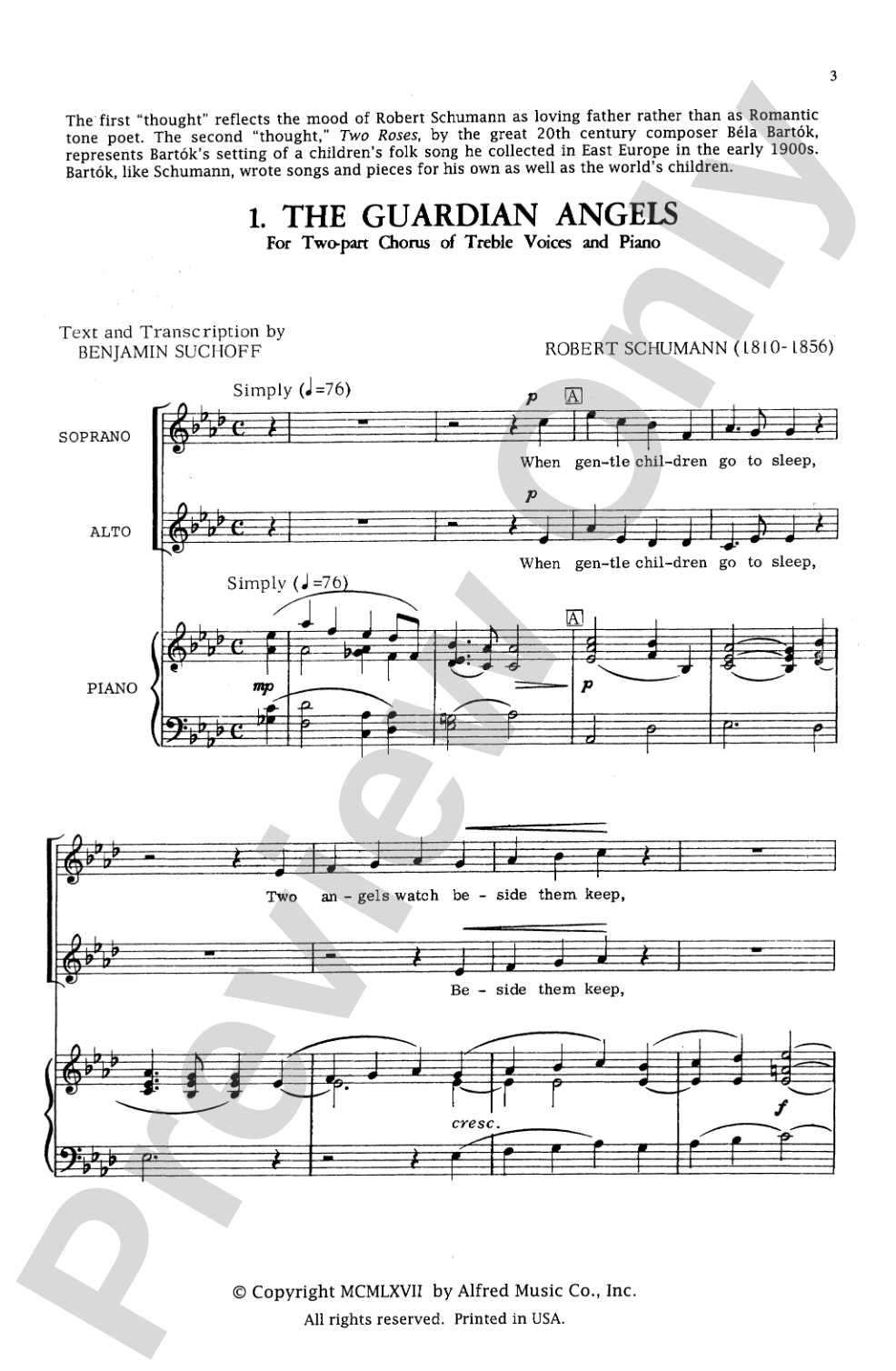

Two Thoughts for Children's Chorus: 2-Part Choral Octavo
Music by Béla Bartók and Robert Schumann / arr. Benjamin Suchoff
Item: 00-PO-0002473
$2.25
Minimum order quantity: 20 copies
Pickup currently not available
Related Items
Two Thoughts for Children's Chorus: 2-Part Choral Octavo |
$2.25
|
View |
Description


Two Thoughts for Children's Chorus: 2-Part Choral Octavo isn't in MakeMusic Cloud just yet...but it could be. Let us know you'd like to see it, and you'll help shape what comes next. In the meantime, start a free trial and dive into thousands of interactive titles your students can play along with today.
Request This Title
Tell us you want it.
Start Your Free Trial
Explore everything that's ready to play right now.
Sample Audio
No sample audio found.
Sample Video
No sample videos found.
Additional Details
Series:
Alfred Archive Edition: Alfred Choral Designs
Publisher:
Alfred Music
Page Count:
8
SKU:
00-PO-0002473
More about this title
About the Composer: Béla Bartók
Béla Bartók (1881-1945) transformed twentieth-century music by systematically collecting and analyzing folk songs from Hungary, Romania, Slovakia, and surrounding regions. His compositions blend this ethnographic foundation with modernist harmonic language, creating works that feel both rooted in tradition and architecturally innovative. He was a pianist, conductor, and tireless advocate for new music, performing his own works across Europe and the United States.
Bartók's approach to composition for young musicians was methodical and pedagogically sound. His "Mikrokosmos" and other works for children demonstrate his belief that young performers should encounter genuine artistic challenges and authentic musical language. His arrangements honor the source material while making it accessible to developing singers, a principle evident in these two movements designed specifically for children's voices.
Why we love this
These two pieces offer your younger singers substantive material without condescension. Bartók's harmonic vocabulary and rhythmic sophistication challenge developing musicianship, while the 2-part writing keeps the score manageable for elementary or middle school voices. The pairing of Bartók with Schumann creates an unexpected collision of late-Romantic sensibility and early twentieth-century thinking, making this octavo a conversation starter for what choral music can be.
What to expect
These pieces radiate the contemplative, almost philosophical quality Bartók brought to works written for young musicians. The harmonic language is fresher and more unusual than typical children's chorus fare, creating moments of real beauty alongside the rhythmic vitality you'd expect from a Bartók work. The writing feels intimate, as if Bartók and Schumann are thinking directly about the voices singing them.
Who it's for
Directors of children's choirs, middle school choir programs, and upper elementary ensembles seeking literature that respects young singers' growing sophistication. This works for contest and festival contexts where judges value authentic repertoire alongside appropriate range and difficulty.
How to get the most out of it
- Balance the alto and soprano lines by listening across the parts rather than within them; these pieces benefit from blend that respects harmonic color over individual projection.
- Pay close attention to the text declamation and phrasing, which often reveal Bartók's or Schumann's harmonic intentions. Singers tend to rush through unfamiliar harmonic territory; slow the learning curve by anchoring each phrase to the words.
- Experiment with tempo flexibility during rehearsal before settling on one tempo for the piece. Bartók's rhythmic language sometimes invites subtle rubato that clarifies the harmonic progression.
- Use the accompaniment to anchor ensemble singing, but reduce reliance on it once the children can sing independently. Two-part writing exposes balance issues that full orchestration can mask.
How to use it
Program these as a contrasting set within a concert that features other folk-based or contemporary choral music. The 2-part texture and modest length make them ideal pairings with unison or simpler repertoire on the same program, allowing you to showcase your singers' range without overstretching them. These also perform well in festival settings where judges expect to hear thoughtful arrangement and genuine compositional voice.
Skills your students will build
- Reading and singing twentieth-century harmonic language (modal and chromatic motion)
- Balancing two independent vocal lines with textural clarity
- Responding to text declamation that shapes musical phrasing
- Understanding the connection between folk idiom and art song tradition
- Ensemble listening across parts rather than within individual vocal lines