Two Selections from Mozart's Requiem Mass: String Bass Sheet Music Preview

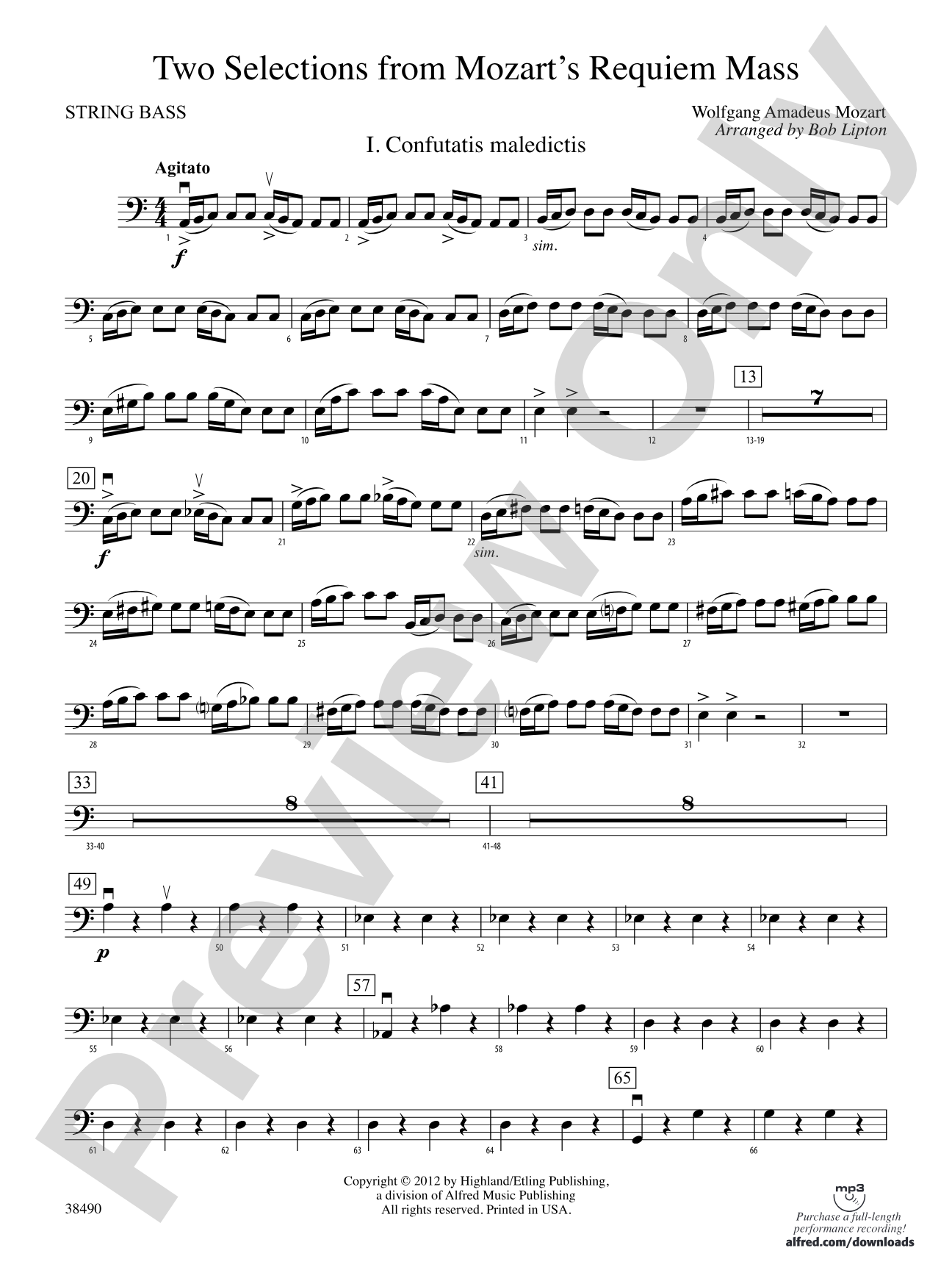
Two Selections from Mozart's Requiem Mass: String Bass

By Wolfgang Amadeus Mozart / arr. Bob Lipton

Grade: 3

Item: 00-PC-0015538_SB

Digital Download
$5.99
Description
The "Confutatis" and "Lacrimosa" from this emotional work comprise some of the most heartbreakingly sad and beautiful music ever written. Your string students get a chance to play the music that was featured in the climatic scenes of the movie Amadeus.

Don't just read it, hear it, play along with it, and watch your students grow with it. In MakeMusic Cloud, Two Selections from Mozart's Requiem Mass: String Bass comes alive with professional accompaniment, adjustable tempo, and built-in practice tools that turn solo practice into real progress.

Sample Audio
0:00
0:00
Sample Video
Additional Details
Series: Highland/Etling String Orchestra
Publisher: Alfred Music
Page Count: 126
SKU: 00-PC-0015538_SB

More about this title

About the Composer: Wolfgang Amadeus Mozart

Wolfgang Amadeus Mozart (1756-1791) composed during the Classical era with a facility for melody and architectural clarity that remains unmatched. His Requiem Mass, left incomplete at his death and finished by his student Franz Xaver Süssmayr, stands as one of the cornerstone works of sacred music literature and demonstrates Mozart's ability to convey profound emotional depth within rigorous formal structures.

For string musicians and conductors, Mozart's string writing offers essential lessons in texture, balance, and the communication of sentiment through economical means. The Requiem's string parts demand careful attention to phrasing and intonation while rewarding players with some of the most expressive material in the orchestral canon.

Why we love this

These two movements distill the Requiem to its most dramatically potent moments, giving Grade 3 string orchestras genuine access to a masterwork without oversimplification. Bob Lipton's arrangement preserves Mozart's harmonic language and the emotional arc that made these sections unforgettable in Amadeus, letting your students discover why this music endures four centuries later.

What to expect

The 'Confutatis' strikes with dramatic urgency before settling into sorrowful introspection; the 'Lacrimosa' unfolds as an extended meditation on grief, with descending lines that seem to trace the path of tears. Both movements invite players into quiet, focused intensity where intonation, balance, and sustained tone become vehicles for genuine musical expression.

Who it's for

String orchestras at the Grade 3 level whose students are ready for substantive repertoire with emotional weight and structural sophistication. Teachers seeking meaningful engagement with Classical masterworks that don't require a full orchestra.

How to get the most out of it

  • Shape the long melodic lines with subtle dynamic inflection rather than sudden shifts; the emotional power lies in sustained, singing quality throughout each phrase.
  • Balance the inner voices carefully, especially in the 'Confutatis' where violas and second violins carry harmonic material that supports the overall texture.
  • Allow space for breath between sections even without explicit rests; treating the score like a vocalist approaches a line will guide your phrasing naturally.
  • Tune the chromatic passages in the 'Lacrimosa' with extra care, as the descending harmonic movement is sensitive to intonation shifts.

How to use it

Position these selections on a concert program as a centerpiece that anchors a thematic program around mortality, loss, or the sacred in music. Their 126-page format and contest/festival designation make them equally suited to competitive festivals or formal concert settings where audiences expect substantive programming.

Skills your students will build

  • Sustained legit playing and control of long melodic phrases
  • Inner voice awareness and balance in four-part textures
  • Chromatic intonation and harmonic sensitivity
  • Interpretation of Classical formal structures with expressive intent
  • Ensemble cohesion under the demands of emotionally nuanced conducting

You May Also Like