
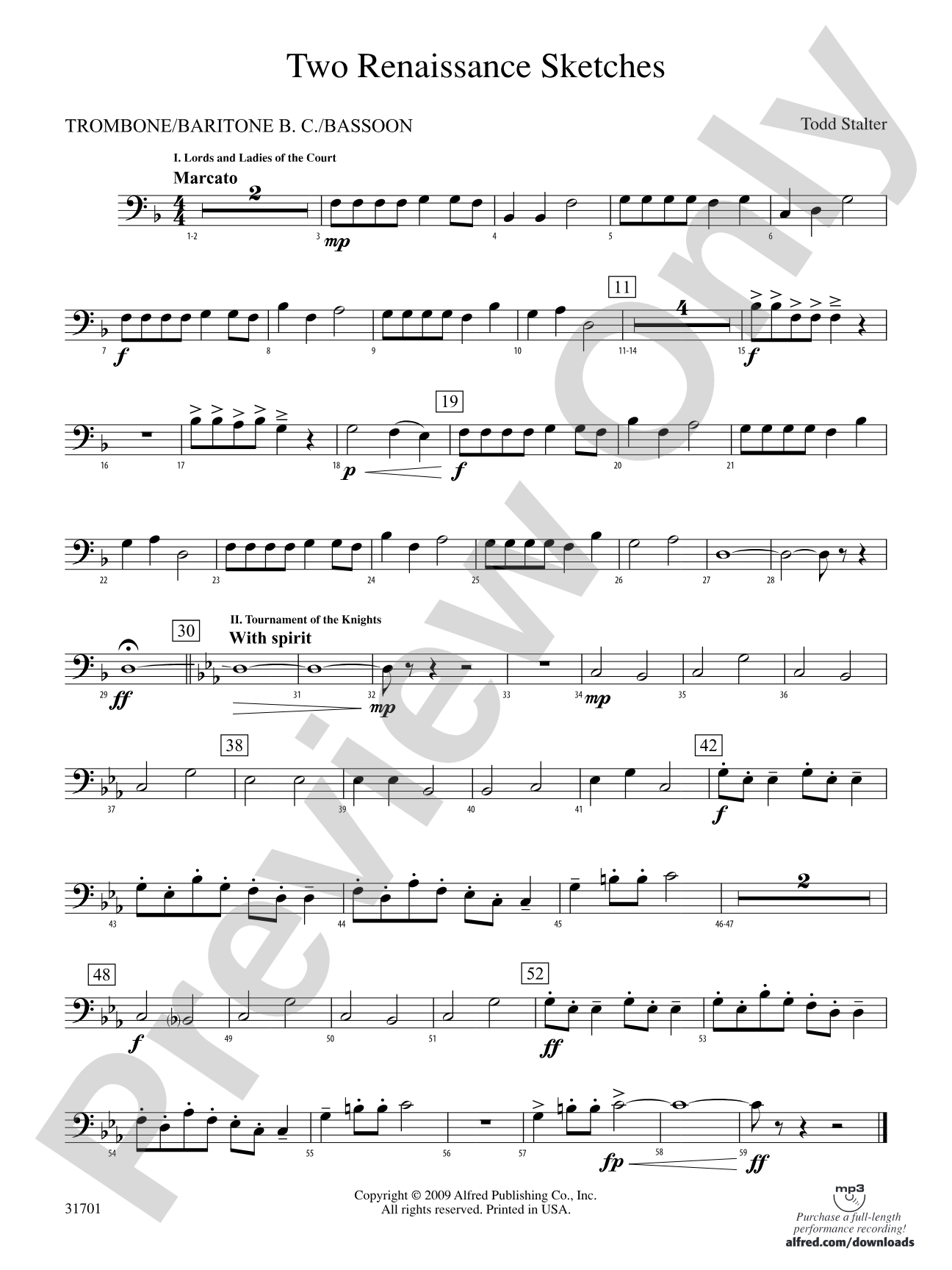

Two Renaissance Sketches: 1st Trombone
By Todd Stalter
Grade: 1.5 (Easy)
Item: 00-PC-0001799_TN1
$3.00
Pickup currently not available
Description
Though entirely original, the melodies of Two Renaissance Sketches come alive with their modal harmonies and tasteful, dance-like percussion accompaniments which are typical of the period. A stately courtly dance and a lively jig give almost everyone in the band a chance to play the melody, and can be an excellent introduction to the sounds and style of Renaissance music. This title is available in MakeMusic Cloud.


Don't just read it, hear it, play along with it, and watch your students grow with it. In MakeMusic Cloud, Two Renaissance Sketches: 1st Trombone comes alive with professional accompaniment, adjustable tempo, and built-in practice tools that turn solo practice into real progress.
Open in the Player
Jump straight in and assign it today.
Start Your Free Trial
Open this title and explore the full library in minutes.
Sample Audio
1
Audio File
--:--
0:00
0:00
Sample Video
Additional Details
Series:
Alfred Debut Series
Publisher:
Alfred Music
Page Count:
122
SKU:
00-PC-0001799_TN1
More about this title
About the Composer: Todd Stalter

Todd Stalter spent 34 years building one of Illinois's most decorated band programs at Eureka High School. His marching band won 16 state championships, his concert band earned consistent Superior ratings at IHSA contests, and his ensembles performed at Orchestra Hall in Chicago and Walt Disney World, along with winning festival championships at the Cotton and Liberty Bowls. He was inducted into the Illinois State Marching Band Championships Hall of Fame.
Beyond his teaching career, Stalter has conducted All-State bands in Georgia and Delaware, led numerous regional honor bands, and maintained an active schedule as an adjudicator and clinician throughout the Midwest. His compositions for band and string orchestra appear on state contest lists across the country and are featured in the GIA publication Teaching Music Through Performance in Band. He holds degrees from Illinois State University in both music education and trumpet performance.
Why we love this
Stalter captures the essence of Renaissance music without relying on period arrangements, giving your band an accessible entry point into modal harmony and the character of early music. Every section gets a moment with the melody across the two movements, which means engagement and ownership from players who might otherwise sit out, and the straightforward Grade 1.5 scoring makes preparation efficient without sacrificing musical substance.
What to expect
The courtly dance moves with dignity and grace, its modal melodies unfolding over a shimmering harmonic backdrop that feels both ancient and immediate. The jig that follows explodes with rhythmic vitality, the kind of spirited energy that makes a Renaissance festival come alive, driven by percussion that dances beneath the melody rather than simply marking time.
Who it's for
This work serves directors introducing young or intermediate ensembles to style, harmonic color, and historical context. The Grade 1.5 level means a developing high school band or an accomplished middle school group can tackle it with confidence, and the transparent instrumentation lets conductors hear exactly what's working and what needs attention.
How to get the most out of it
- Shape the courtly dance with gentle phrase arcs; let the modal harmonies speak without forcing vibrato or romantic expression onto the Renaissance aesthetic.
- Balance the melodic line across sections as it passes from trumpets to clarinets to flutes. Mark score cues so players know when the melody shifts and can listen actively during their rests.
- Approach the percussion accompaniments as the structural anchor of both movements. The dance-like rhythms won't lock without a secure low reed and percussion foundation, so rehearse those parts separately first.
- In the lively jig, maintain rhythmic clarity rather than indulging tempo flexibility. The energy comes from precision, not from pushing the metronome.
How to use it
These two movements pair well as a concert opener that establishes a style shift or as part of a thematic program exploring historical periods. The accessible difficulty means you can prepare them quickly, freeing rehearsal time for more demanding repertoire, and their concert-ready character makes them reliable selections for festival performances or community concerts where clear, engaging writing builds audience connection.
Skills your students will build
- Performing in major and minor modes with attention to harmonic color
- Balancing sectional melody passings and listening across the ensemble
- Reading and executing Renaissance-style rhythmic patterns with precision
- Understanding percussion as a structural voice rather than accompaniment
- Communicating style and character without relying on Romantic-era expression techniques