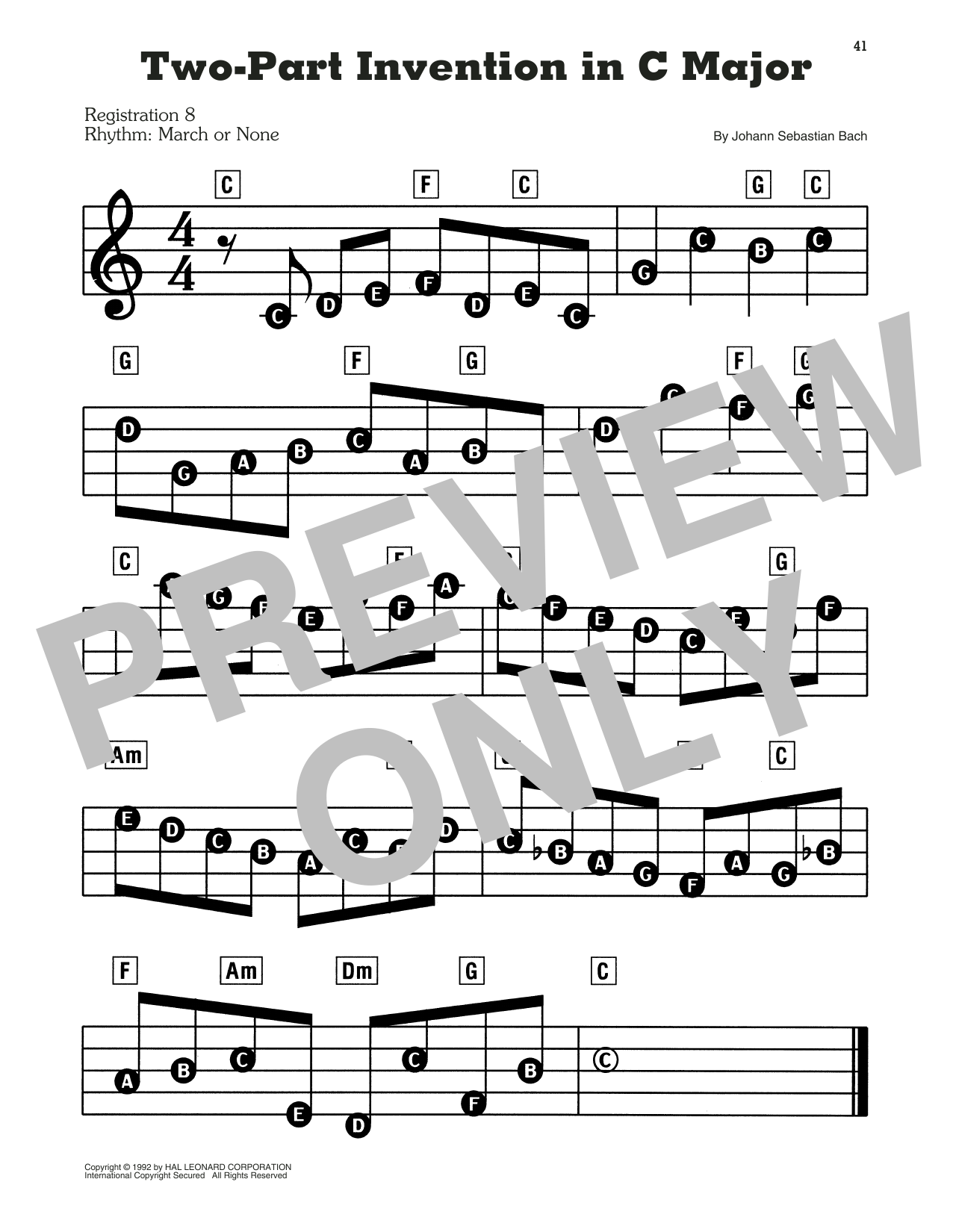
Two-Part Invention In C Sheet Music Preview

Two-Part Invention In C: E-Z Play Today

By Johann Sebastian Bach

Item: 35-DS00733694

Digital Download
$4.99
Description

Two-Part Invention In C: E-Z Play Today isn't in MakeMusic Cloud just yet...but it could be. Let us know you'd like to see it, and you'll help shape what comes next. In the meantime, start a free trial and dive into thousands of interactive titles your students can play along with today.

Sample Audio
No sample audio found.
Sample Video
Additional Details
Publisher: Hal Leonard
Page Count: 1
SKU: 35-DS00733694

More about this title

About the Composer: Johann Sebastian Bach

Johann Sebastian Bach (1685–1750) stands as one of history's most prolific composers of keyboard music. His systematic exploration of musical forms, particularly in works like the Well-Tempered Clavier and the Inventions, established foundational principles that shaped centuries of musical pedagogy. Bach's approach to counterpoint and voice leading remains the gold standard for teaching musicians how to construct independent melodic lines within a unified harmonic framework.

The Two-Part Inventions represent Bach's distilled methodology for developing compositional craft. Each invention isolates a single musical idea and develops it through contrapuntal dialogue between two voices, making them essential training grounds for understanding how great composers think about melodic development and structural coherence.

Why we love this

This simplified arrangement opens Bach's rigorous counterpoint to students who might otherwise find the standard Invention intimidating. The E-Z Play Today edition preserves the essential voice-leading architecture while removing notational obstacles, letting pianists focus on phrasing and the satisfying back-and-forth between hands rather than wrestling with the score.

What to expect

Elegant and conversational. Two independent voices speak to each other in dialogue, each with its own character, yet they belong entirely to the same musical thought. The piece unfolds with an architectural clarity that rewards careful listening, balancing intellectual rigor with genuine warmth.

Who it's for

Early intermediate pianists working toward more sophisticated repertoire, and any student ready to engage with real contrapuntal thinking without the full complexity of Bach's original notation. This edition also serves accomplished musicians who want a quick exploration of Bach's logic in a single-page format.

How to get the most out of it

  • Bring out the primary voice in each measure; resist the urge to play both voices at equal volume. One voice initiates the idea, the other responds, and this conversation should be audible.
  • Notice where the voices exchange material: Bach doesn't simply repeat; he hands the subject from one voice to the other at deliberately chosen moments. Mark these transfers and let them breathe slightly.
  • Keep the harmonic rhythm steady underneath the melodic activity. The underlying pulse should feel inevitable, not rushed, even when the upper voices are busier.

How to use it

Place this early in a student recital as an anchor piece that demonstrates contrapuntal understanding without requiring a lengthy program note. It pairs naturally with later Bach or with Baroque-influenced contemporary works, grounding the audience in the language of voice independence that runs through much of the classical tradition.

Skills your students will build

  • Two-voice counterpoint and independence between hands
  • Recognizing and executing a musical subject through transformation and exchange
  • Shaping a single melodic phrase across both hands without relying on chord changes for direction
  • Maintaining even rhythmic pulse while managing unequal melodic complexity between voices

You May Also Like