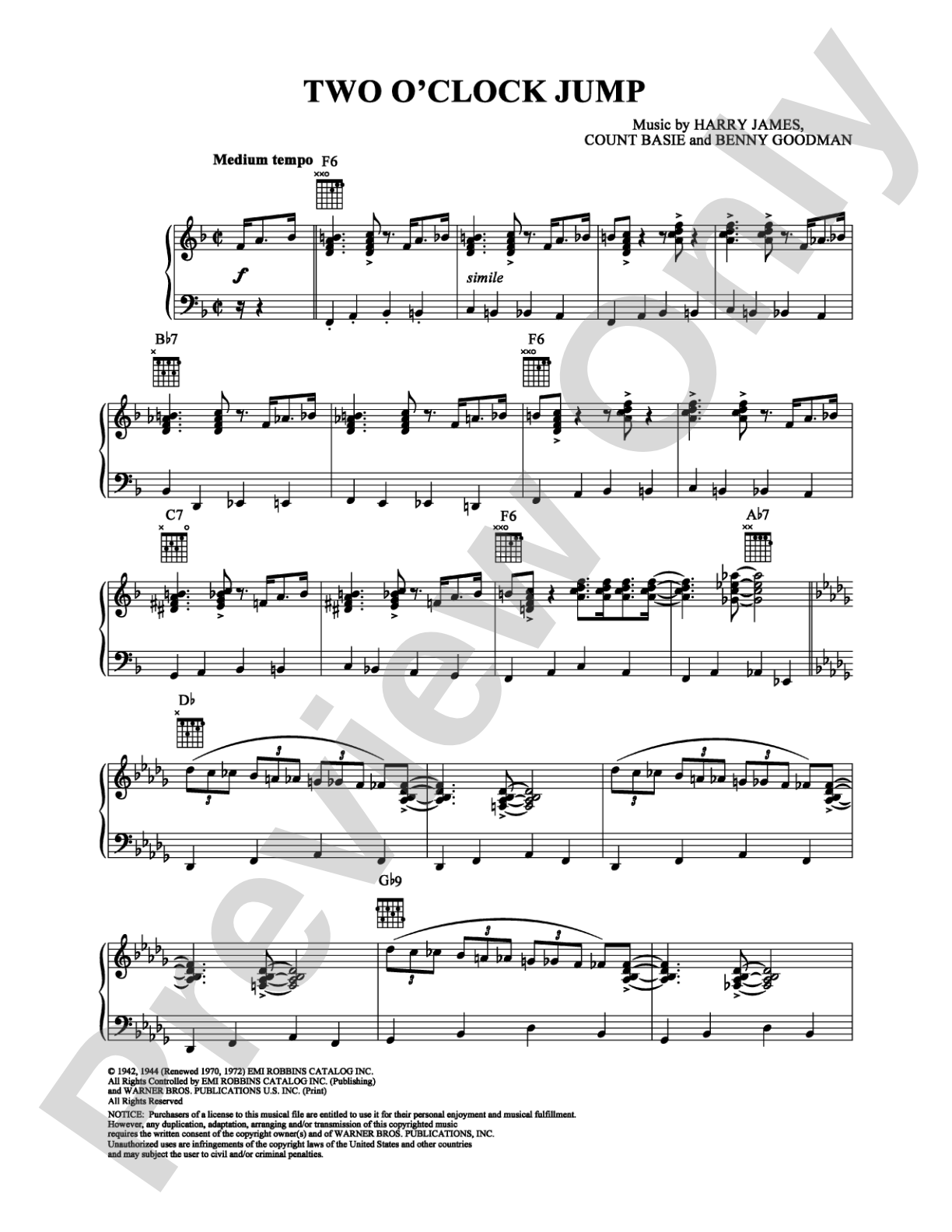
Two O'Clock Jump: Piano Digital Sheet Music

Two O'Clock Jump: Piano Digital Sheet Music

Harry James, Count Basie, Benny Goodman

Item: 00-PS-0007356

Digital Download
$3.99
Description

Two O'Clock Jump: Piano Digital Sheet Music isn't in MakeMusic Cloud just yet...but it could be. Let us know you'd like to see it, and you'll help shape what comes next. In the meantime, start a free trial and dive into thousands of interactive titles your students can play along with today.

Sample Audio
No sample audio found.
Sample Video
Additional Details
SKU: 00-PS-0007356

More about this title

About the Artist: Count Basie

Count Basie (1904-1984) was one of jazz's most influential bandleaders and pianists. His economical, swinging approach to the instrument defined the Kansas City sound and shaped big band jazz for decades. Basie's ability to anchor a band with minimal but perfectly timed notes made him a master of ensemble playing; his left hand kept time like a drum, his right hand stated melodies with clarity and wit.

Why we love this

Two O'Clock Jump is pure swing groove in a form students can actually grasp and perform. The piece gives pianists a genuine taste of big band rhythm section playing without requiring a full orchestra, and its infectious riff-based structure makes it memorable after just a few hearings.

What to expect

Imagine walking into a smoky Kansas City club in the 1940s as the band hits its stride. The riff hooks you instantly; it's simple enough to sing but swings so hard you can't help but move. Energy radiates from the rhythm section, but there's always room to breathe.

Who it's for

Jazz pianists at the intermediate level and above will find a legitimate vehicle for exploring swing phrasing and ensemble thinking. Band and combo directors can use this as a solo feature that showcases a student's feel for rhythm and groove.

How to get the most out of it

  • Lock into a steady, relaxed pulse in the left hand. Basie's genius was making the rhythm section sound effortless; don't rush the tempo even when the melody gets busy.
  • Treat the riff as your anchor. When the main theme repeats, commit fully to its rhythmic shape; the strength of the line carries the whole piece.
  • Let space breathe between phrases. Jazz piano is as much about what you don't play as what you do; resist the urge to fill every measure.
  • Swing the eighth notes naturally. Feel the triplet subdivision underneath without making it mechanical.

How to use it

This works beautifully as a solo feature in a jazz concert or as a transition piece between classical and contemporary music in a multi-genre recital. It's short enough to pair with other standards or original compositions and substantial enough to showcase a pianist's understanding of jazz idiom.

Skills your students will build

  • Swing phrasing and triplet feel
  • Riff-based melody writing and recognition
  • Left-hand independence and steady comping
  • Reading and performing blues changes
  • Balancing rhythmic precision with relaxed swing

You May Also Like