
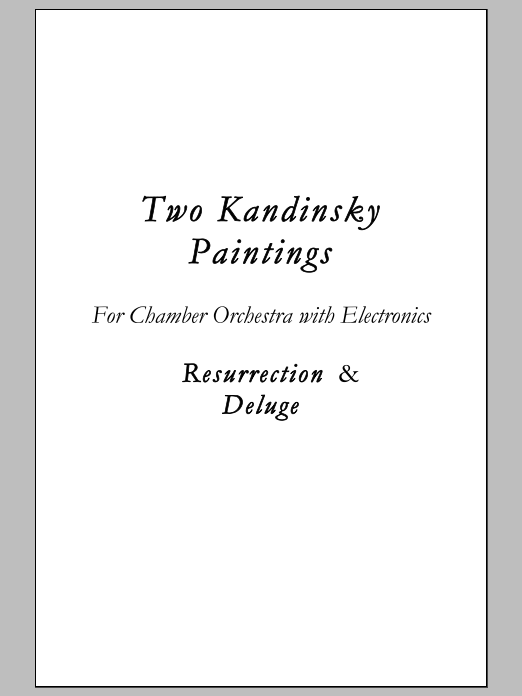

Two Kandinsky Paintings for Chamber Orchestra with Electronics: String Orchestra Conductor Score & Parts
Arranged by Man Fang
Item: 35-PK00283149
$35.15
Pickup currently not available
Buy Extra Parts (Digital PDF Download)
Parts Added to Cart!
Description
This score incudes two electronic works for chamber orchestra composed between 2008-9. Duration: 32:00


Two Kandinsky Paintings for Chamber Orchestra with Electronics: String Orchestra Conductor Score & Parts isn't in MakeMusic Cloud just yet...but it could be. Let us know you'd like to see it, and you'll help shape what comes next. In the meantime, start a free trial and dive into thousands of interactive titles your students can play along with today.
Request This Title
Tell us you want it.
Start Your Free Trial
Explore everything that's ready to play right now.
Sample Audio
No sample audio found.
Sample Video
No sample videos found.
Additional Details
Publisher:
Hal Leonard
SKU:
35-PK00283149
More about this title
Why we love this
The integration of live strings with electronics creates sonic territory most conductors rarely access with student ensembles, and these works do it without requiring specialized technical expertise. The pairing of two related compositions gives you flexibility in how you structure a performance, whether presenting them as a complete arc or as bookends to a larger program.
What to expect
The works evoke the visual abstraction that inspired them, moving between moments of crystalline clarity and immersive harmonic wash. Strings meld with electronic processing to create textures that feel both intimate and expansive.
Who it's for
Conductors leading advanced high school or collegiate string orchestras who want to expose students to contemporary hybrid scoring without abandoning traditional orchestral practice. This works particularly well for directors seeking repertoire that bridges acoustic and digital soundworlds.
How to get the most out of it
- Balance the acoustic string sound against the electronic layer during rehearsal by isolating each element, then gradually blending them. Some players will instinctively pull back when electronics enter; resist that instinct.
- Set clear click or sync points between your conducting and any playback system well before the first rehearsal. Ambiguity here creates cascading timing issues.
- Treat the electronics as an additional section requiring its own cueing and attention, not as background texture. Your physical gestures should acknowledge both realms.
How to use it
Position these works as the centerpiece of a contemporary music concert, or frame them within a program exploring how 21st century composers reimagine classical instrumentation. The 32 minute total duration allows them to anchor a full recital or share a concert with carefully selected shorter works.
Skills your students will build
- Reading and responding to unconventional notation or electronic cues on the page
- Balancing acoustic ensemble sound with fixed playback material
- Sustaining ensemble focus during extended passages without traditional harmonic anchors
- Collaborative listening when acoustic and electronic timbres occupy the same frequency space