
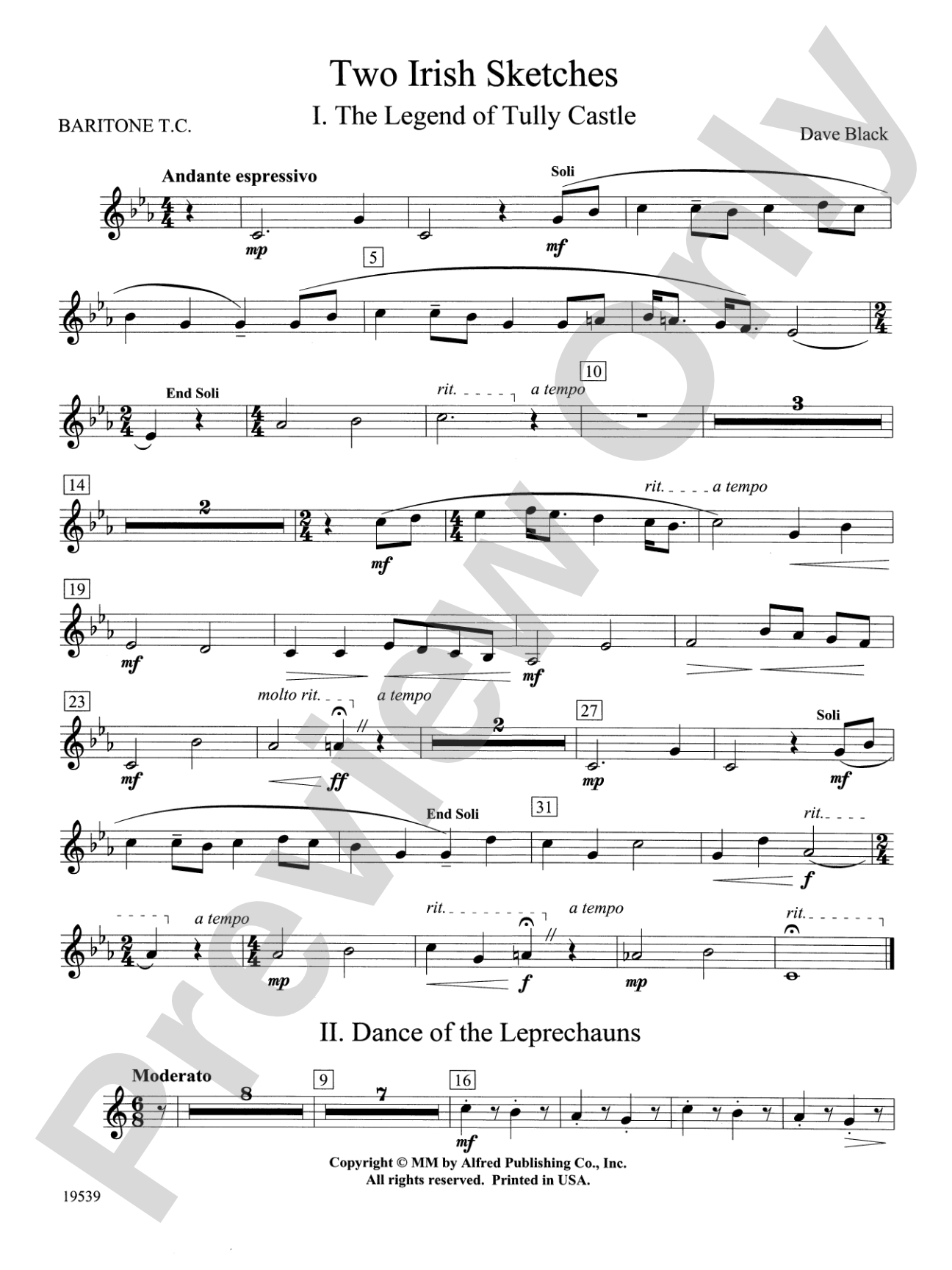

Two Irish Sketches: Baritone T.C.
I. The Legend of Tully Castle, II. Dance of the Leprechauns
By Dave Black
Grade: 3 (Medium)
Item: 00-PC-0000332_BTC1
$3.00
Pickup currently not available
Description
Two Irish Sketches is a beautiful, original work inspired by Irish legend and folklore. Soaring crescendos and soothing harmonies fill the first movement, entitled "The Legend of Tully Castle." "Dance of the Leprechauns" is a lively jig in 6/8 time, featuring clever syncopation and subtle counterpoint. Dave Black's Two Irish Sketches will be a wonderful addition to your next concert! This title is available in MakeMusic Cloud.


Don't just read it, hear it, play along with it, and watch your students grow with it. In MakeMusic Cloud, Two Irish Sketches: Baritone T.C. comes alive with professional accompaniment, adjustable tempo, and built-in practice tools that turn solo practice into real progress.
Open in the Player
Jump straight in and assign it today.
Start Your Free Trial
Open this title and explore the full library in minutes.
Sample Audio
1
Audio File
--:--
0:00
0:00
Sample Video
Additional Details
Series:
Alfred Concert Band
Publisher:
Alfred Music
Page Count:
270
SKU:
00-PC-0000332_BTC1
More about this title
About the Composer: Dave Black

Dave Black is a percussionist and composer whose catalog spans over 60 published works across the major music publishing houses. His education in percussion performance at California State University, Northridge launched a career marked by international performance and studio work with prominent entertainers and touring productions. Black's prolific output has earned him 26 consecutive ASCAP Popular Composer Awards, Grammy Award participation certificates, the Percussive Arts Society President's Industry Award, and recognition in Modern Drummer and Drum! Magazine.
Beyond concert and theatrical composition, Black has shaped music education globally as one of the world's best-selling percussion authors. His foundational works, including Alfred's Drum Method and Sound Innovations for Concert Band, have sold over two million copies combined and remain essential resources in classrooms worldwide. His compositions have been featured in television and film, including the movie Drumline, cementing his influence across both educational and entertainment sectors.
Why we love this
Black crafts two movements that sit comfortably at Grade 3 while offering genuine musical substance. The opening movement delivers the sweeping, emotional arc many programs seek for concert-opening appeal, while the second movement's syncopated jig in 6/8 time keeps the energy high without losing sophistication. This pairing gives conductors the flexibility to program a complete, satisfying work that audiences enjoy and students genuinely look forward to rehearsing.
What to expect
The first movement unfolds with the sweeping grandeur of Irish landscape and legend, building through rich harmonies and dynamic swell. The second movement shifts the mood entirely, trading contemplation for sprightly rhythmic joy as syncopation and counterpoint dance playfully together in 6/8 time.
Who it's for
Concert bands at the Grade 3 level seeking substantial programming material that balances lyrical expression with energetic contrast. Both works are accessible enough for developing musicians while offering rewarding musical challenges that keep players engaged in the rehearsal process.
How to get the most out of it
- Balance the soaring crescendos in "The Legend of Tully Castle" by establishing a clear dynamic trajectory early in rehearsals; have students mark hairpins and dynamic changes in their parts to avoid sudden jumps in volume.
- Lock the syncopated figures in "Dance of the Leprechauns" by isolating rhythm section and melody line separately before combining them; tap-speak the syncopated rhythms to internalize the feel before adding pitch.
- Shape the soothing harmonies in the first movement by asking the band to listen horizontally within their own sections first; this prevents the harmony from feeling static and allows the emotional arc to emerge naturally.
How to use it
Program both movements as a single work to anchor a concert's opening or closing slot, letting the emotional arc and stylistic contrast carry audiences through a complete musical journey. Alternatively, use "The Legend of Tully Castle" as a concert opener and reserve "Dance of the Leprechauns" for a lighter programming block later in the concert.
Skills your students will build
- Dynamic shaping and crescendo control across full ensemble
- Reading and executing syncopated rhythms in 6/8 time
- Balance and blend in four-part harmonic writing
- Articulation clarity in counterpoint
- Sustained melodic line projection over accompaniment figures