Two Irish Folk Melodies: E-flat Alto Saxophone Sheet Music Preview

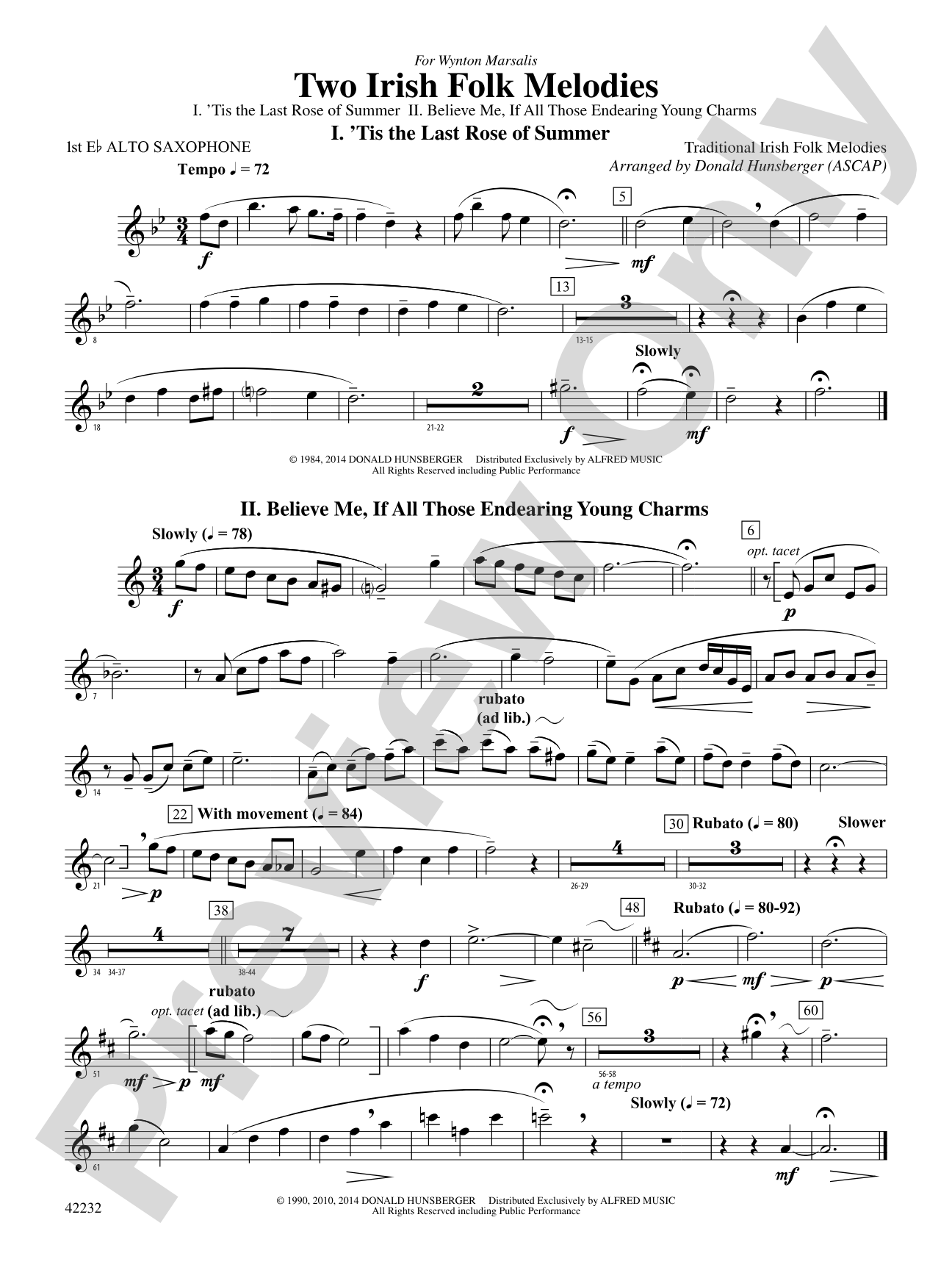
Two Irish Folk Melodies: E-flat Alto Saxophone

I. 'Tis the Last Rose of Summer, II. Believe Me, If All Those Endearing Young Charms

Traditional Irish Folk Melodies / arr. Donald Hunsberger

Grade: 4 (Medium)

Item: 00-PC-0016716_AX1

Digital Download
$3.00
Description
Two charming components of the Carnaval project, scored by Donald Hunsberger for trumpet soloist Wynton Marsalis and the Eastman Wind Ensemble are combined in this freshly engraved setting. The accompaniment is accessible to high school ensembles, including "'Tis the Last Rose of Summer" and "Believe Me, If All Those Endearing Young Charms," this work will provide an opportunity to feature your trumpet soloist with these lush Irish folk tunes. (5:00)

Don't just read it, hear it, play along with it, and watch your students grow with it. In MakeMusic Cloud, Two Irish Folk Melodies: E-flat Alto Saxophone comes alive with professional accompaniment, adjustable tempo, and built-in practice tools that turn solo practice into real progress.

Sample Audio
No sample audio found.
Sample Video
Additional Details
Series: Donald Hunsberger Wind Library
Publisher: Alfred Music
Page Count: 180
SKU: 00-PC-0016716_AX1

More about this title

About the Arranger: Donald Hunsberger

Donald Hunsberger is a legendary conductor, composer, and arranger whose career shaped American wind band music for over five decades. His work with the Eastman Wind Ensemble established a new standard for ensemble sound and repertoire development, and his arrangements have become foundational texts in the concert band canon.

Hunsberger's gift for orchestration shines in his ability to transform existing melodies into rich, ensemble-friendly textures. His arrangements prioritize musical depth without sacrificing accessibility, making advanced compositional techniques available to high school musicians.

Why we love this

This setting gives your trumpet soloist a genuine showcase while keeping the band part gratifying and achievable at the high school level. Hunsberger's orchestration honors both the lyrical beauty of these Irish melodies and the character of the original Marsalis/Eastman collaboration, creating an arrangement that feels concert-ready without demanding virtuosic writing from every section.

What to expect

Warm and nostalgic, with the character of a folk song sung around a hearth. The arrangement wraps these familiar Irish melodies in rich harmonic colors and gentle orchestral textures that feel both intimate and spacious, inviting the listener into a reflective moment.

Who it's for

Concert bands at the high school level seeking repertoire that showcases a strong trumpet soloist while offering the full ensemble a musically rewarding part. This works well for bands with intermediate to upper-level reading skills and a capable solo trumpet player ready for a featured role.

How to get the most out of it

  • Balance the trumpet soloist against the ensemble by having the band play with restraint in softer passages; these folk melodies need space to breathe, and over-balancing the accompaniment will bury the song's heart.
  • Work the rubato with your soloist before full ensemble rehearsals. The flexibility that makes these tunes sing often comes from subtle tempo give-and-take, and the band needs to follow and support those musical choices.
  • Pay attention to the harmonic color in the woodwind writing. Hunsberger often voices supporting harmonies in ways that require blend and balance; uneven intonation will muddy the lush textures he's created.
  • Shape phrases with the soloist's breathing, not against it. These are vocal melodies transposed to trumpet, and the band will sound more musical if sections release slightly at the soloist's natural phrase endings.

How to use it

Program this as a contrasting piece alongside more contemporary concert band works, or as a centerpiece for a concert themed around folk traditions or cultural music. The five-minute runtime makes it an ideal bridge between longer compositional forms, and the melodic accessibility appeals broadly to audiences.

Skills your students will build

  • Accompanying a featured soloist with sensitivity and rhythmic precision
  • Voicing and blending complex harmonic textures across woodwind and brass sections
  • Responding to expressive interpretation and flexible phrasing from a soloist
  • Reading and executing dynamic shadings that support rather than compete with the solo line
  • Balancing part-writing where multiple sections share the harmonic responsibility

You May Also Like