

Two German Folk Songs: Bass Educational Pack
"Lightly Row" and "Song of the Wind" on the D and A Strings
Traditional / arr. Bob Phillips
Grade: 0.5
Item: 00-PC-0018649_SB_EDPAK
$3.00
Pickup currently not available
Description
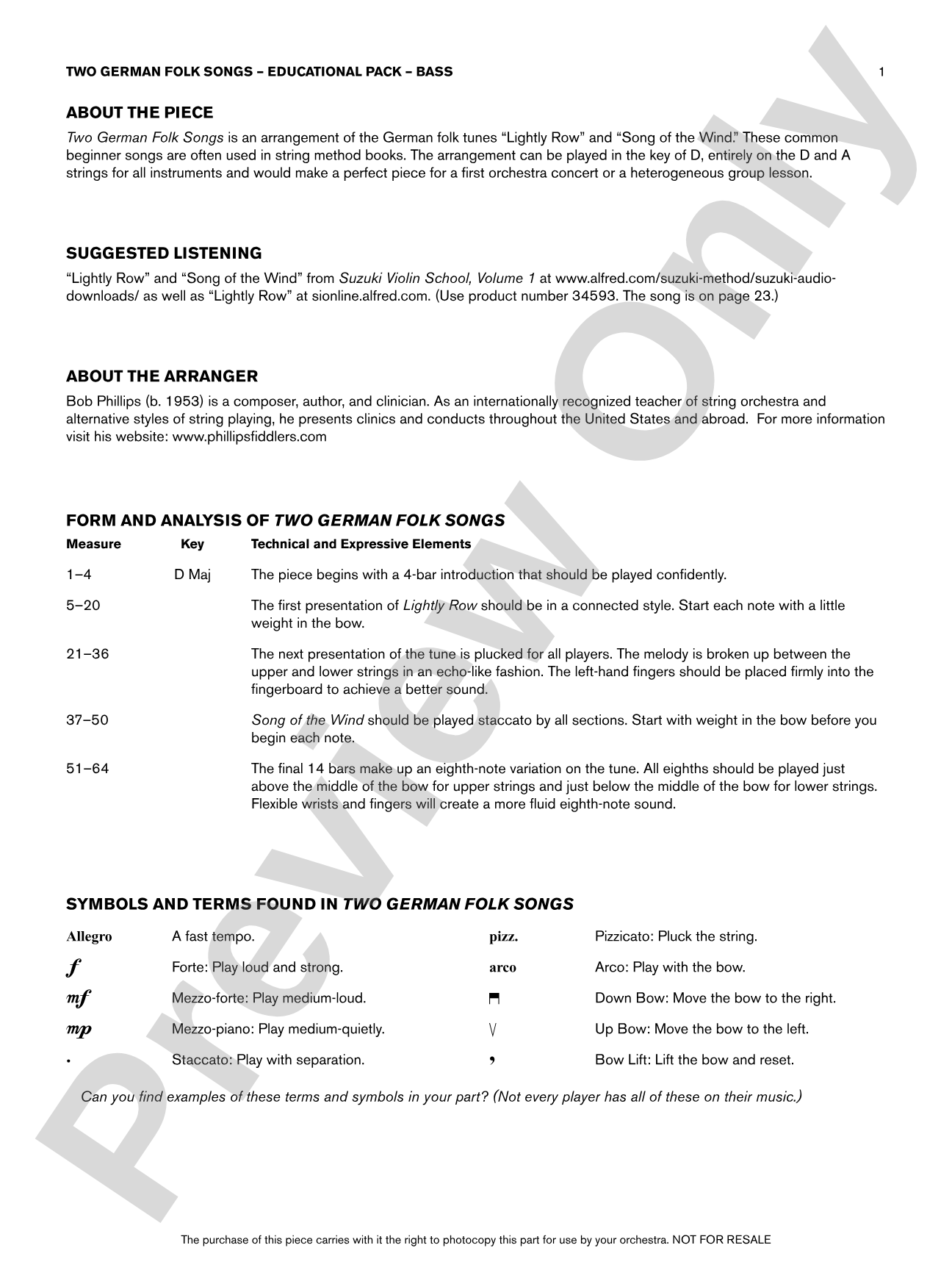
A sparkling gem for a first concert or a mixed-instrument group lesson, this piece will be fun to play and features an exciting ending. Combining two commonly taught folk songs, "Lightly Row" and "Song of the Wind," this delightful medley, Two German Folk Songs by Bob Phillips, uses only the D string and the A string within the D major scale. Parts lie well on every instrument. The second violin and viola parts are doubled. Bass and cello are often in unison. Throughout the piece, all sections are often in rhythmic unison. This piece provides the perfect setting to reinforce detaché, staccato, and pizzicato. This one will go together well! (2:10) This title is available in MakeMusic Cloud.


Don't just read it, hear it, play along with it, and watch your students grow with it. In MakeMusic Cloud, Two German Folk Songs: Bass Educational Pack comes alive with professional accompaniment, adjustable tempo, and built-in practice tools that turn solo practice into real progress.
Open in the Player
Jump straight in and assign it today.
Start Your Free Trial
Open this title and explore the full library in minutes.
Sample Audio
1
Audio File
--:--
0:00
0:00
Sample Video
Additional Details
Series:
Sound Innovations for String Orchestra
Publisher:
Alfred Music
Page Count:
53
SKU:
00-PC-0018649_SB_EDPAK
More about this title
About the Arranger: Bob Phillips

Bob Phillips (b. 1953) has spent his career reshaping how string students learn ensemble skills and musical expression. Over nearly three decades leading the Saline, Michigan string program, he developed a comprehensive pedagogical approach that balances classical training with exposure to folk, jazz, rock, Latin, and mariachi styles. His 25+ published series, including Sound Innovations and the Philharmonic collections, have shaped string education across thousands of classrooms.
As a composer and arranger, Phillips brings orchestral sophistication to material written specifically for young musicians. His work as resident conductor for Wintergrass Festival and his collaborations with youth orchestras at state and national levels inform every piece he creates. Phillips is an ASCAP-award winning composer whose arrangements regularly appear at major music education conferences.
Why we love this
This arrangement strips away the complexity of traditional folk song scoring and builds in exactly what beginning string orchestras need to succeed. The doubling of second violin and viola parts, strategic unison in bass and cello, and consistent rhythmic alignment across sections mean students hear themselves in the ensemble immediately. The brief 2:10 runtime and achievable instrumentation requirements make this a genuine concert piece rather than a warm-up.
What to expect
Bright and energetic, with the comfort of recognizable melodies paired with the satisfaction of producing a polished arrangement. The piece moves with natural forward momentum, driven by the interplay between the two folk tunes and building to a genuine sense of arrival in the final measures.
Who it's for
Beginning string orchestras with mixed instrumentation, particularly those preparing for a first concert or performance festival. Students learning to coordinate bow strokes and pizzicato technique across a full ensemble will benefit from the part writing that reinforces rhythmic unison and strategic doubling.
How to get the most out of it
- Separate detaché and staccato execution during first rehearsals. The distinction between these articulations matters more on simple melodies, so mark the score clearly and have students demonstrate the difference on open strings before diving into the full arrangement.
- Balance the pizzicato section so it doesn't overshadow the D and A string work. Remind students that plucked notes still have tone, and the rhythmic unison makes clarity essential.
- Build momentum steadily through the medley's transition between the two folk songs. The exciting ending Phillips mentions rewards a conductor who shapes the phrasing rather than simply keeping time.
How to use it
Open a concert with this piece to establish confidence and earn immediate audience connection through familiar folk material. It works equally well as a transition piece in a mixed-instrument or all-string ensemble setting, and its manageable length makes it suitable for festival competitions where time slots are tight.
Skills your students will build
- Executing detaché and staccato articulations on D and A strings
- Coordinating pizzicato technique within ensemble rhythm
- Reading and maintaining parts that are frequently in rhythmic unison
- Building dynamic shape across a simple melodic structure
- Playing effectively when doubled or in unison with other sections