
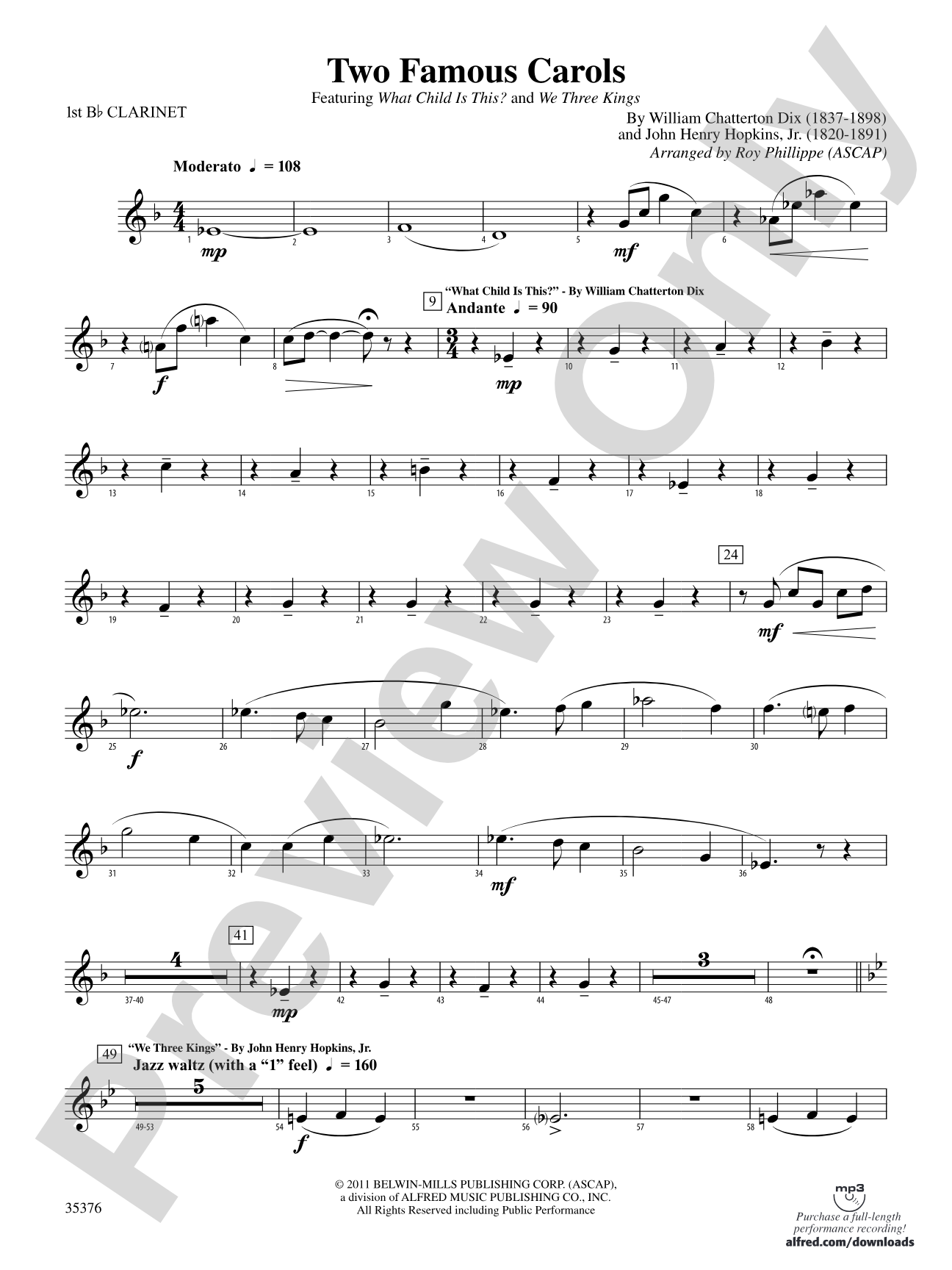

Two Famous Carols: 1st B-flat Clarinet
Featuring: What Child Is This? / We Three Kings
By William Chatterton Dix and John Henry Hopkins, Jr. / arr. Roy Phillippe
Grade: 2 (Easy)
Item: 00-PC-0014926_C1
$5.99
Pickup currently not available
Description
Two Famous Carols is a duo of cherished holiday carols in wildly diverse styles. "What Child Is This?," composed in 1865 by 29-year-old William Chatterton Dix, begins with the beautiful sound of a solo horn, while "We Three Kings," composed by reverend John Henry Hopkins, Jr. in the mid-1850s, is presented in the style of a jazz-waltz. A holiday potpourri!


Don't just read it, hear it, play along with it, and watch your students grow with it. In MakeMusic Cloud, Two Famous Carols: 1st B-flat Clarinet comes alive with professional accompaniment, adjustable tempo, and built-in practice tools that turn solo practice into real progress.
Open in the Player
Jump straight in and assign it today.
Start Your Free Trial
Open this title and explore the full library in minutes.
Sample Audio
1
Audio File
--:--
0:00
0:00
Sample Video
No sample videos found.
Additional Details
Series:
Belwin Young Band
Publisher:
Alfred Music
Page Count:
238
SKU:
00-PC-0014926_C1
More about this title
About the Composer: William Chatterton Dix
William Chatterton Dix (1837-1898) was a Scottish hymn writer and poet whose literary work shaped congregational singing throughout the Victorian era. Though trained in business, Dix devoted himself to sacred music and poetry, composing and adapting numerous hymn texts that remain central to Christian worship today. His most enduring contribution is "What Child Is This?," which set new lyrics to the traditional Scottish melody "Greensleeves," creating one of the most recognizable carol texts in the English-speaking world.
John Henry Hopkins, Jr. (1820-1891) was an American Episcopal clergyman and composer whose "We Three Kings" (also known as "We Three Kings of Orient Are") became an instant classic upon its publication in the mid-1850s. Hopkins's skill lay in crafting memorable melodies paired with vivid theological imagery, and his carol has never left the holiday repertoire since its debut. His gift for blending accessibility with musical substance made sacred music central to his life's work.
Why we love this
Roy Phillippe's arrangement captures the distinct personality of each carol while keeping the Grade 2 band engaged and sounding polished. The solo horn introduction to "What Child Is This?" gives young musicians a chance to hear lyrical writing shine, while the jazz-waltz treatment of "We Three Kings" brings contemporary energy to familiar material without losing the carol's warmth. This pairing delivers two very different rehearsal experiences and concert moments in a single, economical package.
What to expect
"What Child Is This?" opens with intimate, almost chamber-like beauty before the full band joins in gentle support. "We Three Kings" swings with jazz sensibility while retaining the spiritual warmth of the original carol, creating a concert moment that feels both familiar and refreshingly alive.
Who it's for
Young concert bands ready to move beyond basic holiday fare and explore arranging styles that stretch their musical thinking. This collection suits directors programming a winter concert who want two diverse pieces that showcase different facets of band writing without overwhelming Grade 2 musicians.
How to get the most out of it
- Balance the opening horn solo in "What Child Is This?" so it sings clearly above the band's accompaniment; this is the arrangement's most exposed moment and deserves careful balance work in the opening rehearsals.
- Lock the waltz rhythm in "We Three Kings" by having the conductor establish the lilting three-feel firmly; young bands often rush or flatten jazz-waltz styles, so a steady, confident pulse from the podium matters enormously.
- Shape the melody lines through the full dynamic range in both pieces; even at Grade 2, these carols reward expressive playing that honors the emotional arc of each carol.
How to use it
Anchor a winter concert with these back-to-back; the tonal contrast between the reflective first piece and the rhythmically playful second creates natural programming momentum. This works equally well as a complete holiday set or as bookend pieces with other seasonal selections in between.
Skills your students will build
- Balancing solo voices within a full ensemble sound
- Executing rhythmic precision in a swing/waltz style (dotted rhythms, triplet feels)
- Shaping lyrical melody lines with dynamic control
- Reading and responding to conductor interpretation across contrasting tempos and moods