
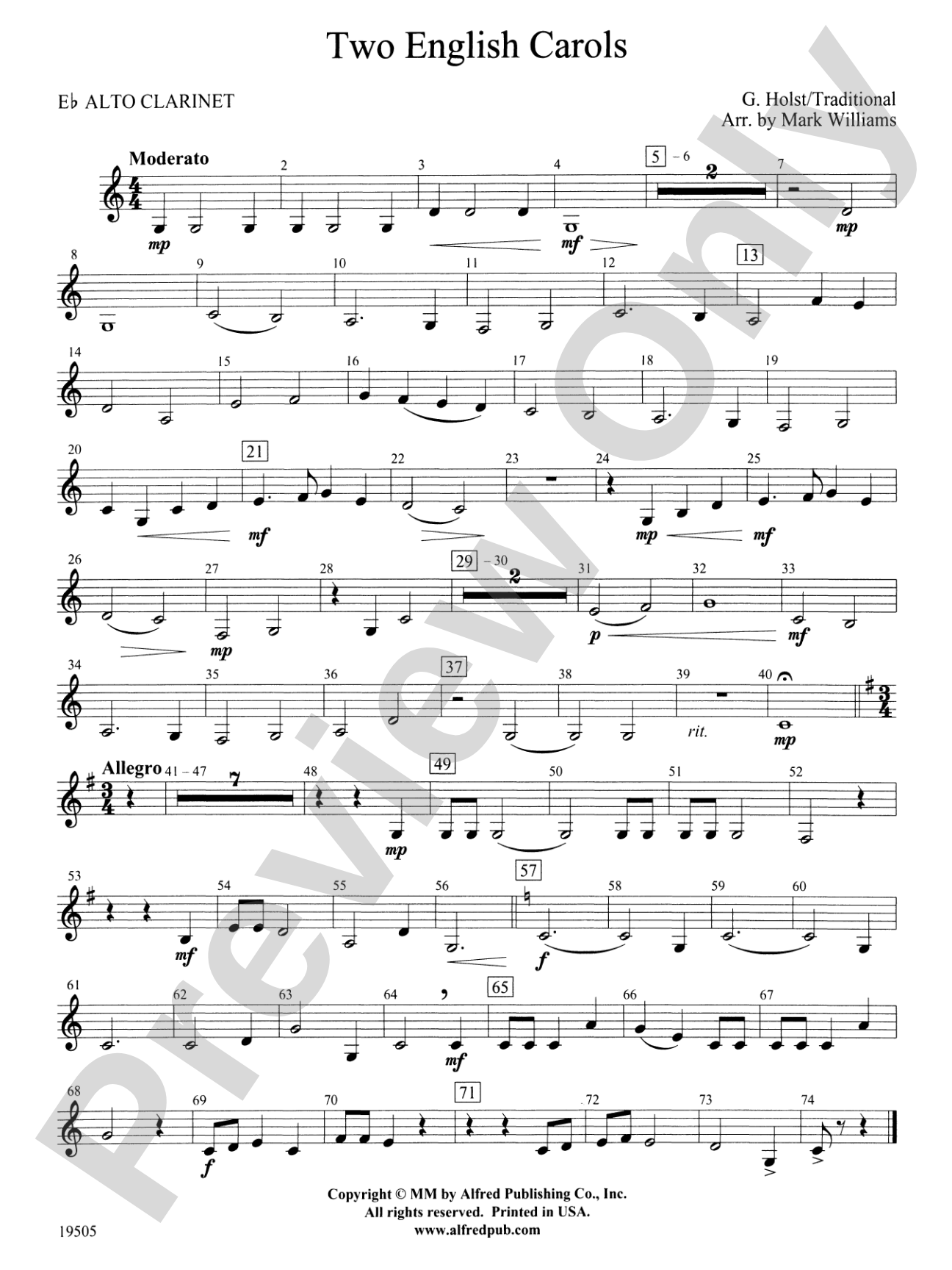

Two English Carols: E-flat Alto Clarinet
Arr. Mark Williams
Grade: 1 (Very Easy)
Item: 00-PC-0014790_AC1
$3.00
Pickup currently not available
Description
This arrangement showcases two beautiful English carols in an easy-to-play arrangement for your young band. "In the Bleak Midwinter," a tune written by Gustav Holst, begins this medley in classic style. Opportunities abound for working on legato phrasing. The lively traditional carol "The Holly and the Ivy" follows in 3/4 time to bring this work to an engaging close. This arrangement is correlated with Accent on Achievement, Book 1, page 30.


Don't just read it, hear it, play along with it, and watch your students grow with it. In MakeMusic Cloud, Two English Carols: E-flat Alto Clarinet comes alive with professional accompaniment, adjustable tempo, and built-in practice tools that turn solo practice into real progress.
Open in the Player
Jump straight in and assign it today.
Start Your Free Trial
Open this title and explore the full library in minutes.
Sample Audio
1
Audio File
--:--
0:00
0:00
Sample Video
No sample videos found.
Additional Details
Series:
Accent on Achievement
Publisher:
Alfred Music
Page Count:
118
SKU:
00-PC-0014790_AC1
More about this title
About the Arranger: Mark Williams

Mark Williams built his career on writing music that young musicians could play with confidence and musicality. A prolific composer with over 200 published works for band, orchestra, and choir, he shaped the sound of school music programs through his role as co-author of the Accent on Achievement Band Method. His expertise came from the ground up: he taught elementary band for many years in Washington state, clinicked and guest-conducted across 34 states, five Canadian provinces, and Australia, and performed professionally as a bassoon player and arranger for the 560th Air Force Band.
Williams earned recognition from the Western International Band Clinic and multiple ASCAP Special Awards for his contributions to band music. Beyond his prolific output, he served as Conductor and Artistic Director for the Spokane British Brass Band and held degrees in Music Education and Education from Eastern Washington University. His understanding of what young bands could accomplish informed every piece he wrote.
Why we love this
Mark Williams knew exactly what Grade 1 bands need: music that sounds sophisticated without overwhelming young players. This medley pairs two beloved English carols in a single rehearsal-friendly package, giving you a concert piece that works for winter programs, festivals, and competitions without requiring extensive rehearsal time. The contrasting moods between the reflective opening and the brisk final section keep student interest high while building legato control and confidence in 3/4 time.
What to expect
The medley opens with the quiet devotion of Holst's tune, inviting careful attention to long tones and air flow. When 'The Holly and the Ivy' arrives in 3/4 time, the mood shifts to something brighter and more playful, with the traditional melody dancing forward in a way that feels both festive and accessible.
Who it's for
This arrangement serves Grade 1 concert bands working with young or developing musicians. It pairs well with Accent on Achievement Book 1 (page 30 specifically), making it an ideal choice for bands using that method or at that proficiency level. Directors seeking a two-part winter program piece that avoids being overly simplistic will find this especially valuable.
How to get the most out of it
- Shape the opening of 'In the Bleak Midwinter' by thinking of it as a single long line rather than isolated phrases. This approach helps the band hear the melody as sustained legato rather than stopping at barlines.
- Lock the rhythmic foundation in 'The Holly and the Ivy' by isolating the percussion and low brass first, then layering in the melody. The 3/4 feel needs confident grounding to sound sprightly rather than tentative.
- Balance the two sections carefully in rehearsal: the first carol should feel somber and measured, while the second should sparkle with energy. Resist the urge to rush the transition between them.
How to use it
Program this as a complete winter concert opener or closer, using the two contrasting carols to frame your concert's emotional arc. Its Grade 1 difficulty makes it a strong festival choice for bands building their competitive or showcase repertoire. The connection to Accent on Achievement Book 1 also makes it a natural fit if you're looking for concert material that directly extends your students' method book studies.
Skills your students will build
- Legato phrasing and sustained tone production
- Reading and performing in 3/4 time
- Balancing contrasting musical moods within a single piece
- Concert band blend and balance at the Grade 1 level
- Sight-reading familiar melodic material in new arrangements