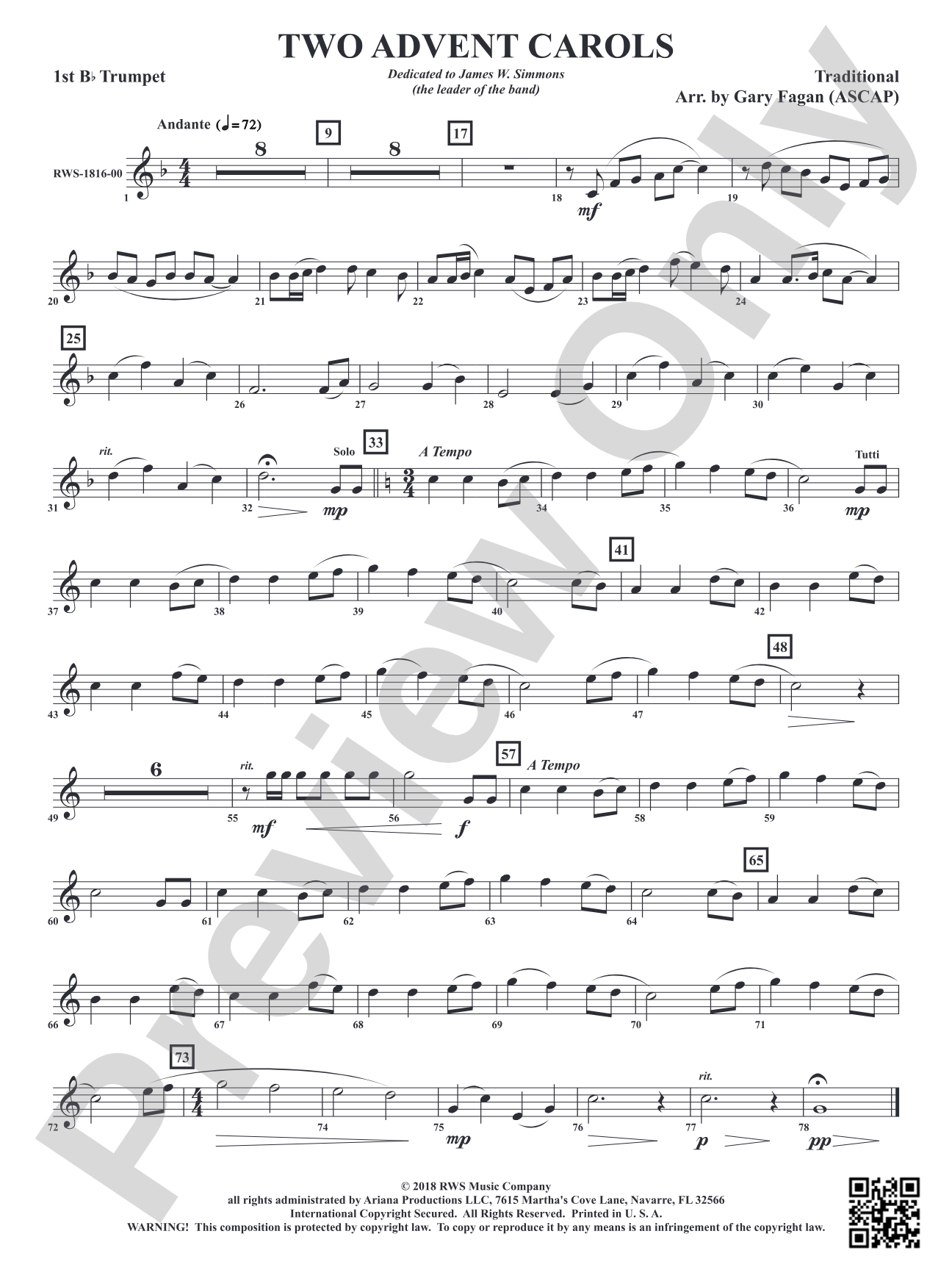
The peaceful and lush arrangement combines the two lovely Christmas classics "Still, Still, Still" and "Infant Holy, Infant Lowly." This lyrical holiday themed work is masterfully scored to display your ensemble's beautiful sonority and blend.
Original Item#: RWS-1816-00
Discover MakeMusic Cloud: thousands of interactive titles your students can play along with today.
Gary Fagan brings decades of practical band directing experience to his arranging work. A Bridgewater College graduate with a master's degree from James Madison University, he spent 36 years leading ensembles in Albemarle County before transitioning to university teaching and clinical work. His arrangements have been heard at the Midwest Band and Orchestra Clinic, the White House, and major regional festivals.
Fagan's contributions to music education extend across multiple roles: he teaches arranging as adjunct faculty at JMU, serves as a University Supervisor, and remains active as a clinician and adjudicator throughout Virginia. He holds memberships in the National Band Association, Phi Beta Mu Bandmasters Fraternity, and ASCAP, and currently plays percussion with the Charlottesville Band while serving as its Assistant Director. His awards include recognition from the Virginia Governor's School for the Visual and Performing Arts and the Piedmont Council of the Arts.
Why we love this
Fagan understands exactly what Grade 3 bands need to sound polished and unified. Rather than cluttering the arrangement with flashy counterpoint or awkward doublings, he writes in a way that lets your ensemble's natural blend shine through, which is where real musical growth happens at this level. The pairing of these two beloved carols gives you substantial concert material without requiring your students to learn entirely new repertoire.
What to expect
These two carols create a hushed, reverent atmosphere. The arrangement unfolds with restraint and tenderness, inviting your band to play with warmth and restraint rather than volume. There's a meditative quality here that contrasts beautifully with more energetic holiday fare.
Who it's for
Grade 3 concert bands looking for substantive holiday programming that doesn't sacrifice musical quality for ease. This arrangement works well for ensembles that have basic intonation control and can balance within sections, making it accessible without being simplistic.
How to get the most out of it
Balance the melody between your primary carrier instruments and the harmonic voices beneath. Fagan's scoring supports both leading a phrase and supporting it; make deliberate choices about who steps forward in each section.
Shape the phrases with slight dynamic tapering rather than hitting the same volume throughout. "Still, Still, Still" especially benefits from gentle contours that let the lyrical quality emerge.
Blend your brass voicing by listening for a unified vowel sound across the entire section. This arrangement depends on that blend to create the warm sonority Fagan has written for.
How to use it
Pair this with a more rhythmically active holiday selection to show your ensemble's range across a single concert. The introspective character makes it an excellent closer for a holiday program, or use it as a contrasting centerpiece between festive openers and more jubilant finales.
Skills your students will build
Balancing melody and accompaniment voices within a complete ensemble texture
Creating warm, blended sonority across brass and woodwind sections
Shaping lyrical phrases with appropriate dynamics and rubato
Reading and performing from conductor score and individual parts simultaneously
You May Also Like
Scan to Complete Your Purchase
Use your phone's camera to scan the code below
You'll log in on your phone and the order will be added to your account