Twist and Stomp!: E-flat Baritone Saxophone Sheet Music Preview

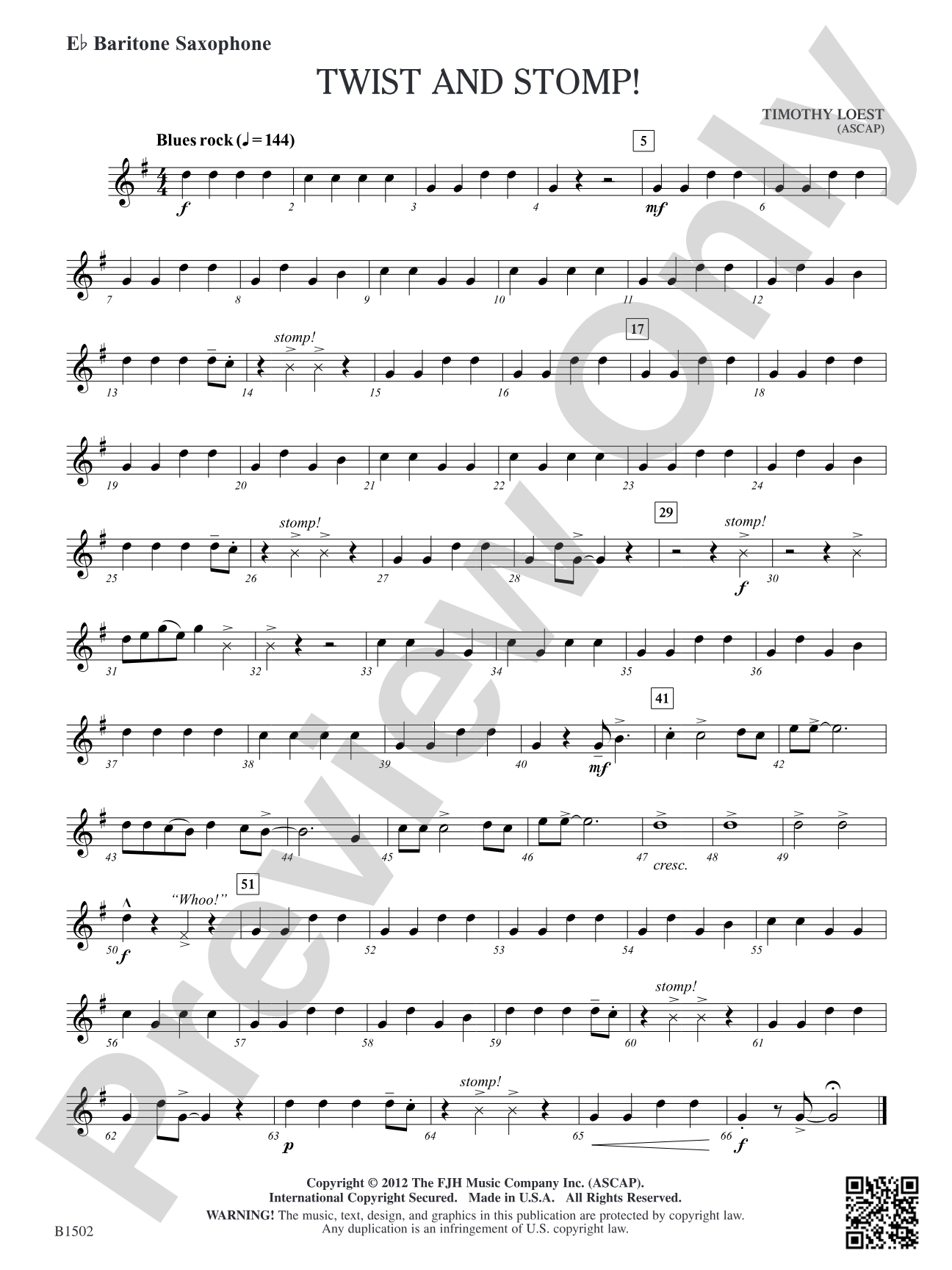
Twist and Stomp!: E-flat Baritone Saxophone

By Timothy Loest

Grade: 1.5

Item: 98-PC-DB1502_BTX

Digital Download
$7.00
Description
It's time to rock 'n' roll doo-wop style! Get your audience twisting and your band stomping with this fun twelve-bar blues reminiscent of hits from the 1950s and 1960s. Come on band, let's twist and stomp!

Don't just read it, hear it, play along with it, and watch your students grow with it. In MakeMusic Cloud, Twist and Stomp!: E-flat Baritone Saxophone comes alive with professional accompaniment, adjustable tempo, and built-in practice tools that turn solo practice into real progress.

Sample Audio
0:00
0:00
Sample Video
Additional Details
Series: FJH Developing Band
Publisher: The FJH Music Company, Inc.
SKU: 98-PC-DB1502_BTX

More about this title

About the Composer: Timothy Loest

Timothy Loest

Timothy Loest has shaped young band programs across the country through decades of classroom experience and prolific compositional output. His work balances accessibility with musical substance, earning recognition at state and national levels; in 2017, his composition Cloud Gate (Reflections of a City) was performed for over 5,000 spectators at Chicago's Millennium Park, the same year he received the Illinois Grade School Music Association's Cloyd Myers Memorial Award for Excellence in Music Education.

Loest's catalog spans publications with major houses including C.L. Barnhouse, FJH Music Company, and MakeMusic Publications, and he founded Fanfare Music Press in 2022 to continue advancing composition and arrangement quality for band. His pedagogical reach extends through collaborations on best-selling methods such as Measures of Success and Warm-ups and Beyond. A graduate of Illinois State University and Northwestern University, he taught for his entire career at F.E. Peacock Middle School in Itasca, Illinois, and continues to accept commissions through his website.

Why we love this

Loest captures the infectious energy of early rock and roll in a package that Grade 1.5 bands can execute with confidence and joy. The twelve-bar blues foundation keeps the harmonic structure predictable while the doo-wop styling and stomp rhythms give students something genuinely fun to perform, not just an exercise to survive.

What to expect

Twist and Stomp! swings with the infectious spirit of a 1950s sock hop, all hand claps, blues shuffle, and unbridled fun. The band rocks in unison one moment and locks into a steady groove the next, capturing that era when rock and roll was still a novelty and audiences couldn't help but move.

Who it's for

Beginning and developing concert bands ready to move beyond fundamentals into stylistic territory. This piece lets Grade 1.5 ensembles discover groove, articulation, and rhythmic swagger without technical demands that obstruct the fun.

How to get the most out of it

  • Lock the pulse of the blues shuffle early in rehearsal so the rhythmic swing feels natural rather than forced; have students internalize the 'swing feel' before layering the stomp parts.
  • Balance the melody with the stomp accompaniment so the blues phrase remains clear; the novelty comes from the groove, not from burying the tune.
  • Encourage a relaxed, confident attitude from the ensemble; this style lives in the pocket, not in precision perfection.
  • Feature the rhythmic kick of the stomp passages by keeping dynamics balanced across the entire band so no section overwhelms the groove.

How to use it

Program this as an audience favorite in a fall or spring concert where you want to showcase the lighter side of your band's musicianship and remind the audience (and students) that concert band repertoire can swing and groove. Its accessibility also makes it an excellent choice for educational outreach or community performances where non-traditional audiences need an invitation into the band's world.

Skills your students will build

  • Blues harmonic structure and twelve-bar form
  • Swing feel and rhythmic nuance in a popular style
  • Dynamic balance between melody and accompaniment
  • Articulation and style appropriate to rock and roll idiom
  • Ensemble cohesion through rhythmic synchronization

You May Also Like