
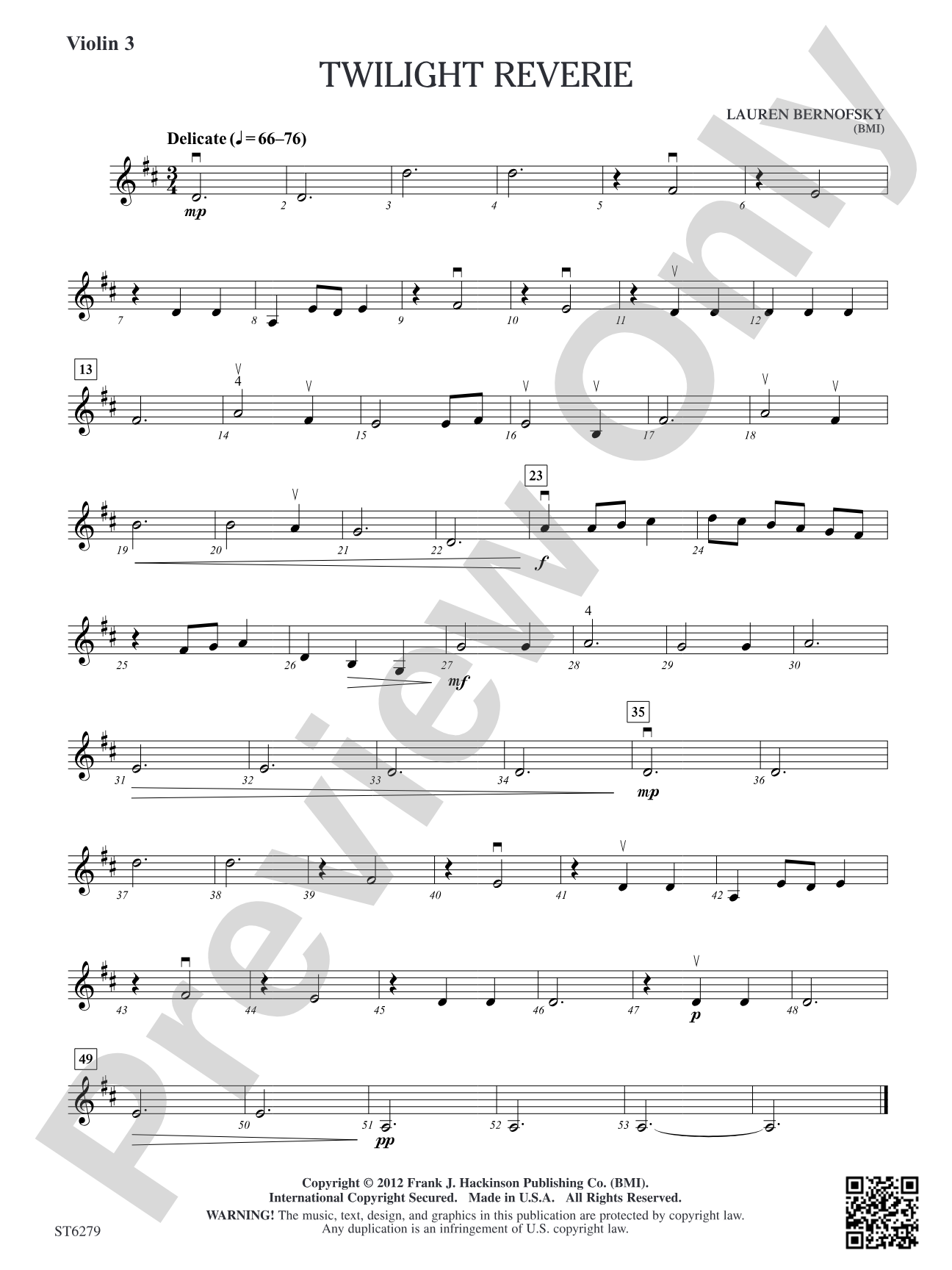

Twilight Reverie: Violin 3 (Viola T.C.)
By Lauren Bernofsky
Grade: 1.5
Item: 98-PC-DST6279_VN3
$7.00
Pickup currently not available
Description
This wistful and dreamy piece explores colorful harmonies and expressive melodies in an accessible setting. Lyrical lines seem to float in mid air as the color of the work moves from subdued to bright and focused. Engaging and compelling.


Twilight Reverie: Violin 3 (Viola T.C.) isn't in MakeMusic Cloud just yet...but it could be. Let us know you'd like to see it, and you'll help shape what comes next. In the meantime, start a free trial and dive into thousands of interactive titles your students can play along with today.
Request This Title
Tell us you want it.
Start Your Free Trial
Explore everything that's ready to play right now.
Sample Audio
1
Audio File
--:--
0:00
0:00
Sample Video
No sample videos found.
Additional Details
Series:
FJH Beginning Strings
Publisher:
The FJH Music Company, Inc.
SKU:
98-PC-DST6279_VN3
More about this title
About the Composer: Lauren Bernofsky

Lauren Bernofsky is a prolific composer whose works span solo repertoire, chamber music, choral literature, and large-scale orchestral forms including opera, ballet, and film scores. Recognized by conductor Lukas Foss as "a master composer," her music has earned significant recognition, including the National Flute Association's Newly Published Music Competition for her Sonatine and the Opera Puppets Award at Boston Metro Opera for her opera Mooch the Magnificent. Her compositions have been commissioned by ensembles ranging from The Del Mar Trio to The Bloomington Symphony, and her choral work Prayer of Shantideva, winner of the Dalai Lama Composition Contest, was premiered at a prayer service attended by the Dalai Lama himself.
Bernofsky holds degrees from The Hartt School (Bachelor's in violin and composition), New England Conservatory (Master's in composition), and Boston University (Doctorate of Musical Arts in composition). She has taught at the Peabody Institute and Interlochen Center for the Arts, and her works have been featured on PBS and in publications of the International Trumpet Guild. Her music is described as striking "a fantastic balance between the emotional and intellectual; technical and lyrical side of 21st Century composition."
Why we love this
Bernofsky crafts a piece that feels genuinely expressive without demanding technical heroics from young players. The accessible Grade 1.5 scoring lets students focus on shaping long lines and responding to harmonic color shifts, building musicianship through the work itself rather than through struggle. It's the kind of piece that sounds and feels like "real music" in the hands of a developing orchestra.
What to expect
Twilight Reverie inhabits a reflective, impressionistic soundworld where melodies seem to drift without gravity. The piece moves gradually from quieter, more introspective colors toward brighter, more focused moments, creating an arc that feels both intimate and inevitable. Listen closely and you'll hear how Bernofsky's harmonies shift the emotional temperature while the melodic ideas remain recognizable and lyrical.
Who it's for
Young string orchestras developing sensitivity to harmonic color and long-line phrasing will find genuine artistic challenge here without technical barriers. This score works for groups preparing for contests or festivals, or for any conductor seeking a piece that teaches musicianship while remaining accessible to Grade 1.5 players.
How to get the most out of it
- Shape the opening melody by thinking in longer phrase units rather than measure-to-measure. Even at this level, students can sustain a musical idea across 4 or 8 measures if you clarify where the phrase breathes.
- Use dynamic contrast to highlight the harmonic movement from subdued to bright. Let students hear how the same melodic gestures feel different when surrounded by richer or sparser harmony.
- Balance the "floating" lyrical lines by checking that accompanying voices stay transparent. Young string players often press too hard on sustained notes; lighter bow pressure here creates the dreamlike quality the score describes.
- Work the transition points between harmonic sections carefully in sectionals. Even brief shifts in color need rhythmic precision and tonal unity from each section to register effectively.
How to use it
This piece sits beautifully in a concert program as a contrasting moment between more energetic works, or as an opening that sets a thoughtful, artistic tone. Consider pairing it with a more rhythmic or driving piece by the same composer to show range, or program it alongside other accessible but harmonically interesting works that cultivate audience appreciation for young ensembles' growing musicianship.
Skills your students will build
- Sustaining long melodic lines without mechanical phrasing
- Listening to and responding to harmonic color and dynamic nuance
- Balancing accompaniment voices to maintain transparency and blend
- Understanding formal structure through harmonic motion (movement from subdued to bright)
- Ensemble precision during harmonic transitions and sectional shifts