
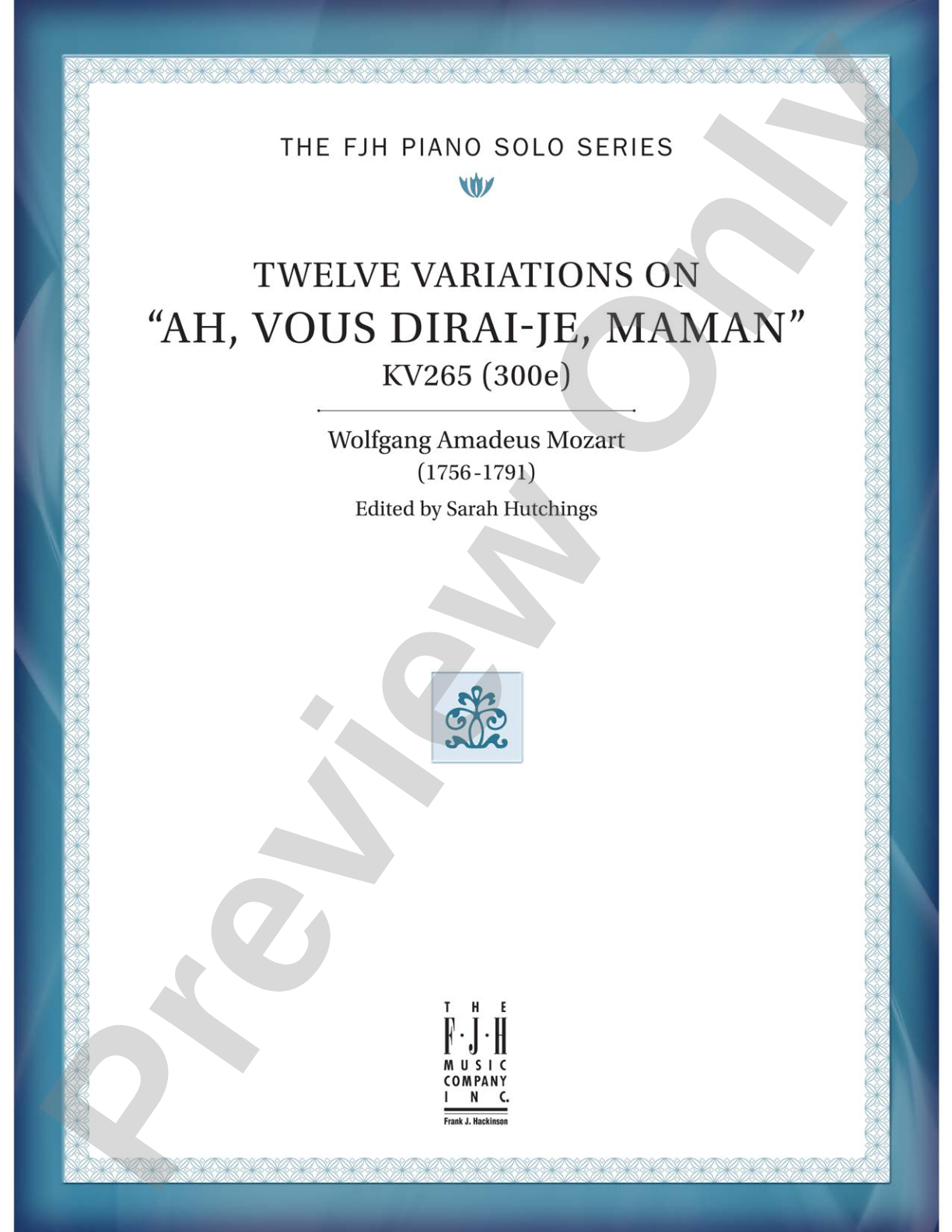

Twelve Variations on "Ah, vous dirai-je, Maman": Piano
By Wolfgang Amadeus Mozart / ed. Sarah Hutchings
Item: 98-DPS1032
$6.95
Pickup currently not available
Related Items
Twelve Variations on "Ah, vous dirai-je, Maman": Piano Book |
$6.95
|
View |
Description
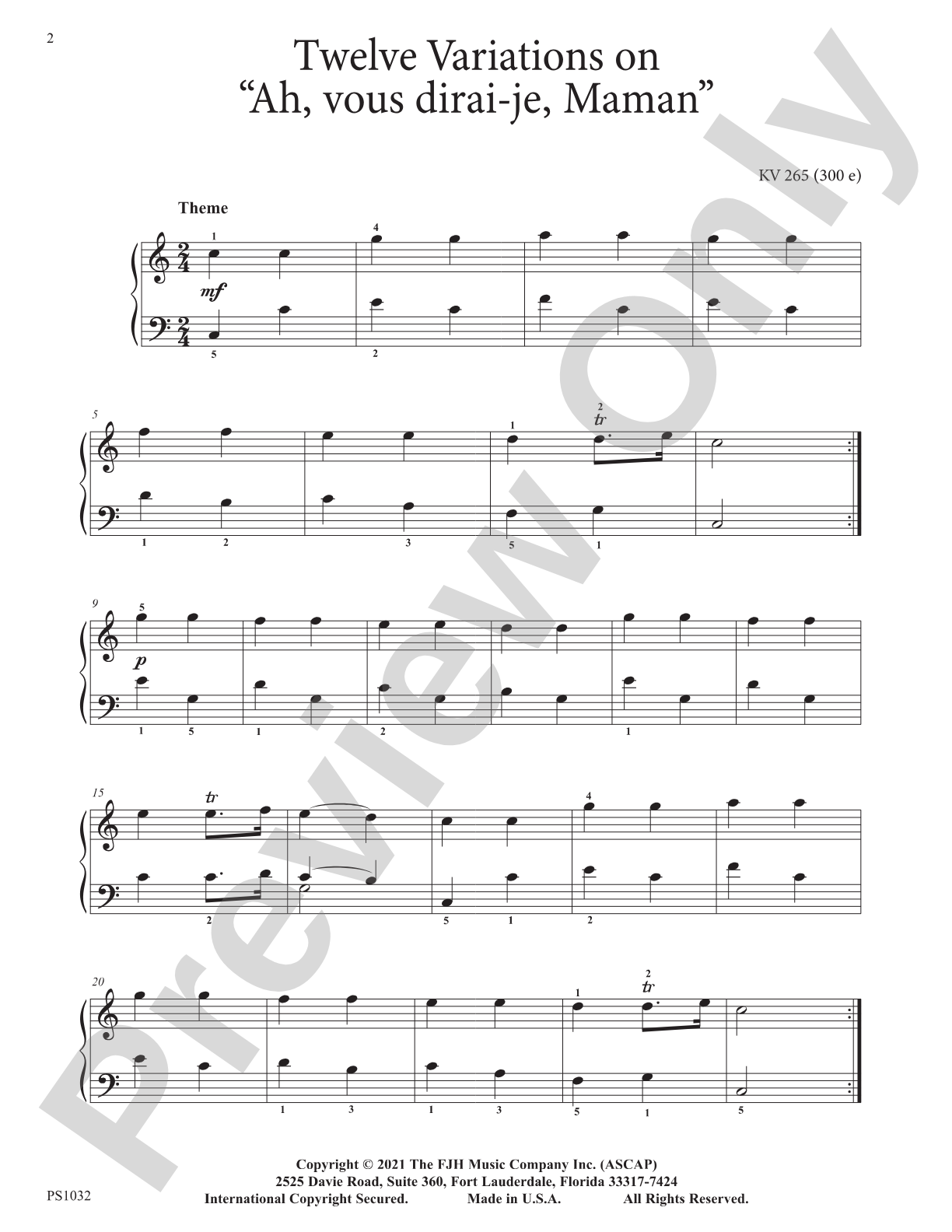
A new edition of Mozart's famous theme and variations on the well-known tune, "Twinkle, Twinkle, Little Star." Entitled, "Ah, vous dirai-je, Maman," or "Ah, shall I tell you, Mama," with 13 variations, this edition is suited for Late Intermediate to Early Advanced students wishing to study a legendary tune that all piano students should know.


Twelve Variations on "Ah, vous dirai-je, Maman": Piano isn't in MakeMusic Cloud just yet...but it could be. Let us know you'd like to see it, and you'll help shape what comes next. In the meantime, start a free trial and dive into thousands of interactive titles your students can play along with today.
Request This Title
Tell us you want it.
Start Your Free Trial
Explore everything that's ready to play right now.
Sample Audio
No sample audio found.
Sample Video
No sample videos found.
Additional Details
Series:
The FJH Piano Solo Series
Publisher:
The FJH Music Company, Inc.
SKU:
98-DPS1032
More about this title
About the Composer: Wolfgang Amadeus Mozart
Wolfgang Amadeus Mozart (1756-1791) was an Austrian composer whose prolific output shaped the Classical era. Born in Salzburg, he began composing and performing publicly as a child prodigy, eventually settling in Vienna where he produced symphonies, concertos, operas, and chamber works that remain central to the concert repertoire and music education worldwide.
Mozart's ability to write idiomatically for each instrument while maintaining elegant melodic lines makes his music particularly valuable for teaching. His variations, especially those based on simple, recognizable melodies, demonstrate how a composer can explore harmonic and textural possibilities without abandoning clarity—a lesson pianists of every level benefit from studying.
Why we love this
This work sits at exactly the right difficulty sweet spot for students ready to move beyond early intermediate fare but still building technical security. The familiar tune provides immediate musicality and engagement, while the variations themselves offer a masterclass in compositional craft: each one introduces a fresh idea without overwhelming the player with arbitrary difficulty, and the progression through all thirteen variations gives students a satisfying sense of extended musical exploration.
What to expect
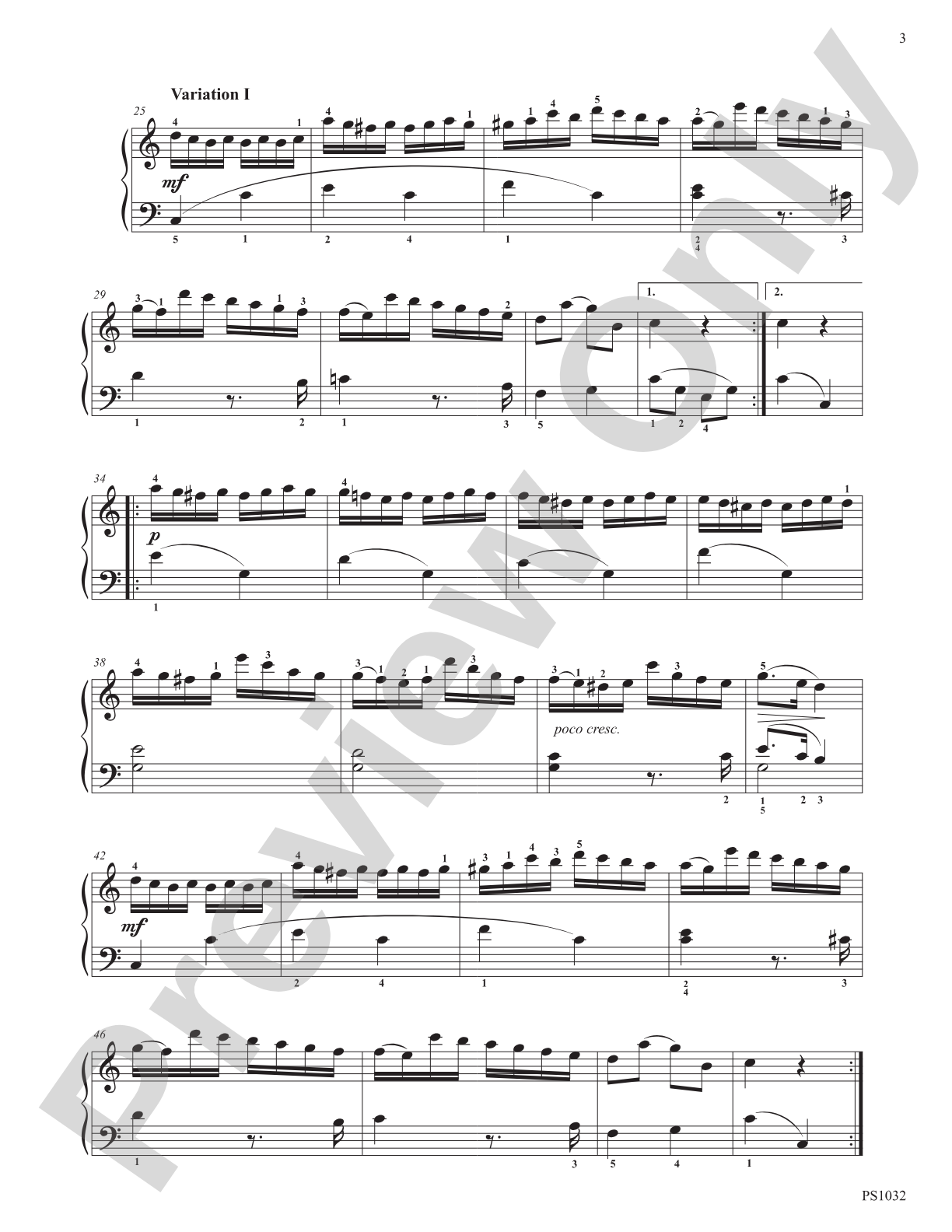
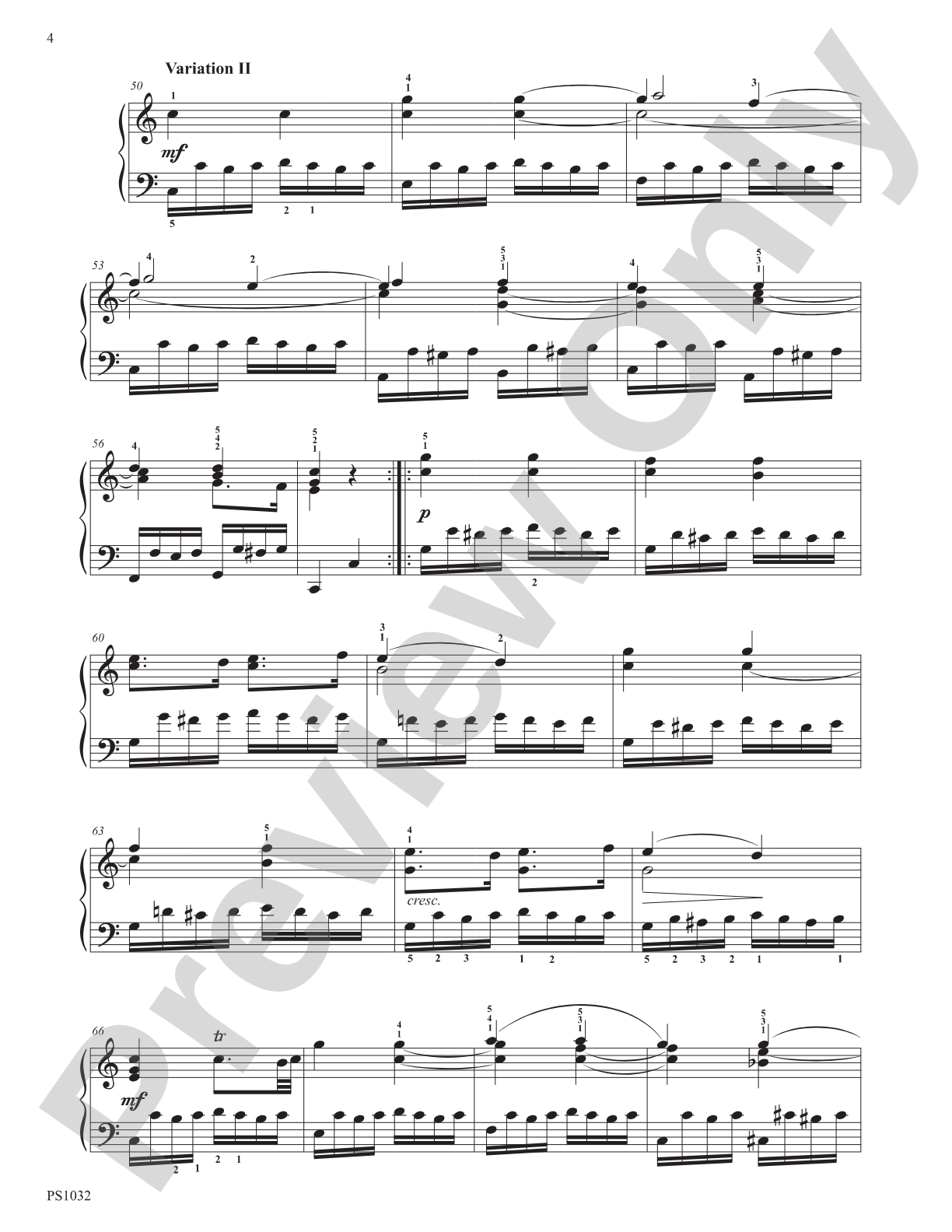
The theme arrives with disarming simplicity, almost like a musical conversation opening with a familiar greeting. As variations unfold, the piece becomes a series of creative transformations: playful figuration dances across the keyboard, the melody shifts into unexpected registers and harmonies, and moments of virtuosity emerge naturally from the music itself rather than feeling imposed. Throughout, there remains an underlying elegance that keeps even the most elaborate passages grounded in clarity.
Who it's for
Late intermediate to early advanced pianists seeking substantial repertoire that balances technical growth with musical substance. Students preparing for upper-level jury exams or recitals will find this a prestigious choice that demonstrates both technical ability and interpretive maturity.
How to get the most out of it
- Establish a clear mental tempo before beginning; the theme's straightforward character will ground your interpretation for all variations to follow
- Treat each variation as its own piece with distinct character and voicing. Resist the urge to rush through technically simpler variations; phrasing and tone color matter as much as speed
- Listen critically to the harmonic movement beneath faster passagework. Many variations preserve the original harmonic scheme while transforming the surface; this awareness prevents empty virtuosity
- Pay attention to Mozart's original articulation and dynamic markings rather than adding your own interpretive layer. His sparse notation often speaks more forcefully than additional expression
How to use it
Program this as a bridge piece that appeals to audiences across ages and backgrounds. Its fame as the melody underlying "Twinkle, Twinkle, Little Star" makes it immediately accessible, while the compositional sophistication satisfies musicians who know Mozart's stature. It works beautifully on a recital where you want a substantial solo that feels both polished and engaging.
Skills your students will build
- Navigating extended variation form while maintaining musical coherence
- Playing rapid passagework with clarity and control across multiple registers
- Balancing melody and accompaniment in different hand positions
- Interpreting Classical-era articulation and ornamentation
- Sustaining listener engagement over an extended single-movement work