Twelfth of Never Sheet Music Preview

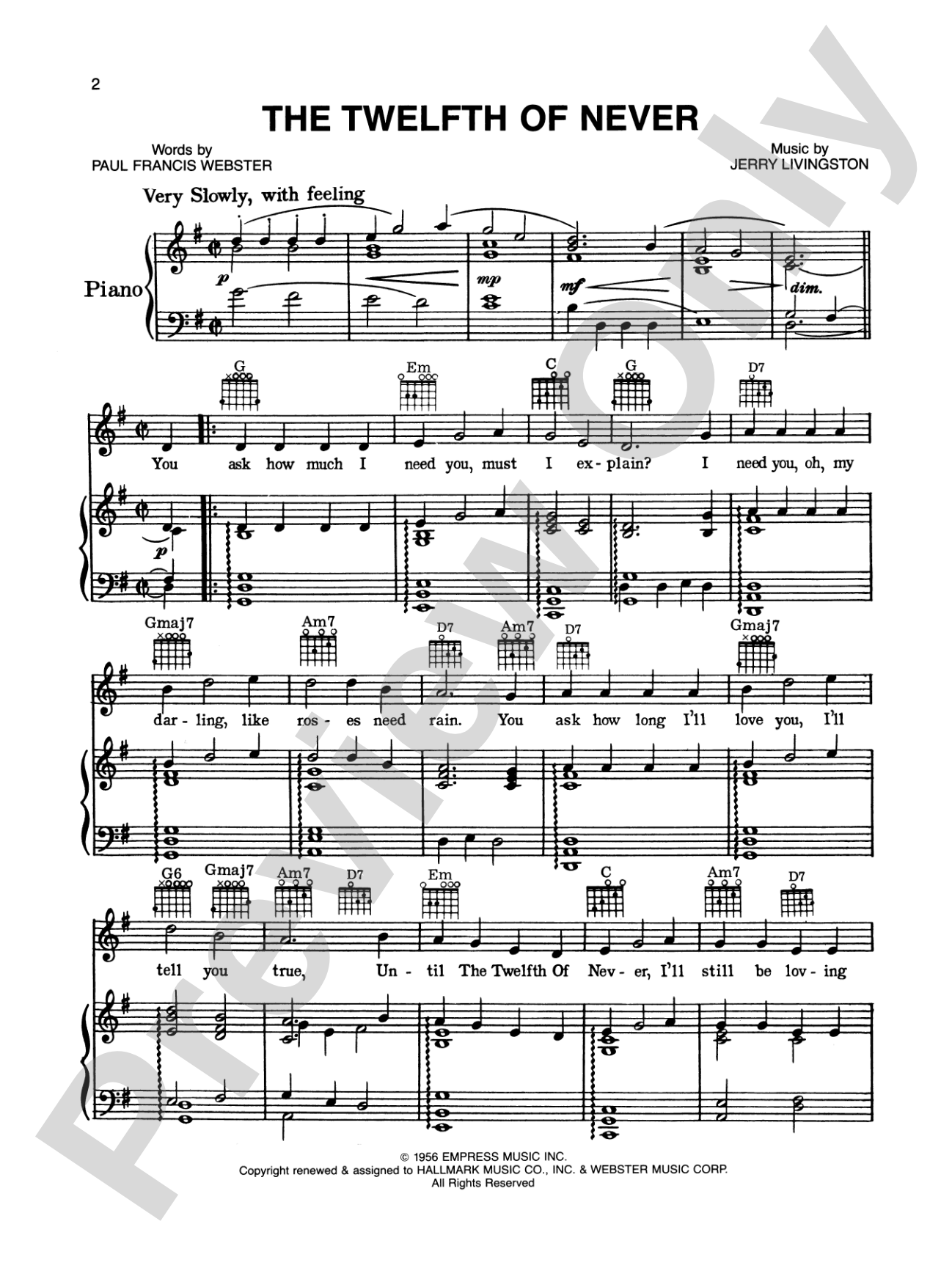
Twelfth of Never: Piano/Vocal/Chords

Lyrics by Paul Francis Webster, music by Jay Livingston

Item: 00-PIP-000141

Digital Download
$3.99
Description

Twelfth of Never: Piano/Vocal/Chords isn't in MakeMusic Cloud just yet...but it could be. Let us know you'd like to see it, and you'll help shape what comes next. In the meantime, start a free trial and dive into thousands of interactive titles your students can play along with today.

Sample Audio
No sample audio found.
Sample Video
Additional Details
Series: Deluxe Edition
Publisher: Alfred Music
Page Count: 4
SKU: 00-PIP-000141

More about this title

About the Composer: Jay Livingston

Jay Livingston (1915-2001) was an Oscar-winning composer and lyricist who shaped the sound of American popular music across film, television, and Broadway. Known for his gift for melody and his collaborative work with lyricist Ray Evans, Livingston created some of the most enduring standards of the 20th century, including "Mona Lisa," "Que Sera, Sera," and "Silver Bells." His music has become central to the jazz standards and pop vocal repertoire taught in music education settings.

Livingston's approach to songwriting emphasized singable, memorable melodies that work equally well in intimate vocal settings and large orchestral arrangements. For music teachers and vocalists, his compositions offer accessible entry points into American songwriting tradition while maintaining the harmonic sophistication and emotional depth that make them rewarding to perform.

Why we love this

This standard sits in that sweet spot where sophisticated harmony meets genuine accessibility. The lead sheet format gives singers and pianists room to interpret the melody and shape the phrasing in ways that feel personal, making it ideal for teaching stylistic choices and vocal interpretation without rigid arrangements constraining the learning process.

What to expect

There's a wistful, romantic quality to this melody that lingers. The phrasing feels almost conversational, with natural rises and falls that invite emotional interpretation and allow the lyrics to carry weight. The harmony supports the melody without overwhelming it, creating space for both voice and piano to shine.

Who it's for

This lead sheet works for vocalists preparing for jazz standards classes, recitals, or auditions; pianists accompanying student singers; and anyone studying American songwriting and pop standards from the mid-20th century. It's also valuable for students learning to read and interpret chord symbols in a real-world performance context.

How to get the most out of it

  • Pay attention to the lyrical quality of the melody line; each phrase should breathe naturally rather than rushing through the bar. The piano and vocal parts should feel conversational.
  • Use the chord symbols to explore different voicings in the piano part. Try inverting chords and adding color (ninths, thirteenths) appropriate to your performance style.
  • Treat the title phrase as the emotional anchor of the song. Make sure the piano and voice are locked into the same tempo and articulation when that key moment arrives.

How to use it

Include this in a concert exploring American standards or a showcase of music from classic film. It pairs naturally with other Livingston compositions or with other mid-century pop standards. This works equally well as a solo feature for a vocalist or as a collaborative piece that highlights student pianist-vocalist partnerships.

Skills your students will build

  • Reading and interpreting lead sheet chord symbols
  • Vocal phrasing and lyrical interpretation
  • Piano accompaniment voicing and improvisation
  • Understanding song form and melodic structure in standards
  • Collaborating between voice and piano parts

You May Also Like