Tweet Fatigue: 2nd B-flat Trumpet Sheet Music Preview

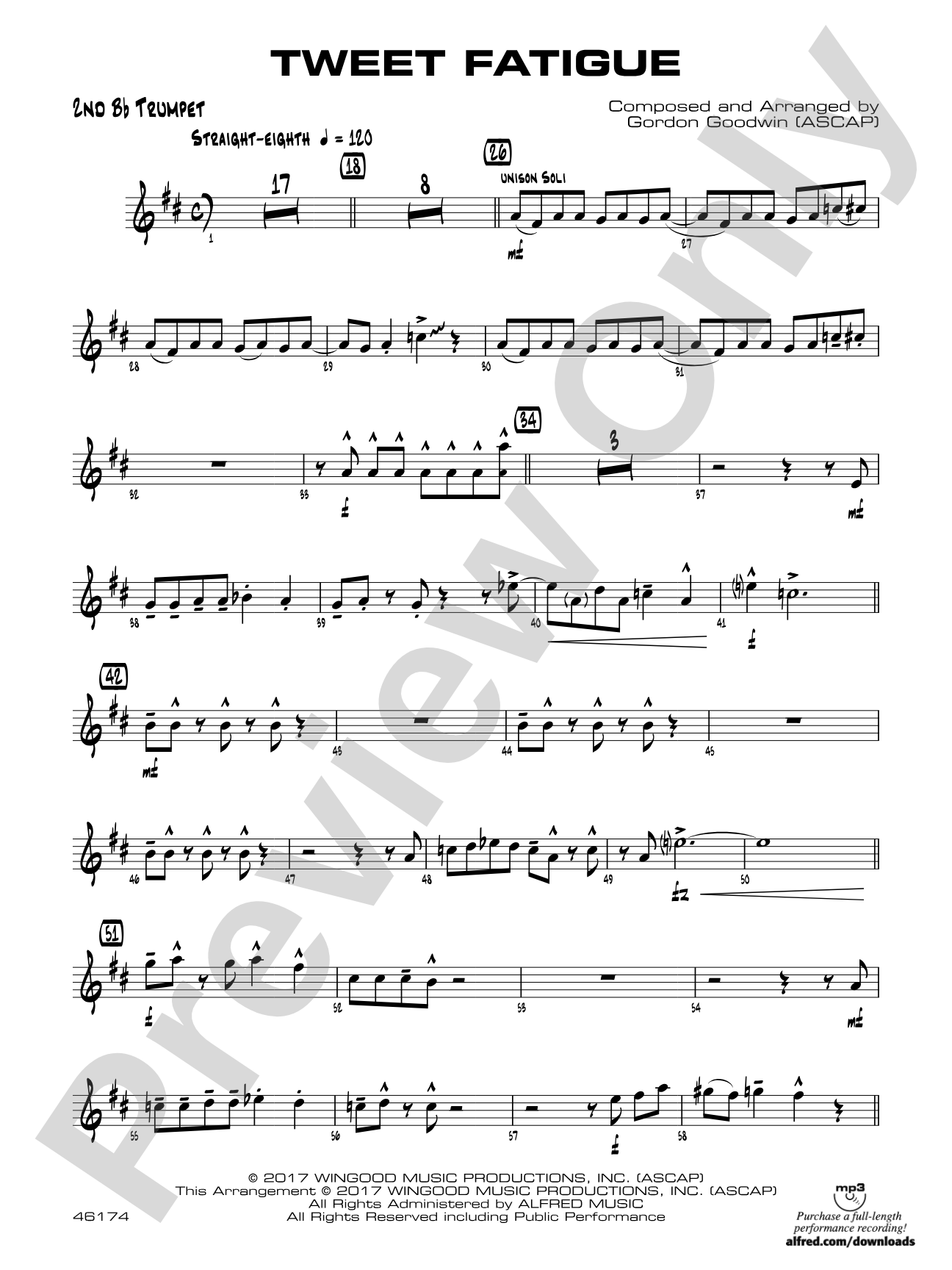
Tweet Fatigue: 2nd B-flat Trumpet

By Gordon Goodwin

Grade: 3.5 (Medium)

Item: 00-PC-0017763_T2

Digital Download
$3.00
Description
Gordon scored this superb chart for a good high school jazz ensemble to be played around 126 BPM with a straight-eighth feel into a rock groove. The saxes start things off acapella then things heat up in a quirky but clever "Goodwin" way. Solo space is provided for a variety of players with separate sample solos provided for C, B-flat, E-flat, and trombone soloists. An auxiliary percussion part plus all the usual optional parts plus vibes are included. (5:35)

Don't just read it, hear it, play along with it, and watch your students grow with it. In MakeMusic Cloud, Tweet Fatigue: 2nd B-flat Trumpet comes alive with professional accompaniment, adjustable tempo, and built-in practice tools that turn solo practice into real progress.

Sample Audio
0:00
0:00
Sample Video
Additional Details
Series: Jazz Band Series
Publisher: Alfred Music
Page Count: 116
SKU: 00-PC-0017763_T2

More about this title

About the Composer: Gordon Goodwin

Gordon Goodwin

Gordon Goodwin began composing full-fledged pieces before kindergarten, transcribing complete works rather than isolated fragments. His first big band arrangement, Hang Loose, emerged when he was just thirteen years old. This early mastery led to work in television and film scoring, where he earned three Emmy Awards and Grammy nominations for projects including Bad Boys II, Con Air, Gone in 60 Seconds, and Remember the Titans.

Goodwin has written for and performed alongside major artists including Christina Aguilera, Quincy Jones, David Foster, Ray Charles, and Sarah Vaughn. He has conducted major symphony orchestras across North America and Europe. Since 2000, he has led Gordon Goodwin's Big Phat Band, a Los Angeles-based ensemble whose albums have earned multiple Grammy nominations and pioneered formats like DVD audio recording.

Why we love this

Goodwin's writing style is instantly recognizable: clever harmonic turns, quirky ensemble textures, and infectious groove that keeps students engaged without condescending to them. The straight-eighth feel into rock groove gives this chart genuine contemporary energy while the acapella saxophone introduction immediately captures attention and sets up the ensemble for success.

What to expect

Tweet Fatigue opens with spare, angular saxophone writing that feels like a conversation among sections before erupting into a groove-heavy rock feel. Goodwin's quirky harmonic language keeps the ear engaged throughout, making the five-and-a-half-minute duration feel both economical and substantial.

Who it's for

High school jazz ensembles with solid fundamentals and at least one section of capable soloists. The Grade 3.5 difficulty demands clean articulation and harmonic awareness, making this ideal for groups that have moved beyond basic jazz reading into interpretation and groove.

How to get the most out of it

  • Lock the straight-eighth feel from the very beginning of the sax introduction; this establishes the groove's foundation before the rhythm section enters.
  • Balance the saxophone voicings carefully during the opening passage so each voice projects without muddying the chord colors.
  • Work with your rhythm section to nail the pocket around 126 BPM; the rock groove demands precision but also pocket space for the soloists.
  • Assign sample solos strategically among your section players and have backups prepared so multiple students experience solo time.

How to use it

This works beautifully as a concert closer or standout mid-set selection where you want contemporary energy without sacrificing musical substance. Pair it with one or two other Goodwin big band charts to showcase his distinctive voice across an entire set.

Skills your students will build

  • Reading and executing straight-eighth feel
  • Locking ensemble rhythm in rock-influenced grooves
  • Trading solos across multiple instrument ranges (C, B-flat, E-flat, trombone)
  • Executing quirky harmonic changes and voicing clarity
  • Managing dynamic contrast between sparse and dense ensemble textures

You May Also Like