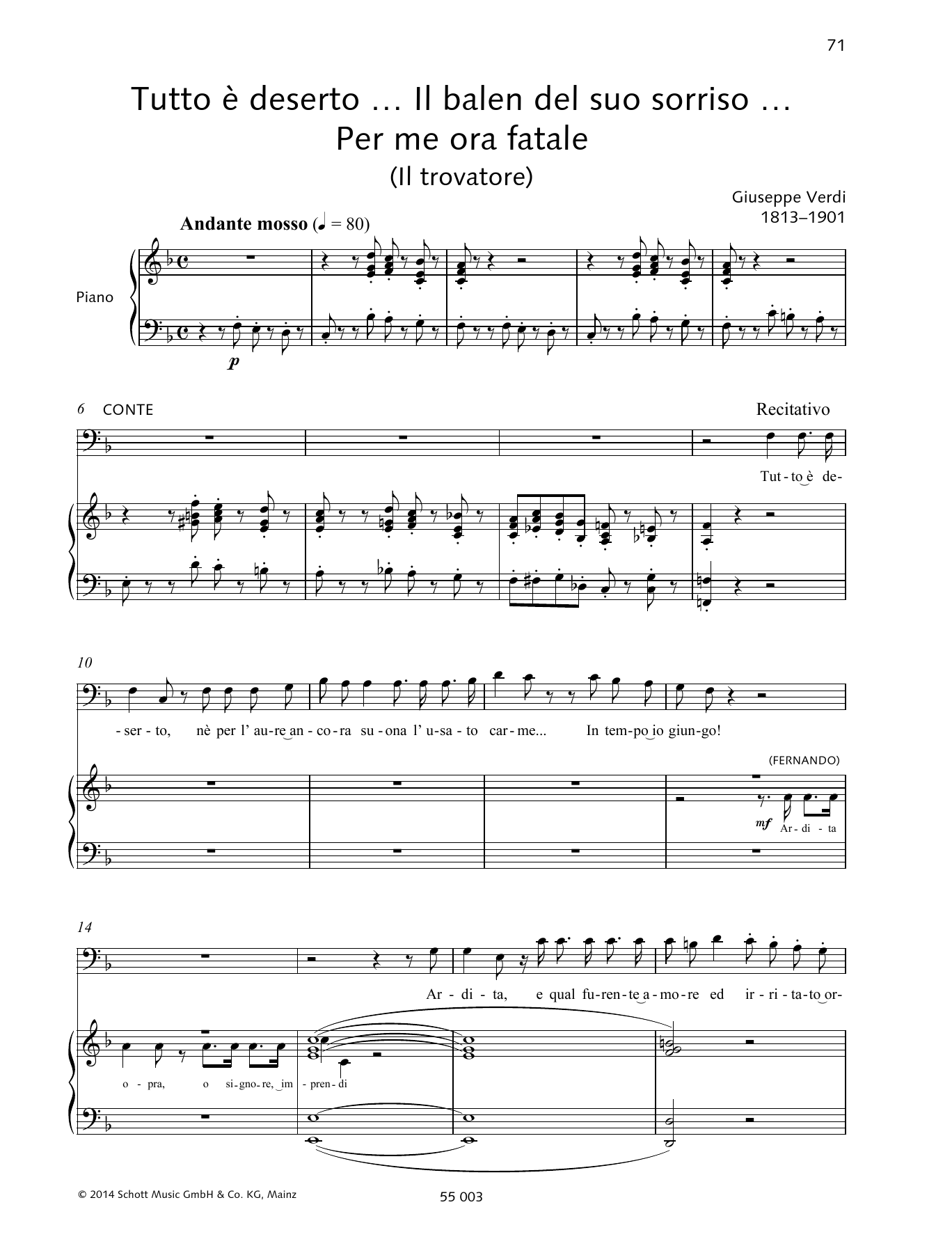
Tutto #232; deserto... Il balen del suo sorriso... Per me ora fatale Sheet Music Preview

Tutto #232; deserto... Il balen del suo sorriso... Per me ora fatale: Piano Vocal

By Giuseppe Verdi / Edited by Francesca Licciarda

Item: 35-DS00369826

Digital Download
$4.99
Description

Tutto #232; deserto... Il balen del suo sorriso... Per me ora fatale: Piano Vocal isn't in MakeMusic Cloud just yet...but it could be. Let us know you'd like to see it, and you'll help shape what comes next. In the meantime, start a free trial and dive into thousands of interactive titles your students can play along with today.

Sample Audio
No sample audio found.
Sample Video
Additional Details
Publisher: Hal Leonard
Page Count: 11
SKU: 35-DS00369826

More about this title

About the Composer: Giuseppe Verdi

Giuseppe Verdi (1813–1901) shaped opera across two continents and nearly six decades. His gift for vocal melody that serves character rather than mere display became the standard by which later composers measured themselves. In the classroom and rehearsal room, Verdi's scores remain unsurpassed teaching texts for understanding how voice, orchestra, and drama interlock.

Verdi's middle period saw him at peak command of dramatic timing. He knew exactly when to strip away accompaniment, when to build orchestral weight, and how to write for singers in a way that both honors the voice and advances the story.

Why we love this

Singers gravitate to this music because Verdi writes tessitura that demands but never punishes. The emotional arc is immediate and unmistakable; even pianists unfamiliar with the opera grasp the dramatic weight. This excerpt stands alone beautifully while also connecting singers to one of the repertoire's most essential dramatic works.

What to expect

Passionate and unsettled, moving between moments of vocal introspection and sudden emotional turbulence. The melody carries weight and urgency; phrases that soar demand real support from both singer and pianist. This is music that insists on being heard.

Who it's for

Intermediate to advanced soloists preparing arias for voice lessons, recitals, or vocal competitions. Pianists who accompany opera singers will value having this core dramatic material in accessible format. Programs seeking to include Verdi's middle period without staging a full opera.

How to get the most out of it

  • Establish a clear sense of pacing before rehearsal begins. The recitative passages need breathing room; they're not to be rushed even when tempo feels urgent.
  • Shape the lyrical sections with long-line phrasing rather than bar-by-bar attacks. Verdi's melodies reward singing across the barline.
  • Listen to multiple recordings of this scene beforehand. The vocal and interpretive choices vary widely, and singers benefit from understanding the range of valid approaches.
  • Balance transparency in the accompaniment with harmonic richness. The piano writing is deliberately reduced; use that reduction as an interpretive choice rather than accompanying by default.

How to use it

Feature this as a solo recital centerpiece when programming around the dramatic baritone voice. Pair it with art songs in other languages to show the singer's interpretive range across styles. In a teaching context, use the excerpt to demonstrate how nineteenth-century opera composers differentiated recitative from aria, and how both serve storytelling.

Skills your students will build

  • Maintaining long vocal lines through recitative and aria without losing forward motion
  • Managing extended range and dynamic shifts within a single phrase
  • Coordinating vocal expression with piano accompaniment that shifts between supporting and leading roles
  • Executing stylistically appropriate vibrato and diction in Italian
  • Building dramatic narrative understanding from a single scene rather than full opera context

You May Also Like