
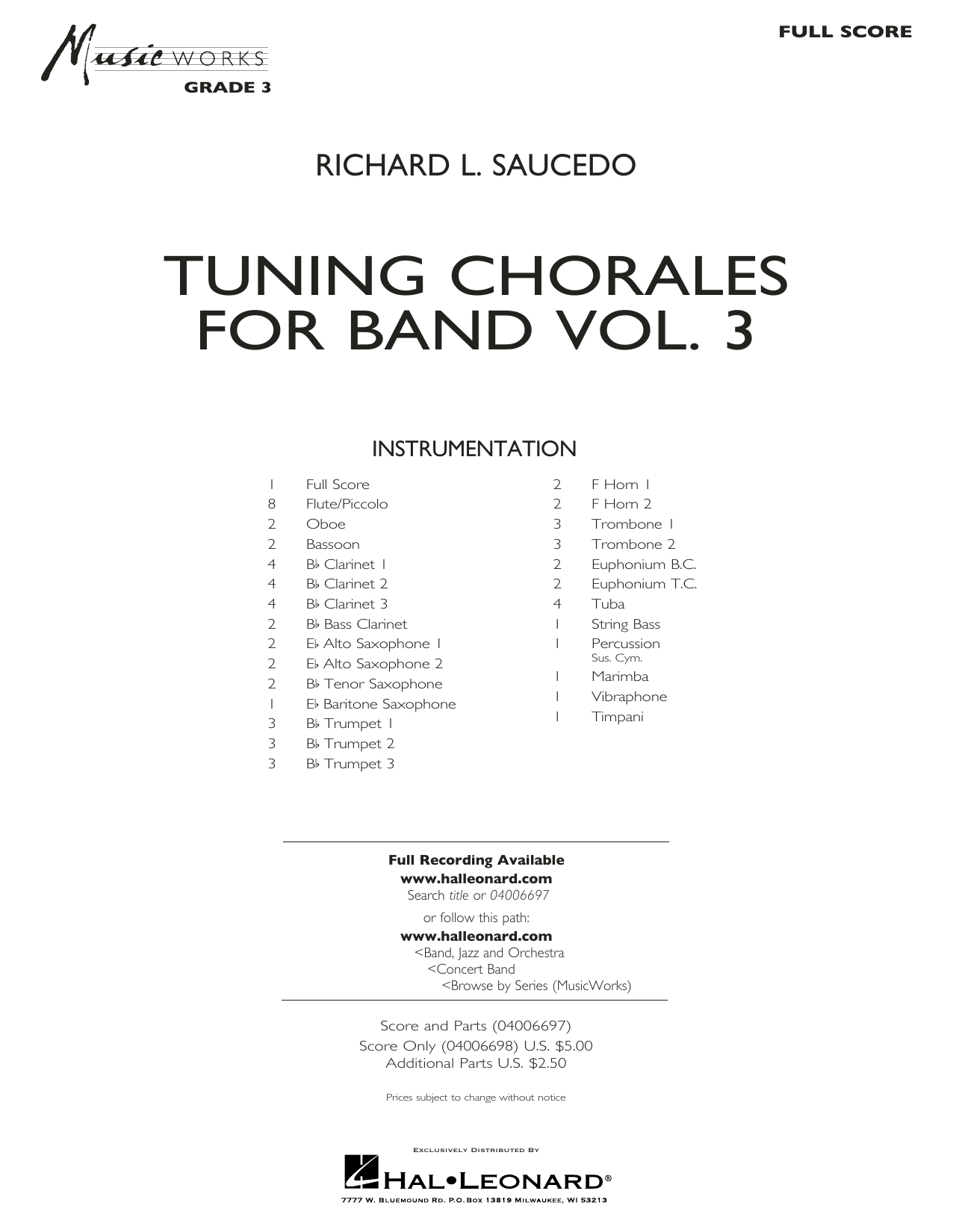

Tuning Chorales for Band Vol. 3: Concert Band Conductor Score & Parts
By Richard L. Saucedo
Grade: 3
Item: 35-PK00469747
$50.00
Pickup currently not available
Buy Extra Parts (Digital PDF Download)
Parts Added to Cart!
Description
Using the concept of drones as well as tuning hints written into both the score and parts, this volume of chorales will help students understand more of the tuning process and how it "feels" as well as how it sounds. (Keys: Db Major, C Minor, C Major)


Discover MakeMusic Cloud: thousands of interactive titles your students can play along with today.
Sample Audio
No sample audio found.
Sample Video
No sample videos found.
Additional Details
Publisher:
Hal Leonard
SKU:
35-PK00469747
More about this title
About the Composer: Richard L. Saucedo

Richard L. Saucedo directed bands at Carmel High School in Indiana for 31 years, building a program that earned consistent recognition at state, regional, and national levels. His ensembles won Indiana State Champion Concert Band honors multiple times, performed at the Music for All National Concert Band Festival, and the Carmel Marching Greyhounds claimed top-ten placements at the Bands of America Grand National Championship for 17 consecutive years, winning national titles in 2005 and 2012.
Beyond his classroom leadership, Saucedo earned recognition as Indiana's Bandmaster of the Year (1998-99) and Outstanding Music Educator (2010). He was inducted into the Music for All Hall of Fame in 2015 and the Drum Corps International Hall of Fame in 2022. As a freelance composer and arranger, he creates for marching bands, concert bands, choral groups, and orchestras. Saucedo served as Brass Arranger/Composer for the Cavaliers Drum and Bugle Corps, contributing to five DCI world championships, and currently serves as music ensemble coordinator for the Blue Devils. He holds membership in the American Bandmasters Association and serves as a Senior Educational Consultant for Music for All and Bands of America.
Why we love this
Saucedo builds tuning into the fabric of the arrangement itself rather than treating it as a separate technical exercise. The embedded drone concept makes intonation tangible for students; they feel the acoustical relationships rather than just aiming for a pitch. Your band will develop genuine ear training while working on functional Grade 3 literature.
What to expect
These chorales sit somewhere between warm-up and art music. The drones create a contemplative, focused atmosphere in the room, and students often describe the experience as calming yet deeply engaging. There is genuine satisfaction when the band hears itself lock into tune.
Who it's for
Concert bands working at Grade 3 level who want tuning instruction embedded in performance repertoire. This works especially well for programs preparing for festival or contest where clean, unified intonation is judged.
How to get the most out of it
- Assign students in unison sections to tune against the drone first, then gradually reduce its prominence as confidence grows.
- Read the tuning hints aloud during sectionals before full band rehearsal; most students respond better when they understand the acoustic principle behind each adjustment.
- Record a full run-through and listen back as an ensemble, asking students to identify spots where the intonation felt locked versus loose.
- Work the three keys (Db Major, C Minor, C Major) across separate rehearsals rather than in sequence, so students transfer tuning strategies between tonal centers.
How to use it
Rotate these throughout your season as opening pieces in rehearsal to establish a strong tuning baseline before tackling more complex repertoire. They also work well as contest selections where the clarity of intonation directly supports your adjudication score.
Skills your students will build
- Matching pitch against a sustained drone
- Recognizing and correcting sharp/flat tendencies within major and minor tonalities
- Adjusting intonation across three distinct key centers (Db Major, C Minor, C Major)
- Identifying the acoustic sensation of locked versus loose ensemble tuning
- Reading and interpreting tuning notation in both score and individual parts