Tunbridge Meadows: B-flat Tenor Saxophone Sheet Music Preview

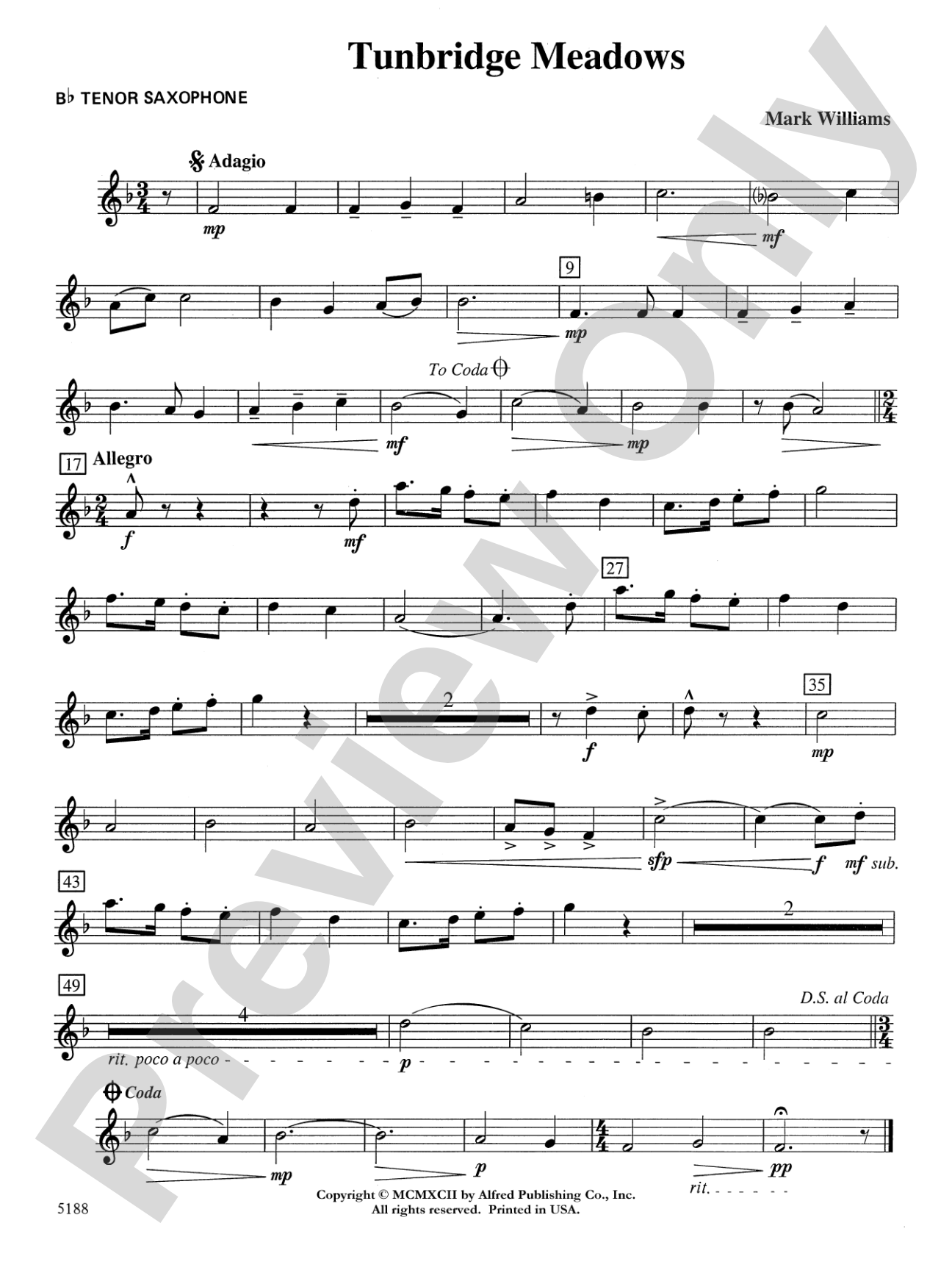
Tunbridge Meadows: B-flat Tenor Saxophone

By Mark Williams

Grade: 2 (Medium Easy)

Item: 00-PC-0001884_TX1

Digital Download
$3.00
Description
Clarinets play the hymn-like opening melody with the full ensemble scored underneath in a rich accompaniment. The first section in 3/4 has a folk quality inspiring a pastoral setting. (Grade 2) This title is available in MakeMusic Cloud.

Don't just read it, hear it, play along with it, and watch your students grow with it. In MakeMusic Cloud, Tunbridge Meadows: B-flat Tenor Saxophone comes alive with professional accompaniment, adjustable tempo, and built-in practice tools that turn solo practice into real progress.

Sample Audio
0:00
0:00
Sample Video
Additional Details
Series: Young Symphonic
Publisher: Alfred Music
Page Count: 130
SKU: 00-PC-0001884_TX1

More about this title

About the Composer: Mark Williams

Mark Williams

Mark Williams built his reputation as one of the most prolific and respected composers for school bands and orchestras, creating over 200 published works throughout his career. A native of Chicago who spent formative years in Spokane, Washington, he taught elementary band in Washington schools while earning degrees from Eastern Washington University and serving as a woodwind performer and arranger for the 560th Air Force Band.

Williams' impact extended far beyond the classroom. As a clinician and guest conductor, he traveled across 34 states, five Canadian provinces, and Australia, sharing his vision for accessible, musically rewarding band literature. He earned recognition including the Western International Band Clinic's Gralia Competition and multiple ASCAP Special Awards. Beyond composing, Williams remained an active bassoon performer and served as Conductor and Artistic Director for the Spokane British Brass Band. He was also co-author of the Accent on Achievement Band Method, a foundational resource for generations of young musicians.

Why we love this

Williams writes Grade 2 concert band music that sounds mature without requiring technical wizardry from your ensemble. The pastoral quality here, built on a hymn-like clarinet melody with rich, voice-leading accompaniment, gives students a genuine musical experience rather than a mere exercise. This is the kind of piece that reminds young musicians why they wanted to play band in the first place.

What to expect

Tunbridge Meadows evokes a quiet, sunlit pastoral landscape where a simple folk melody unfolds over gentle harmonic support. The hymn-like opening has a timeless quality that invites musicians to think beyond notes and rhythms, touching something more reflective and genuine in their playing.

Who it's for

This score is designed for Grade 2 concert bands with developing musicianship and moderate technical facility. Conductors programming festival or contest performances will find an accessible yet musically substantial work that showcases ensemble growth without demanding advanced techniques.

How to get the most out of it

  • Bring out the clarinet melody in the opening by balancing the accompanying voices underneath; they support the tune without overshadowing it.
  • Maintain consistent phrasing across the folk-quality sections so the pastoral character stays intact rather than feeling episodic.
  • Use the 3/4 meter as a guide for gentle, flowing articulation; avoid bouncy or march-like interpretations that would undercut the hymn-like quality.
  • Shape the piece with dynamic clarity between sections so that ensemble cohesion is obvious even at a young band's technical level.

How to use it

Program this as a contrasting centerpiece in a concert that might otherwise lean toward march tempo or energetic contemporary works. Its Grade 2 accessibility makes it an excellent choice for a festival program where you want to demonstrate musical maturity and ensemble balance rather than technical showmanship.

Skills your students will build

  • Balancing melodic and harmonic voices in ensemble texture
  • Phrasing in 3/4 meter with a flowing, unhurried approach
  • Listening to the ensemble while playing a supporting part
  • Sustaining tone and intonation in hymn-like, slower-moving music
  • Understanding pastoral and folk-inspired musical character

You May Also Like