
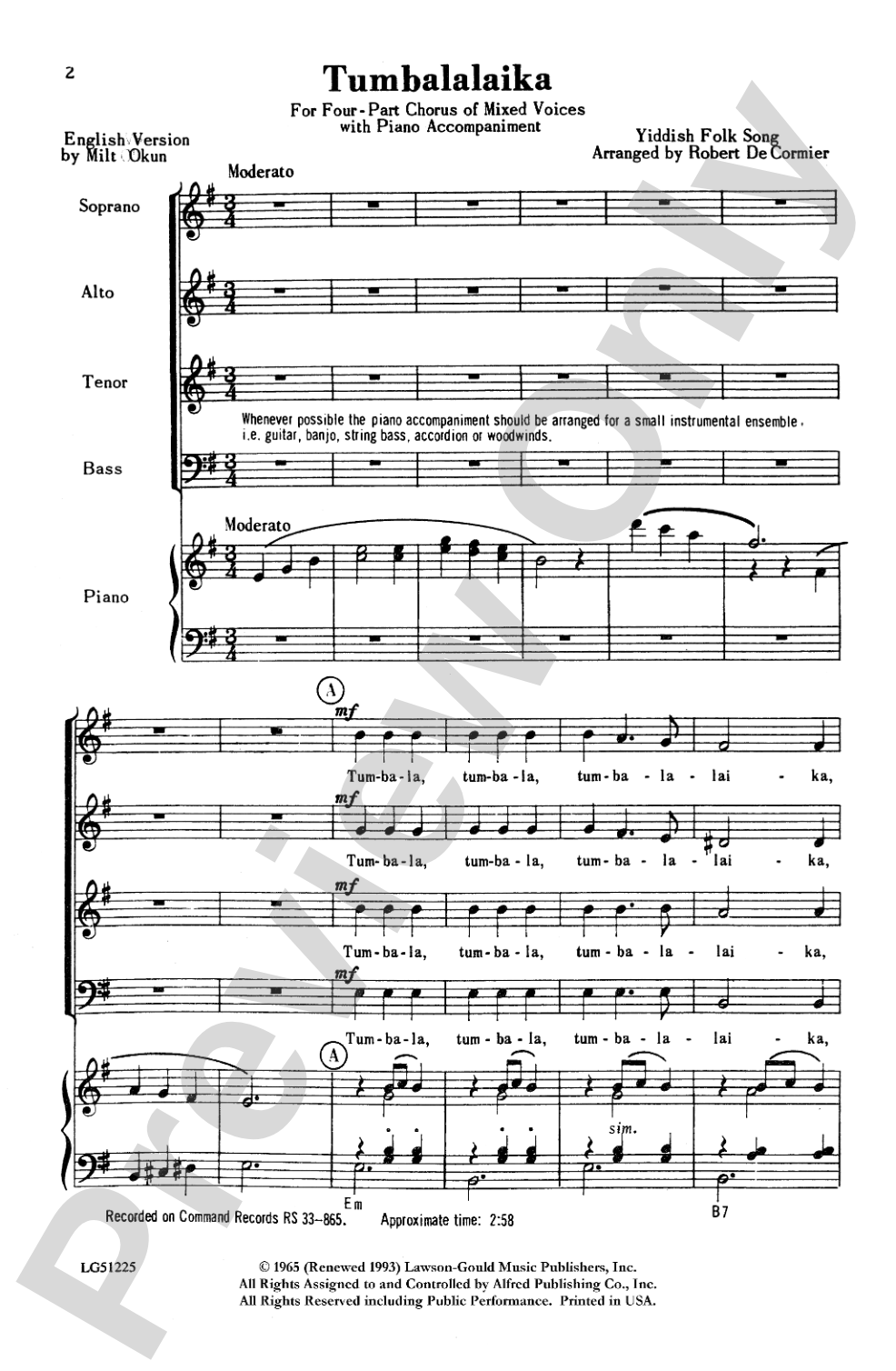
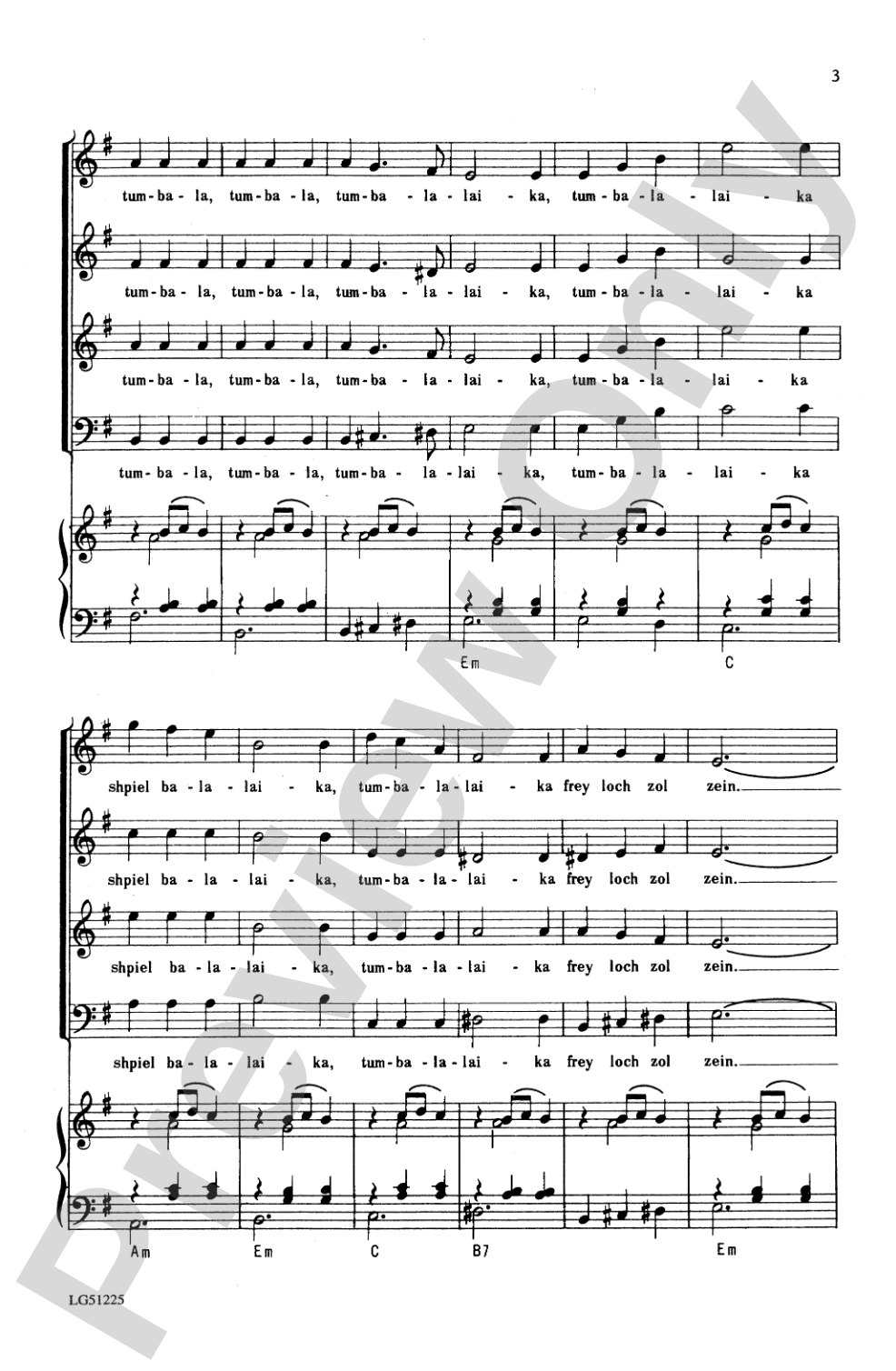
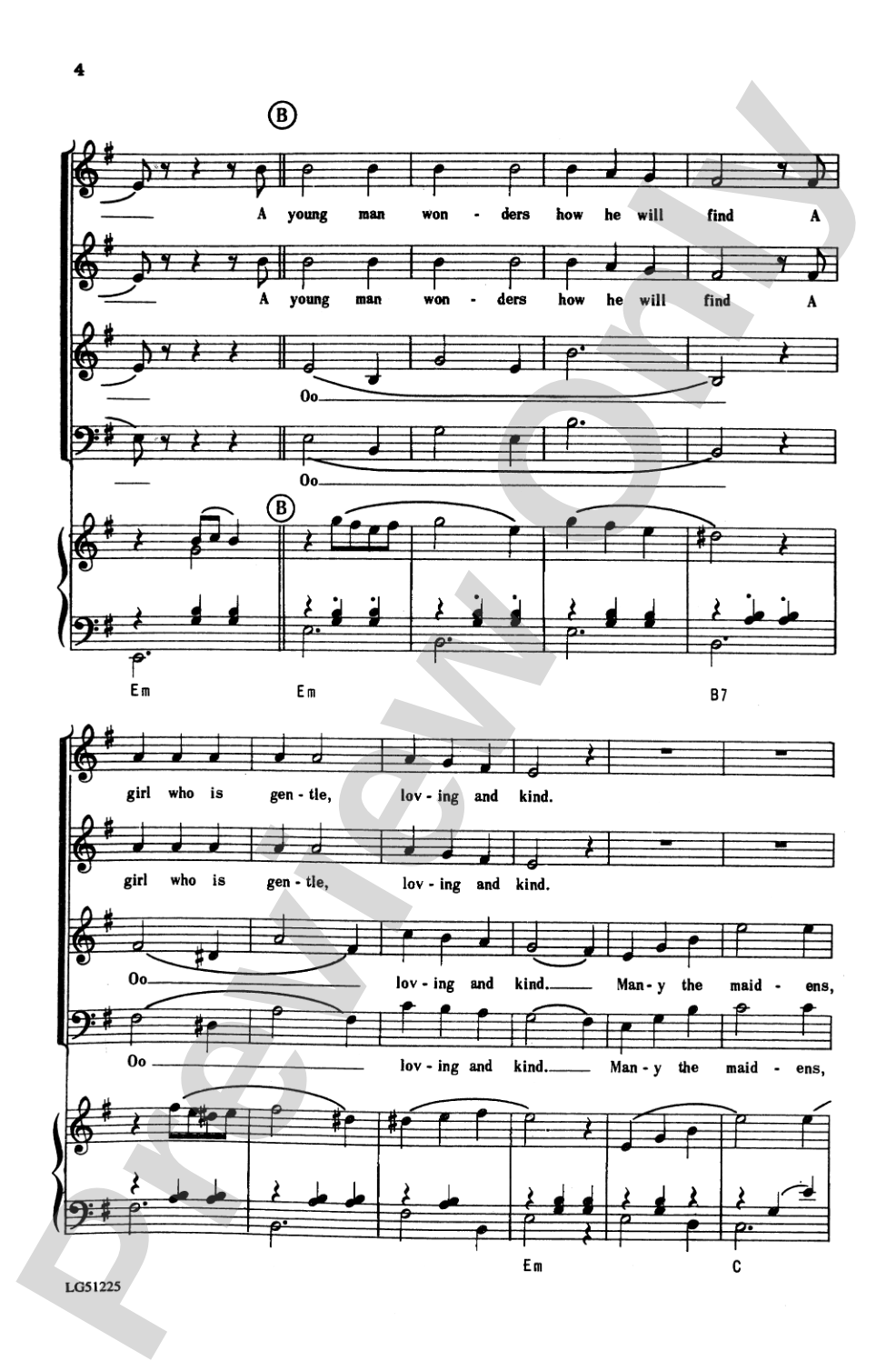

Tumbalalaika: SATB Choral Octavo
Yiddish Folk Song / arr. Robert DeCormier
Item: 00-PO-0004981
$2.25
Minimum order quantity: 20 copies
Pickup currently not available
Description


Tumbalalaika: SATB Choral Octavo isn't in MakeMusic Cloud just yet...but it could be. Let us know you'd like to see it, and you'll help shape what comes next. In the meantime, start a free trial and dive into thousands of interactive titles your students can play along with today.
Request This Title
Tell us you want it.
Start Your Free Trial
Explore everything that's ready to play right now.
Sample Audio
No sample audio found.
Sample Video
No sample videos found.
Additional Details
Series:
Alfred Archive Edition: Lawson-Gould Music Publishers
Publisher:
Alfred Music
Page Count:
12
SKU:
00-PO-0004981
More about this title
About the Arranger: Robert DeCormier

Robert DeCormier brought a lifetime of versatility to American choral music, moving fluidly between Broadway, opera, concert stages, and folk traditions. A Juilliard graduate, he served as music director of the New York Choral Society for seventeen years, worked as conductor and arranger for Harry Belafonte, and held the position of music director for Peter, Paul and Mary from 1978 to 2010. He taught conducting and ensembles at the Eastman School of Music, initiated the Vermont Symphony Orchestra Chorus, and founded the professional vocal ensemble Counterpoint, which recorded extensively and performed workshops with high school choirs across New England.
DeCormier's arranging work spanned African-American spirituals, American folk songs, and international repertoire, grounded in a deep respect for source material and accessibility. His honors include the Vermont Governor's Award for Excellence in the Arts (2002) and a Lifetime Achievement Award from the New England Choral Arts Foundation (2006). His recordings appeared on major labels including Arabesque, Centaur, and Albany Records, and his television credits range from BBC choral series to a CBS Emmy-winning special with Harry Belafonte.
Why we love this
DeCormier's arrangement honors the melody and spirit of this Yiddish folk classic while crafting vocal lines that sit naturally within an SATB range. The writing avoids unnecessary complexity, letting the singers and audience connect directly to the song's warmth and accessibility. Choirs love performing it because it feels both contemporary and deeply rooted, making it an ideal bridge between folk traditions and concert programming.
What to expect
"Tumbalalaika" arrives as a gentle, conversational song with a melody that lingers in memory. The arrangement unfolds with warmth and humor, capturing the piece's origins in Jewish folk culture while remaining universally approachable. It invites singers and listeners into an intimate space where melody and harmony interweave without pretension.
Who it's for
This arrangement suits intermediate to advanced SATB choirs seeking accessible yet genuinely musical folk repertoire. It works equally well for concert ensembles, community choirs exploring world vocal traditions, and school choirs looking to build cultural literacy alongside musicianship.
How to get the most out of it
- Establish a comfortable, conversational tempo that lets the text breathe naturally; this song thrives when it feels lived-in rather than driven.
- Balance the harmony so that the melody remains clear and singable; DeCormier's arrangement supports the tune, not obscures it.
- Attend to diction with intention, especially on the repeated "tumbalalaika" sections, allowing the playful character of the text to emerge.
- Consider adding gentle dynamics to follow the narrative arc; restraint in the middle sections makes climactic moments more impactful.
How to use it
Program this alongside other folk or world music selections to create thematic variety in a concert. It pairs well with spirituals, international art songs, or contemporary settings of traditional material, offering a moment of direct emotional connection without technical showiness. The modest length and moderate difficulty make it suitable for mid-concert placement, where it can provide both relief and warmth.
Skills your students will build
- Singing folk melody with authentic phrasing and natural text declamation
- Blending SATB harmony while maintaining melodic clarity
- Understanding and honoring cultural context in arrangement choices
- Shaping musical phrases through dynamic restraint and expressive nuance
- Collaborative ensemble singing in a smaller-scale, text-driven work