
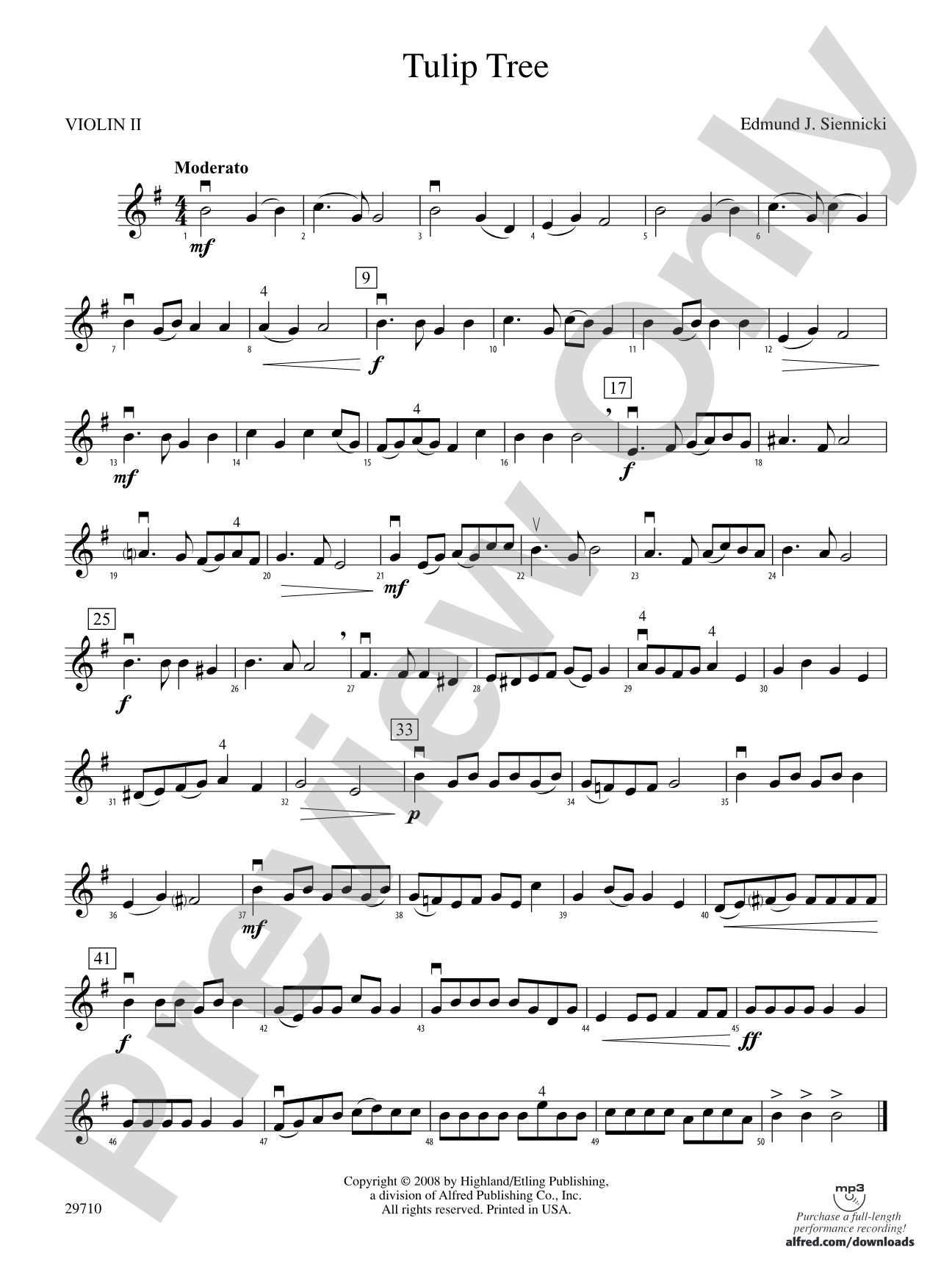

Tulip Tree: 2nd Violin
By Edmund J. Siennicki
Grade: 2
Item: 00-PC-0001564_VN2
$5.99
Pickup currently not available
Description
This charming original piece contains a myriad of learning opportunities for your young string students. Dotted quarter/eighth note rhythms, slurs that cross strings and brief excursions into the minor mode will challenge every section while improving technique. Accidentals are introduced as easy-to-teach (and to hear!) unisons for the entire orchestra. (2:25)
Correlates with Strictly Strings, Book 2, page 22.


Correlates with Strictly Strings, Book 2, page 22.
Don't just read it, hear it, play along with it, and watch your students grow with it. In MakeMusic Cloud, Tulip Tree: 2nd Violin comes alive with professional accompaniment, adjustable tempo, and built-in practice tools that turn solo practice into real progress.
Open in the Player
Jump straight in and assign it today.
Start Your Free Trial
Open this title and explore the full library in minutes.
Sample Audio
1
Audio File
--:--
0:00
0:00
Sample Video
No sample videos found.
Additional Details
Series:
Highland/Etling Strictly Strings
Publisher:
Alfred Music
Page Count:
72
SKU:
00-PC-0001564_VN2
More about this title
About the Composer: Edmund J. Siennicki

Edmund J. Siennicki grew up in Cleveland, Ohio, where a formative conversation with pianist Ignacy Jan Paderewski at age 12 set the course for his musical life. He earned his Bachelor's degree from Kent State University, where he composed Fight on for KSU, a work still performed at the university's football games. In 1994, the School of Music honored him with the Distinguished Alumnus Award.
Siennicki's formal training included an MA from Teachers College at Columbia University, where he studied composition with Herbert Elwell, explored electronic music with Sergio Barroso, and consulted with Vincent Persichetti. As a performer, he mastered both bassoon and piano. His compositional output spans roughly 200 published works, many of which have earned recognition in National School Orchestra composition contests. He has served on the faculties at Michigan and Kent State University and spent much of his career teaching in Cleveland's junior high schools. ASCAP has recognized his contributions annually for two decades. He continues to compose, visit schools, and lead clinics.
Why we love this
Siennicki writes with genuine understanding of what Grade 2 string students can achieve. The piece introduces important technical challenges—dotted rhythms, string crossings in slurs, minor mode passages—without overwhelming players, and the unison introduction of accidentals gives every section a chance to hear and internalize new pitches together before tackling them individually.
What to expect
Charming and accessible, yet purposeful. The piece moves with gentle grace, allowing younger players to feel the success of handling new challenges while listeners enjoy a complete musical thought from opening to close. Its brief excursions into minor mode add subtle color and emotional depth without drama.
Who it's for
Grade 2 string orchestras looking to build rhythmic precision and expand technical range without losing musicality. This work suits programs that follow the Strictly Strings curriculum and directors seeking concert or festival repertoire that teaches while it performs.
How to get the most out of it
- Isolate the dotted quarter/eighth figures in rehearsal before they appear in context. Have students tap the rhythm while bowing long tones, then gradually add pitch.
- When teaching the slurs that cross strings, address string changes first as separate bowing exercises, then gradually compress the rest between the string crossings.
- Use the unison passages with accidentals as teaching moments for listening. Ask students to match tone quality across the section when playing the same pitch together.
- Let the piece breathe at phrase endings. Young players often rush after completing a technical challenge; mark breath points and tempo anchors in the score.
How to use it
Program this early in a school year concert or festival to highlight technical growth across all sections, or place it in the middle of your program as a confident statement of student progress. Its moderate length and Grade 2 accessibility make it ideal for mixed-level performances where younger and more advanced orchestras share a concert.
Skills your students will build
- Dotted quarter/eighth note rhythms
- String-crossing slurs within phrases
- Reading and playing accidentals in unison
- Minor mode passages
- Cross-section rhythmic unification