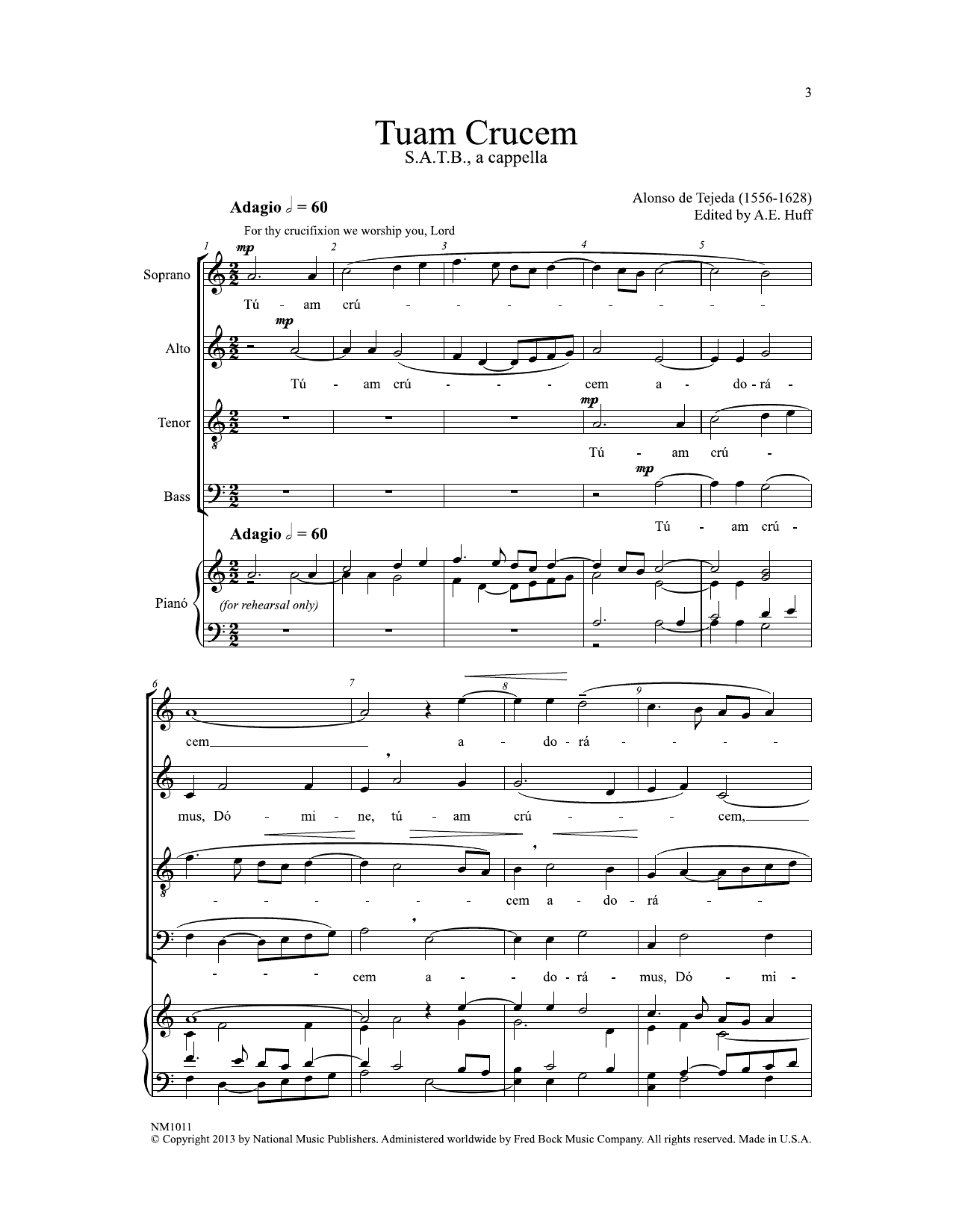
Tuam Crucem (ed. Arthur E. Huff) Sheet Music Preview

Tuam Crucem (ed. Arthur E. Huff): SATB Choral Octavo

By Alonso de Tejeda / Edited by Arthur E. Huff

Item: 35-DS00450764

Digital Download
$2.99
Description

Tuam Crucem (ed. Arthur E. Huff): SATB Choral Octavo isn't in MakeMusic Cloud just yet...but it could be. Let us know you'd like to see it, and you'll help shape what comes next. In the meantime, start a free trial and dive into thousands of interactive titles your students can play along with today.

Sample Audio
No sample audio found.
Sample Video
Additional Details
Publisher: Hal Leonard
Page Count: 6
SKU: 35-DS00450764

More about this title

About the Composer: Alonso de Tejeda

Alonso de Tejeda was a prominent Spanish composer and chapel master working in the late sixteenth and early seventeenth centuries. His sacred works, including motets and polyphonic settings, exemplify the sophisticated compositional techniques of the Spanish Renaissance and earned him significant recognition in both liturgical and court contexts.

Why we love this

Tejeda's setting carries the architectural clarity and harmonic sophistication that made Spanish Renaissance polyphony distinctive. The piece sits perfectly in that sweet spot where it challenges ensemble discipline without requiring virtuosic soloists, making it ideal for building cohesion in a mixed SATB group.

What to expect

The piece unfolds with the architectural poise characteristic of sixteenth century Spanish sacred music, its polyphonic lines intersecting with clarity and contemplative grace. There's a formal dignity here that asks singers to attend closely to each other and to the text.

Who it's for

This edition works for high school and college choirs seeking repertoire that develops ensemble technique without excessive technical demands. It's equally suited to festival performance, concert programming, or contest preparation where a cappella Renaissance sacred music is valued.

How to get the most out of it

  • Balance the outer voices first. The structural weight often lives in the soprano and bass lines; once those are secure and well-projected, inner voices settle naturally into place.
  • Shape phrases by the text's natural syntax rather than by individual melodic contours. Renaissance text setting rewards this kind of structural listening from singers.
  • Approach the a cappella texture as an opportunity to refine intonation across sections. With no instrumental support, tuning issues become immediately apparent and addressable.

How to use it

Include this alongside other Renaissance works to build a cohesive set, or program it as a transition piece between more elaborate Baroque settings and contemporary sacred music. It reads as substantial without overshadowing lighter repertoire, and typically sits well in the middle of a concert.

Skills your students will build

  • Polyphonic independence while maintaining ensemble balance
  • Sustained intonation in a cappella singing
  • Renaissance-era text expression and phrasing conventions
  • Attention to harmonic function across multiple voice lines

You May Also Like