Tua Jesu Dilectio Sheet Music Preview

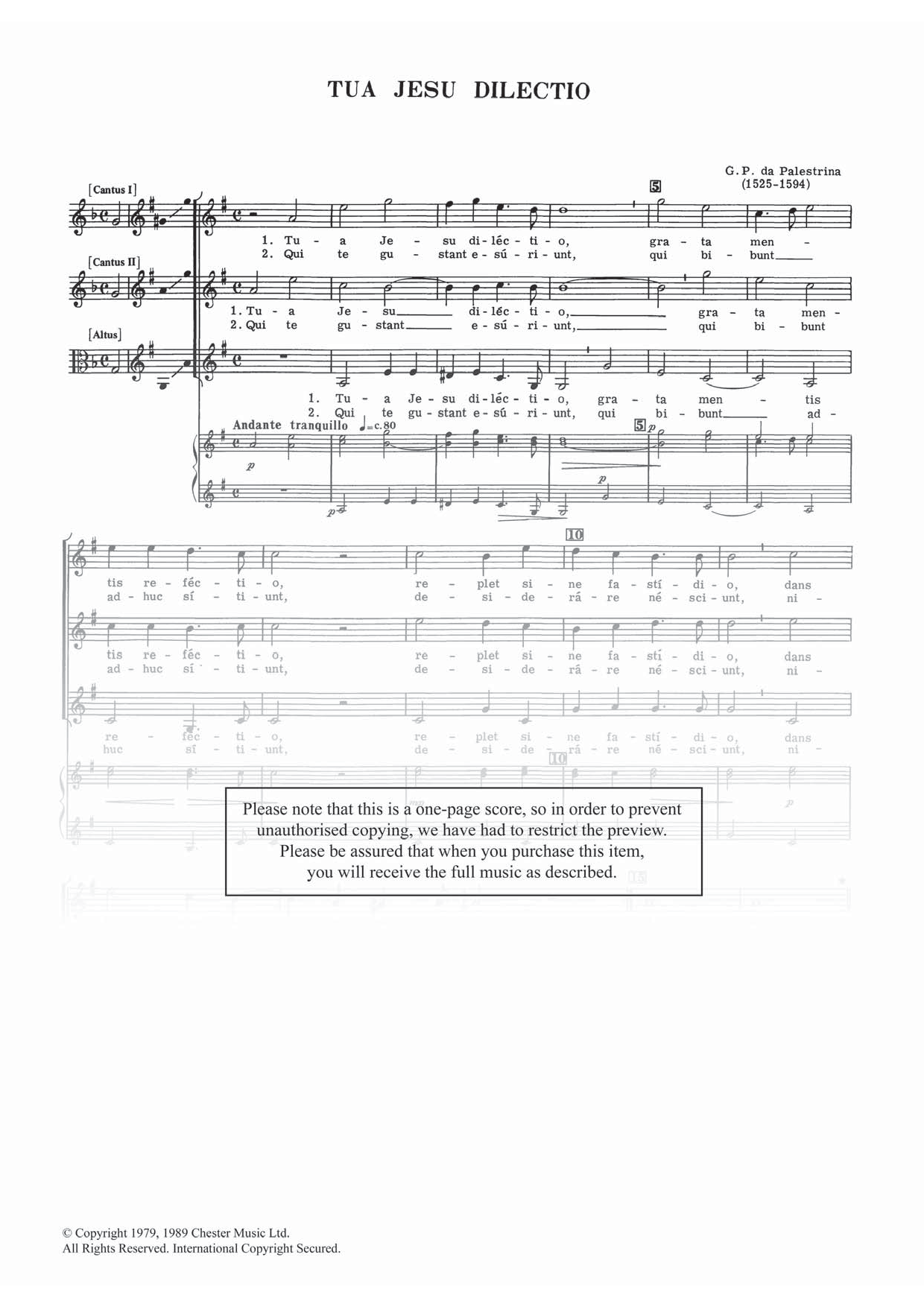
Tua Jesu Dilectio: Choral Octavo

As performed by Giovanni Palestrina

Item: 35-DS00333752

Digital Download
$2.99
Description

Tua Jesu Dilectio: Choral Octavo isn't in MakeMusic Cloud just yet...but it could be. Let us know you'd like to see it, and you'll help shape what comes next. In the meantime, start a free trial and dive into thousands of interactive titles your students can play along with today.

Sample Audio
No sample audio found.
Sample Video
Additional Details
Publisher: Hal Leonard
Page Count: 2
SKU: 35-DS00333752

More about this title

About the Artist: Giovanni Palestrina

Giovanni Palestrina (c. 1525-1594) stands as one of the Renaissance's most influential composers, known for his crystalline polyphonic writing and devotion to the human voice. His career centered on sacred music for the Catholic Church, where he served as a choirmaster and composer in Rome. His works became foundational to Western choral tradition because of their clarity, singability, and spiritual directness.

Palestrina's music exemplifies the Counter-Reformation's aesthetic values: text-driven composition, balanced counterpoint, and emotional restraint that never sacrifices musical sophistication. His output includes over 100 masses and 250 motets. Teachers and conductors return to his work repeatedly because it teaches singers how to move through complex polyphony with elegance and precision.

Why we love this

This motet distills Palestrina's gift for making intricate counterpoint feel inevitable rather than labored. The spiritual warmth of the text combined with his signature smooth voice leading makes it rewarding for both singers and listeners. It's substantial enough to demonstrate Renaissance choral writing without overwhelming singers who are encountering polyphony for the first time.

What to expect

The music unfolds with quiet dignity. Voices interweave without urgency, each line singing its own shape while belonging to a unified whole. The effect is contemplative and timeless; the piece invites singers to connect the Latin text to the musical architecture around them.

Who it's for

This octavo suits intermediate to advanced choirs looking to expand their Renaissance repertoire or students encountering authentic polyphony in a manageable form. It works equally well for secular choirs drawn to spiritual texts and for church musicians wanting a short, impactful motet.

How to get the most out of it

  • Shape each phrase according to the text's syntax rather than harmonic rhythm alone; let the words guide your conductor's beat.
  • Balance the voices so that each line remains distinct, especially where two or three voices move in parallel motion.
  • Approach the piece without vibrato or with minimal vibrato to honor Renaissance performance practice and allow the polyphonic texture to ring clearly.
  • Find a tempo that allows singers to sing through long note values without rushing; patience reveals the piece's harmonic beauty.

How to use it

Pair this with other Renaissance motets in a concert devoted to polyphonic masters, or use it as an opening or closing moment in a mixed program that needs a moment of harmonic clarity. Its two-page length makes it ideal for informal performances, choral festivals, or as a teaching piece within a regular rehearsal schedule.

Skills your students will build

  • Renaissance polyphonic texture and voice independence
  • Singing in Latin with proper text awareness and phrasing
  • Reading and performing multiple independent melodic lines simultaneously
  • Balancing blend while maintaining individual vocal line clarity
  • Understanding harmonic motion across separated voices

You May Also Like