
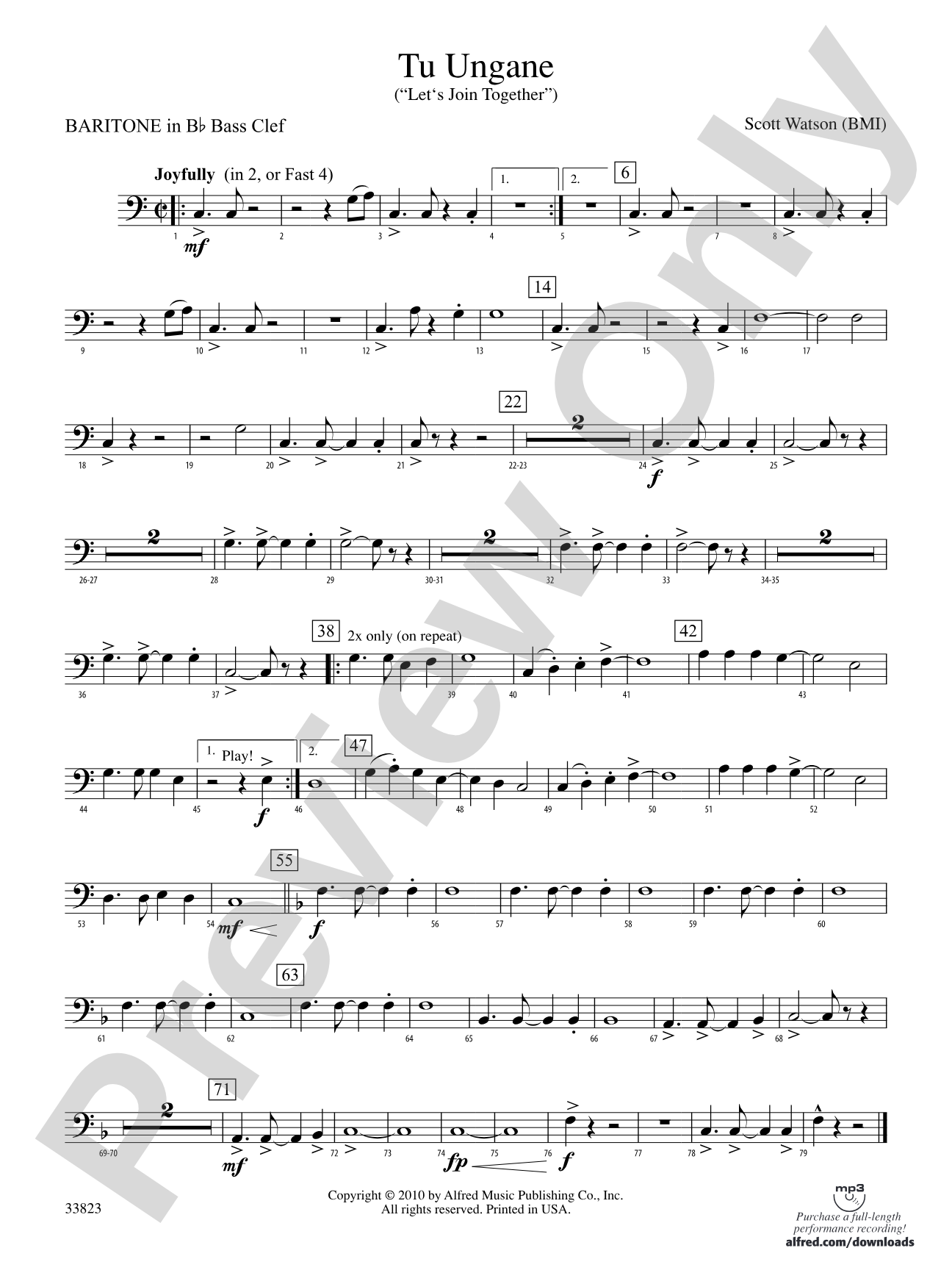

Tu Ungane: (wp) B-flat Baritone B.C.
Let's Join Together
By Scott Watson
Grade: 1.5 (Easy)
Item: 00-PC-0014554_wpBBBC
$3.00
Pickup currently not available
Description
Tu Ungane (Swahili, pronounced TOO une-GAH-nay) means "Let's join together" and refers both to musicians coming together to play as well as African and Western styles merging musically. Western musical styles such as Gospel, Blues, and Jazz owe much to African influence. African music has been influenced by the West as well, fusing British military and brass band music, along with the hymns and songs of missionaries from Europe and the United States, with tribal folk elements. Tu Ungane explores this musical cross-pollination incorporating the Tanzanian folk song "Asali Ya Nyuki" ("Honey of Bees") and original musical material in the style of the British-African fusion. This title is available in MakeMusic Cloud.


Don't just read it, hear it, play along with it, and watch your students grow with it. In MakeMusic Cloud, Tu Ungane: (wp) B-flat Baritone B.C. comes alive with professional accompaniment, adjustable tempo, and built-in practice tools that turn solo practice into real progress.
Open in the Player
Jump straight in and assign it today.
Start Your Free Trial
Open this title and explore the full library in minutes.
Sample Audio
1
Audio File
--:--
0:00
0:00
Sample Video
No sample videos found.
Additional Details
Series:
Challenger Band Series
Publisher:
Alfred Music
Page Count:
124
SKU:
00-PC-0014554_wpBBBC
More about this title
About the Composer: Scott Watson

Scott Watson has spent four decades shaping young musicians, first as Director of Bands and later as coordinator of elementary band and strings across the Parkland School District in Allentown, Pennsylvania. His work as a clinician, guest conductor, and commissioned composer has taken him to venues including the Academy of Music in Philadelphia, the Midwest Clinic, and the White House. Watson now serves as Associate Professor of Music at Cairn University while maintaining his role as an exclusive composer and clinician for Alfred Publications.
With over 120 published works for concert band, string orchestra, and chamber ensembles, Watson's voice draws equally from contemporary concert art music and practical band room experience. His textbook on music technology and creativity, published by Oxford University Press, reflects his commitment to helping educators expand their pedagogical toolkit. His music has been performed internationally and frequently appears in festival and contest settings.
Why we love this
Tu Ungane achieves something difficult at Grade 1.5: it tells a genuine musical story about cultural fusion without sacrificing accessibility. The incorporation of the Tanzanian folk song 'Asali Ya Nyuki' alongside original material in British-African brass band style gives your students something musically substantive to interpret, not just notes to play. The contest/festival designation means it works equally well for assessment or as a concert opener that engages audiences.
What to expect
Tu Ungane balances the warmth of a folk melody with the contemporary energy of fused musical traditions. There's movement and momentum in the original material that energizes the ensemble, yet the Tanzanian folk song grounds the piece in something genuine and reflective, creating a journey from cultural acknowledgment to collaborative celebration.
Who it's for
This work suits Grade 1.5 bands preparing for fall festivals, contest circuits, or concert programs built around themes of cultural exchange and world music. It's ideal for directors seeking repertoire that educates students about musical lineage while remaining technically approachable, making it equally valuable for developing bands and more experienced groups looking for meaningful community concert programming.
How to get the most out of it
- Introduce the historical context of musical cross-pollination before rehearsals begin; students who understand they're playing the meeting point of African, European, and American traditions will find deeper expression in the phrasing and style choices.
- Balance the incorporation of Gospel, Blues, and Jazz elements with clear articulation in the brass section so the distinct styles read individually rather than blend into undifferentiated modern sound.
- Use the recorded accompaniment (when available) to establish the fusion style and help players internalize the rhythmic feel before rehearsing the parts independently.
- Pay particular attention to sectional blend when moving between the traditional folk melody and the contemporary original material; these sections demand different tonal colors even though they're often played by the same voices.
How to use it
Open a fall concert or festival round with this piece to establish a thematic approach to world music and cultural influence; the Grade 1.5 level won't exhaust your ensemble's preparation time before more demanding repertoire. Pair it alongside other selections that explore musical borrowing and fusion, or program it when your director comments address music's universal language and cross-cultural connections.
Skills your students will build
- Distinguishing and performing contrasting musical styles (Gospel, Blues, Jazz, and African folk) within a single work
- Reading and interpreting folk melody alongside original composition
- Sectional balance and blend across shifting tonal centers
- Rhythmic independence in passages that layer different cultural musical traditions