
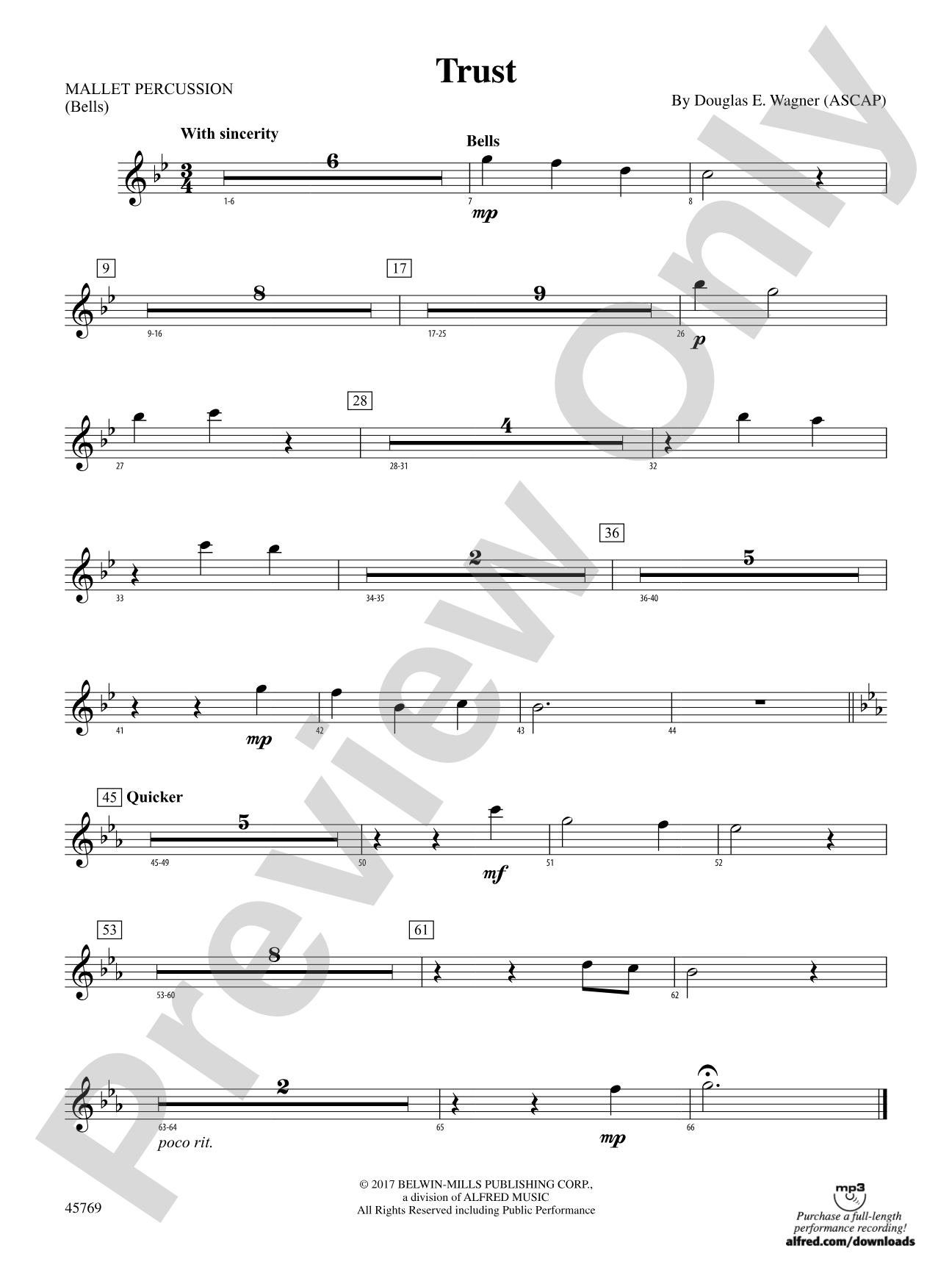

Trust: Mallets
By Douglas E. Wagner
Grade: 1 (Very Easy)
Item: 00-PC-0017580_M1
$3.00
Pickup currently not available
Description
The title for this hopeful composition is defined as the confidence, belief, hope, or reliance on someone, or something, that guides each of us on our journey through life. Cast in triple meter, the introspective melody of "Trust" by Douglas E. Wagner will reinforce the concept of balance while displaying a charming variety of sections and timbres seamlessly interwoven within the rich harmony. A sensationally musical choice. (2:30)


Don't just read it, hear it, play along with it, and watch your students grow with it. In MakeMusic Cloud, Trust: Mallets comes alive with professional accompaniment, adjustable tempo, and built-in practice tools that turn solo practice into real progress.
Open in the Player
Jump straight in and assign it today.
Start Your Free Trial
Open this title and explore the full library in minutes.
Sample Audio
1
Audio File
--:--
0:00
0:00
Sample Video
Additional Details
Series:
Belwin Beginning Band
Publisher:
Alfred Music
Page Count:
130
SKU:
00-PC-0017580_M1
More about this title
About the Composer: Douglas E. Wagner

Douglas E. Wagner studied music at Butler University, earning both undergraduate and graduate degrees before spending three decades in high school music education and administration. Since 1973, he has published over 3,500 compositions across choral, band, orchestral, handbell, organ, piano, and vocal genres; his work has reached audiences through concert halls, radio broadcasts, and performances worldwide, with more than seventeen million copies in circulation.
Based in Indianapolis, Indiana, Wagner has built a catalog distinguished by accessibility and musical substance. His output spans educational settings to professional performance contexts, making him one of the most frequently programmed composers in American school music.
Why we love this
Wagner crafts Grade 1 music that doesn't condescend. Trust moves with genuine harmonic interest and orchestrational finesse, offering young musicians a piece that sounds and feels musical without overwhelming technique. The triple meter and varied timbres keep ensemble parts engaging, and the two-and-a-half minute arc gives students a complete, satisfying performance experience.
What to expect
Trust opens with a reflective, introspective quality that invites quiet listening and genuine musicality. The piece breathes with hope and balance, moving through warm harmonic colors and varied instrumental combinations that unfold naturally, creating moments of brightness and moments of contemplation without demanding technical fireworks.
Who it's for
Beginning concert bands and first-year players at all levels will find Trust immediately accessible. The Grade 1 difficulty makes this suitable for middle school beginners, younger high school students, or community band musicians new to instrumental music.
How to get the most out of it
- Shape the introspective melody with long lines and consistent air support; young bands often rush lyrical passages, so establish a steady pulse and encourage players to sing through their phrases.
- Explore the harmonic color changes as they occur. Wagner's variety of sections creates natural textural shifts; highlight these transitions by adjusting articulation and balance rather than relying on tempo changes.
- Balance the ensemble so inner voices remain audible. At this grade level, young musicians benefit from hearing how their part supports the melody, which reinforces listening and sectional awareness.
- Use the full score to show students the complete picture. Point out where themes migrate between sections so the band understands how all the parts fit together as one musical whole.
How to use it
Program Trust as an early-season concert selection to build ensemble confidence and musicality during the first semester. Its hopeful character and manageable technical demands make it ideal for winter or spring concerts where you want to feature your developing ensemble without overextending their capabilities. The triple meter and thematic clarity also make it effective for festival adjudication, where clarity and musical intent matter more than virtuosity.
Skills your students will build
- Playing in triple meter with rhythmic accuracy
- Sustaining introspective melodies with proper phrasing and dynamic control
- Listening to and balancing inner harmony parts
- Responding to harmonic color changes and timbral variety
- Understanding how ensemble sections work together to create a unified musical statement