
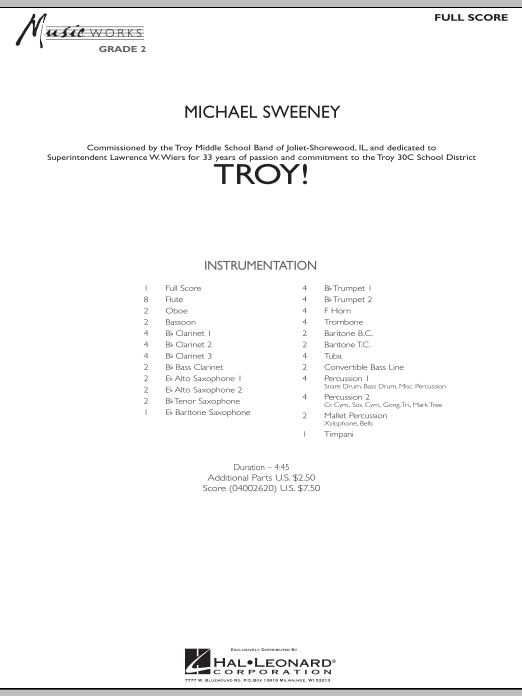

Troy!: Concert Band Conductor Score & Parts
By Michael Sweeney
Grade: 2
Item: 35-PK00120419
$55.00
Pickup currently not available
Buy Extra Parts (Digital PDF Download)
| Product | Price | Quantity |
|---|---|---|
| Troy! - Full Score | $7.50 | |
| Troy! - Flute | $6.00 | |
| Troy! - Oboe | $6.00 | |
| Troy! - Bassoon | $6.00 | |
| Troy! - Bb Clarinet 1 | $6.00 | |
| Troy! - Bb Clarinet 2 | $6.00 | |
| Troy! - Bb Clarinet 3 | $6.00 | |
| Troy! - Bb Bass Clarinet | $6.00 | |
| Troy! - Eb Alto Saxophone 1 | $6.00 | |
| Troy! - Eb Alto Saxophone 2 | $6.00 | |
| Troy! - Bb Tenor Saxophone | $6.00 | |
| Troy! - Eb Baritone Saxophone | $6.00 | |
| Troy! - Bb Trumpet 1 | $6.00 | |
| Troy! - Bb Trumpet 2 | $6.00 | |
| Troy! - F Horn | $6.00 | |
| Troy! - Trombone | $6.00 | |
| Troy! - Baritone B.C. | $6.00 | |
| Troy! - Baritone T.C. | $6.00 | |
| Troy! - Tuba | $6.00 | |
| Troy! - Convertible Bass Line | $6.00 | |
| Troy! - Percussion 1 | $6.00 | |
| Troy! - Percussion 2 | $6.00 | |
| Troy! - Mallet Percussion | $6.00 | |
| Troy! - Timpani | $6.00 |
Parts Added to Cart!
Description
Opening with a majestic brass fanfare punctuated by the percussion section, here is a masterful overture for young players that contains a well-rounded array of moods and styles. The primary theme features a driving pulse and a few mixed meters, while the dreamlike middle section includes free-form atmospheric percussion effects along with lush harmonies. A new spirited fast theme is then briefly introduced before reprising the earlier themes along with a dynamic ending. Mature sounds for young bands. Dur: 4:40


Troy!: Concert Band Conductor Score & Parts isn't in MakeMusic Cloud just yet...but it could be. Let us know you'd like to see it, and you'll help shape what comes next. In the meantime, start a free trial and dive into thousands of interactive titles your students can play along with today.
Request This Title
Tell us you want it.
Start Your Free Trial
Explore everything that's ready to play right now.
Sample Audio
No sample audio found.
Sample Video
No sample videos found.
Additional Details
Publisher:
Hal Leonard
SKU:
35-PK00120419
More about this title
About the Composer: Michael Sweeney
Michael Sweeney has shaped the concert band repertoire with works that consistently balance accessibility with musical substance. His compositions for young ensembles demonstrate a keen understanding of what sounds impressive without requiring virtuosic technique, making him a trusted voice in band directing circles across all levels.
Why we love this
Troy! delivers the kind of orchestral sophistication that young players rarely encounter at Grade 2. Sweeney's construction moves through distinct musical territories (majestic, atmospheric, spirited) without losing coherence, and the mixed meters in the primary theme introduce harmonic complexity that feels organic rather than imposed. Your band will sound genuinely polished.
What to expect
An overture that opens with ceremonial fanfare before softening into an almost impressionistic middle passage, where the band breathes and listens rather than just plays. The return of earlier melodies feels satisfying rather than repetitive, and the final section builds genuine momentum without leaving anyone behind.
Who it's for
Conductors building a Grade 2 program that needs substance beyond crowd-pleasing miniatures. Young bands ready to develop awareness of form, harmonic color, and rhythmic flexibility within their technical grasp.
How to get the most out of it
- Balance the brass fanfare carefully during the opening. The percussion punctuations should accent without overwhelming; think spotlight rather than chorus.
- In the dreamlike middle section, invest rehearsal time in the free-form percussion effects. Clarity and ensemble listening are harder to achieve here than in metered passages, but the payoff in musical maturity is substantial.
- The reprised themes at the end require ensemble focus. Mark the transitions between returning material and new thematic content so players maintain direction through the formal design.
- Shape the dynamic ending with intention. Resist the urge to simply crescendo; instead, let the full band sound find its natural weight.
How to use it
Open a concert with this to establish that you expect your young band to handle sophisticated architecture and varied moods. It also works as a strong centerpiece on a program mixing shorter character pieces, giving the program shape and demonstrating what your ensemble can accomplish musically.
Skills your students will build
- Reading mixed meters (transitions between different time signatures within a flowing pulse)
- Balancing brass and percussion in exposed fanfare textures
- Responding to free-form conducting in non-metered sections
- Sustaining tone and blend through atmospheric passages
- Recognizing and executing thematic return in formal structure