
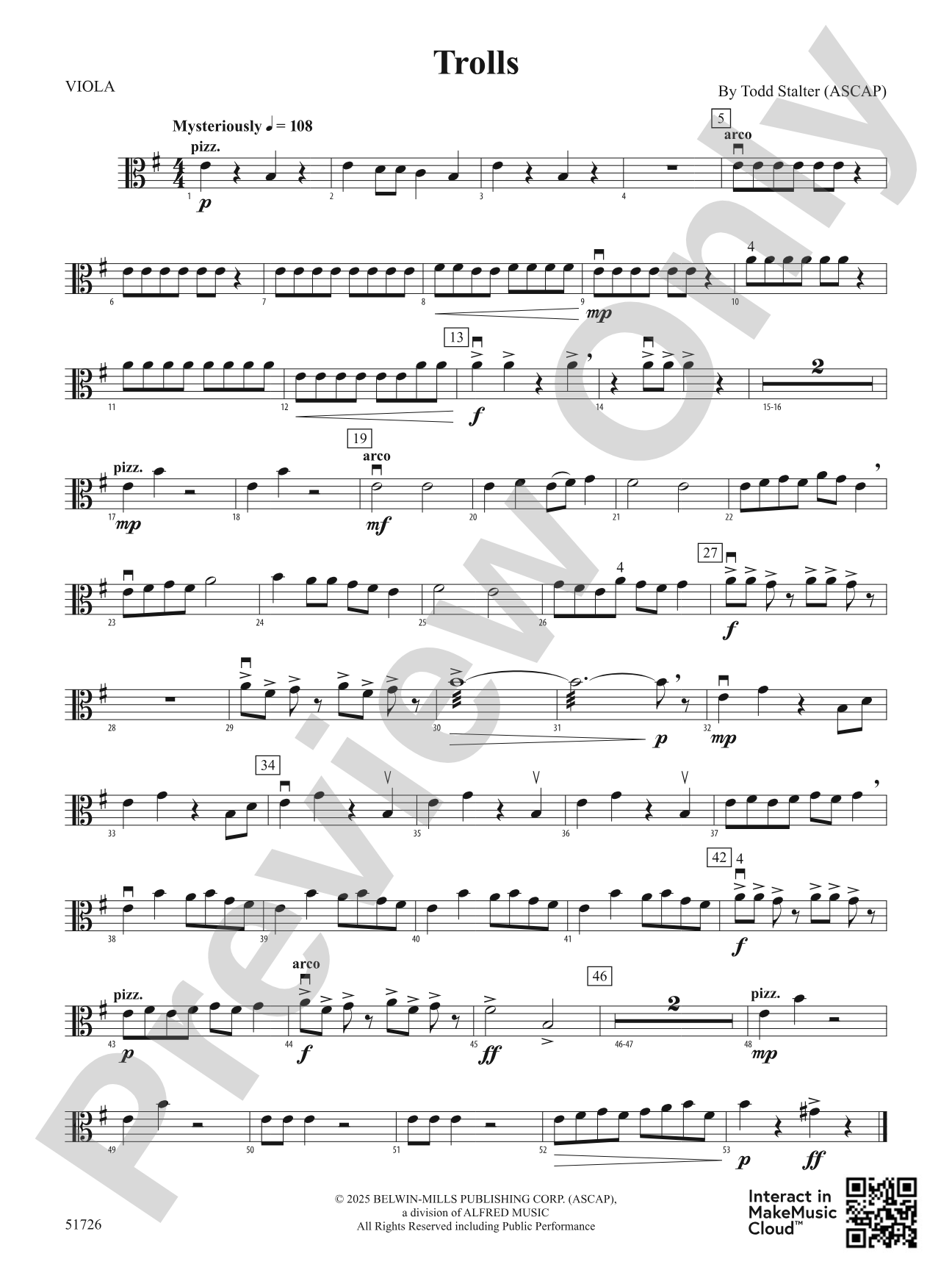

Trolls: Viola
By Todd Stalter
Grade: 1.5
Item: 00-PC-0019480_VA1
$7.99
Pickup currently not available
Description
This title features Alfred Music's String Orchestra FLEX options. That means that every part in this set is now transposed into every other part, so you can play this title with any combination of like- or mixed-string ensemble. After purchasing this set, decide what additional parts you need to meet the unique needs of your ensemble, then download and print them for free at alfred.com/supplemental---free of charge.
In Norse mythology, trolls were creatures that lived in the forests, mountains, or caves, away from human settlements. They were seen as antagonistic towards humans, brutish-looking, and were to be avoided. Various folk legends claimed they were as big as giants or as small as gnomes and had shapeshifting abilities. No doubt, many curious people must have ventured out to see a troll for themselves. Trolls, by Todd Stalter, vividly explores sneaking around in dark and unfamiliar places, a sense of confident adventure, and---quite possibly---the surprise of spotting a troll! This will come together very well in rehearsal and with its unique sound, will intrigue your students. (2:00)


In Norse mythology, trolls were creatures that lived in the forests, mountains, or caves, away from human settlements. They were seen as antagonistic towards humans, brutish-looking, and were to be avoided. Various folk legends claimed they were as big as giants or as small as gnomes and had shapeshifting abilities. No doubt, many curious people must have ventured out to see a troll for themselves. Trolls, by Todd Stalter, vividly explores sneaking around in dark and unfamiliar places, a sense of confident adventure, and---quite possibly---the surprise of spotting a troll! This will come together very well in rehearsal and with its unique sound, will intrigue your students. (2:00)
Discover MakeMusic Cloud: thousands of interactive titles your students can play along with today.
Sample Audio
1
Audio File
--:--
0:00
0:00
Sample Video
Additional Details
Series:
Belwin Beginning String Orchestra
Publisher:
Alfred Music
SKU:
00-PC-0019480_VA1
More about this title
About the Composer: Todd Stalter

Todd Stalter built a legendary band program at Eureka High School in Illinois, where he served as Director of Bands for 34 years. His marching band won 16 State Class 1A Championships, his concert band earned consistent Superior ratings at IHSA contests, and his ensembles performed at Orchestra Hall in Chicago and Walt Disney World, earning festival championships at the Cotton and Liberty Bowls. He was inducted into the Illinois State Marching Band Championships Hall of Fame.
As a conductor, Stalter has led All-State bands in Georgia and Delaware and guest conducted regional honor bands throughout Illinois. He maintains an active schedule as an adjudicator and clinician, presenting at state music education conferences on composition, conducting, and pedagogy. His compositions for band and string orchestra are performed nationwide and appear on state contest lists across the country. Stalter earned his Bachelor of Music Education and Master of Music in Trumpet Performance from Illinois State University.
Why we love this
Stalter captures the mythological adventure beautifully here, using orchestration and pacing to build genuine drama without overwhelming beginning string players. The FLEX instrumentation means you can cast this piece exactly as your ensemble needs it, making it genuinely adaptable across multiple rehearsal seasons as your group grows or changes.
What to expect
This piece invites you into a shadowy forest where curiosity and caution walk hand in hand. There's genuine atmosphere here, built through texture and suggestion rather than dramatic gestures, and a satisfying payoff when the troll finally appears.
Who it's for
String orchestras at the Grade 1-1.5 level who want programmatic music that feels substantial and engaging without requiring advanced technical facility. Directors working with mixed or uneven instrumentation will especially appreciate the FLEX system, which lets you download and print exactly the parts your students need at no additional cost.
How to get the most out of it
- Balance the opening dark, mysterious texture by ensuring lower voices establish a secure harmonic foundation before upper voices enter with the main melody.
- Shape the moderate tempo with slight give-and-take in the confident adventure sections to keep the narrative feeling organic rather than metronomic.
- Use light articulation in staccato passages to convey the sneaking motion; heavy attacks will muddy the folk-like quality Stalter builds into the material.
- Let the surprise moment at the troll's reveal land with clear dynamic contrast; this payoff is earned by restraint in the earlier exploration sections.
How to use it
Program this as a concert opener or closing number on a family concert; the two-minute duration and narrative arc make it a strong standalone piece that captures audience attention immediately. It works especially well on multicultural or folklore-themed concerts, or as a bridge between classical and contemporary string repertoire.
Skills your students will build
- Reading and executing staccato and legato articulation contrasts
- Maintaining rhythmic ensemble cohesion in moderate tempos with lyrical phrasing
- Creating dynamic shape and narrative momentum in programmatic music
- Balancing melody and accompaniment roles within a flexible ensemble instrumentation