
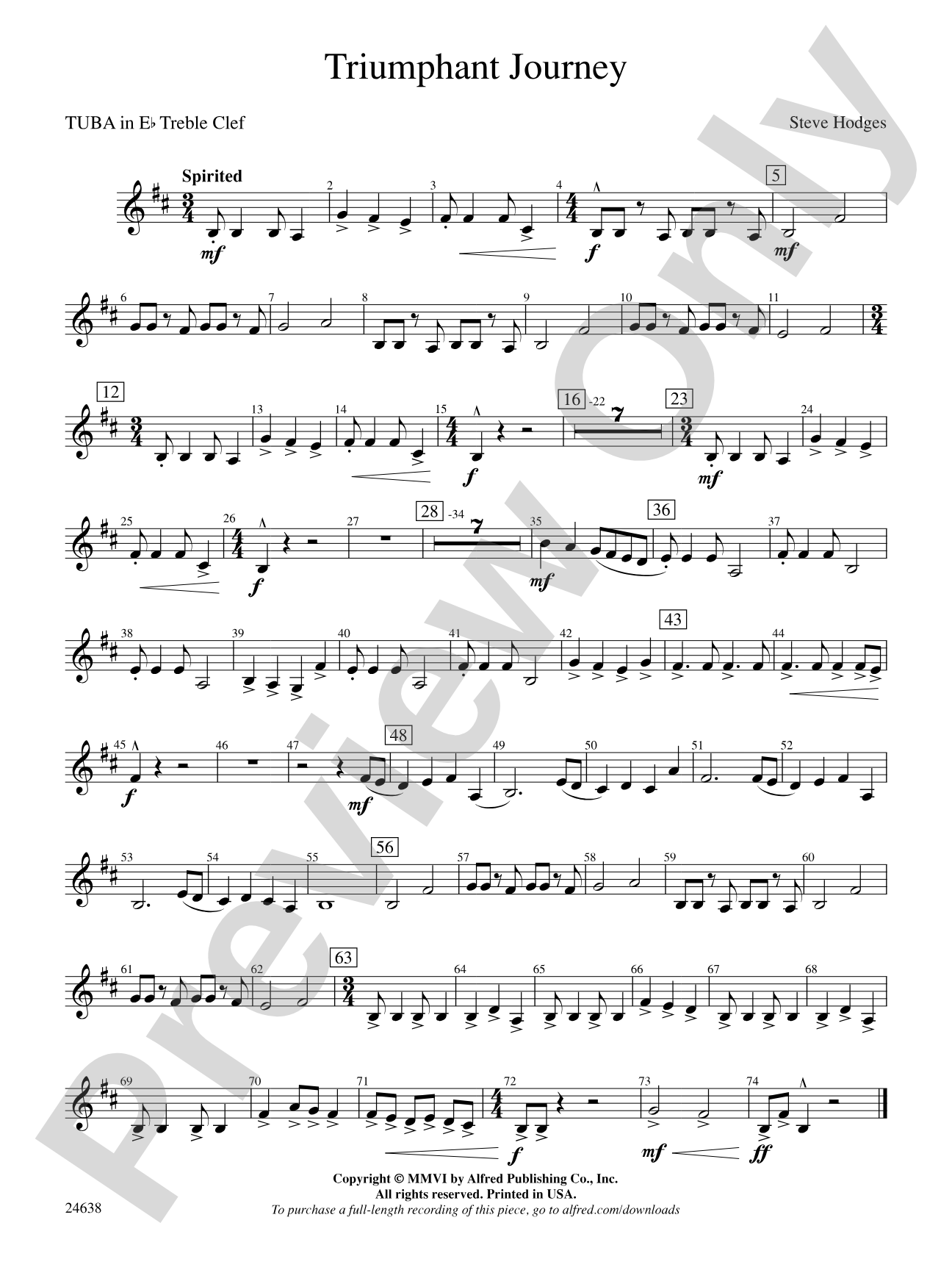

Triumphant Journey: (wp) E-flat Tuba T.C.
By Steve Hodges
Grade: 1.5 (Easy)
Item: 00-PC-0000806_wpTBETC
$3.00
Pickup currently not available
Description
Here is a very unique piece that the band will really enjoy working up. With changing meters, frequent syncopations and smooth melodic and harmonic transitions from minor to major modes, there remains a smooth flow to the entire piece. The melody moves easily from section to section climaxing with a very effective contrapuntal presentation prior to the dynamic conclusion. This 'journey' will keep everybody busy and will be a welcome addition to any concert or contest program!


Don't just read it, hear it, play along with it, and watch your students grow with it. In MakeMusic Cloud, Triumphant Journey: (wp) E-flat Tuba T.C. comes alive with professional accompaniment, adjustable tempo, and built-in practice tools that turn solo practice into real progress.
Open in the Player
Jump straight in and assign it today.
Start Your Free Trial
Open this title and explore the full library in minutes.
Sample Audio
1
Audio File
--:--
0:00
0:00
Sample Video
No sample videos found.
Additional Details
Series:
Challenger Band Series
Publisher:
Alfred Music
Page Count:
122
SKU:
00-PC-0000806_wpTBETC
More about this title
About the Composer: Steve Hodges

Steve Hodges studied music education at Western Oregon University and earned his Master of Music Education from Central Washington University. He spent four decades in public school music education, directing bands, choirs, and small ensembles at every level before retiring from classroom teaching.
Since 1986, Hodges has composed over 120 concert band works published by Alfred Music, along with choral arrangements through Staff Music and Shawnee Press. His music has traveled internationally, appearing at festivals and state conventions across the United States and Canada, and has been featured on TBS and ESPN broadcasts. He holds membership in ASCAP and has received multiple composition awards. Hodges continues to compose from his home in The Dalles, Oregon, and delights in hearing his grandchildren perform his pieces in their school bands.
Why we love this
Hodges writes with genuine understanding of what young bands need: music that sounds impressive without demanding impossible technique. The shifting meters and syncopations here add real interest while the melodic material stays accessible, and the contrapuntal climax gives students a moment of genuine musical accomplishment. This is the kind of piece that makes a 1.5-grade band sound polished and confident.
What to expect
A piece that moves with purpose and momentum. The frequent syncopations keep energy alive while the smooth harmonic and melodic transitions make everything feel connected and flowing. By the time you reach the contrapuntal section, the band has traveled somewhere real and comes home with a sense of arrival.
Who it's for
Easy-level concert bands ready for something with real musical substance. This works well for groups that have solid fundamentals and can handle rhythmic complexity without getting lost, making it ideal for middle school bands or beginning high school programs looking to program something engaging.
How to get the most out of it
- Pay close attention to the meter changes; mark them clearly in all parts so students see them coming. A quick verbal cue at rehearsal (counting or conducting pattern changes) prevents stumbles.
- Balance the harmonic shifts from minor to major carefully. The transitions should feel natural, not jarring. Work the section transitions slowly at first to hear how the voices move together.
- Bring out the contrapuntal section before the final push. Each line has independent melodic interest, so make sure every section understands where their voice sits in the texture.
- Let the dynamic conclusion breathe. Hodges writes toward a satisfying finish, so trust the buildup and avoid rushing the final measures.
How to use it
This works equally well on a concert program or a contest/festival schedule. The changing meters and syncopations show off musicality, while the easy grade level means rehearsal time spent on interpretation and balance rather than technique. Pair it with a slower ballad and a march to round out a varied program.
Skills your students will build
- Reading and executing meter changes (mixed 4/4 and 3/4 time signatures)
- Playing syncopated rhythms with rhythmic precision
- Following harmonic transitions between minor and major tonalities
- Balancing independent melodic lines in contrapuntal textures
- Shaping phrase transitions across different instrumental sections
- Building dynamic control through extended musical climaxes