
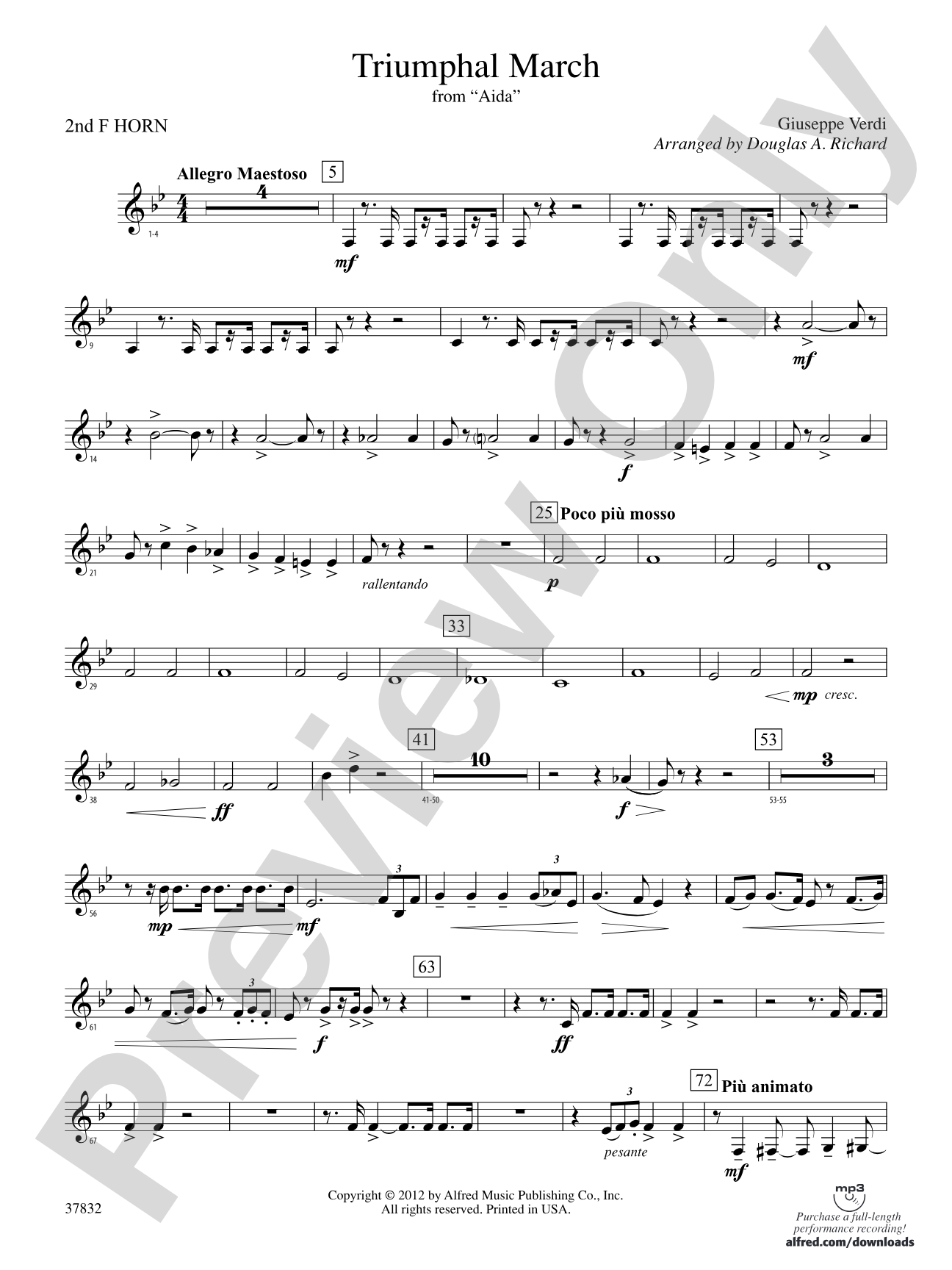

Triumphal March (from Aida): 2nd F Horn
By Giuseppe Verdi / arr. Douglas A. Richard
Grade: 4.5 (Medium Difficult)
Item: 00-PC-0015362_H2
$3.00
Pickup currently not available
Description
There is a saying that "the test of great music is that it stands the test of time." While there have been many triumphal marches written by great composers, few are as well-known as this powerful and exuberant march from Act II of Giuseppe Verdi's 1871 grand opera, Aida. This arrangement is orchestrated to showcase the richness and capabilities of the contemporary wind band and is based on the early 20th Century setting by the famous Italian bandmaster and composer Giuseppe Creatore. (5:10)


Don't just read it, hear it, play along with it, and watch your students grow with it. In MakeMusic Cloud, Triumphal March (from Aida): 2nd F Horn comes alive with professional accompaniment, adjustable tempo, and built-in practice tools that turn solo practice into real progress.
Open in the Player
Jump straight in and assign it today.
Start Your Free Trial
Open this title and explore the full library in minutes.
Sample Audio
1
Audio File
--:--
0:00
0:00
Sample Video
No sample videos found.
Additional Details
Series:
Alfred Concert Band
Publisher:
Alfred Music
Page Count:
256
SKU:
00-PC-0015362_H2
More about this title
About the Composer: Giuseppe Verdi
Giuseppe Verdi (1813-1901) stands as one of opera's towering figures, a composer whose dramatic vision and gift for melody defined the Romantic era. His operas, including Rigoletto, La Traviata, and Aida, remain central to the repertoire worldwide, prized for their soaring vocal lines, orchestral color, and unflinching emotional power. Verdi's influence extends far beyond the opera house; his most celebrated moments have been adapted and performed across ensembles and contexts for over 150 years, a testament to the universality of his musical ideas.
Why we love this
This arrangement captures everything that makes Verdi's triumphal march iconic while giving a modern concert band the full orchestral palette to realize its grandeur. Douglas A. Richard's orchestration respects the original's ceremonial impact while taking advantage of the wind band's ability to project brightness and power across all registers. You get a legitimate, substantial showpiece that connects your ensemble to genuine operatic tradition without requiring your students to sing a single note.
What to expect
Processional pageantry unfolds with each phrase, stately and ornate, built from bold brass declarations and luminous woodwind counterpoint. The march propels forward with genuine ceremonial grandeur, never stalling despite its substantial length; you feel the confidence and civic pride that animated Verdi's original vision. Beneath the spectacle lies genuine melody and harmonic sophistication, rewarding close listening even as it dazzles from the concert hall.
Who it's for
Grade 4.5 ensembles with strong fundamentals in intonation and section balance will find this a satisfying mid-year or spring concert vehicle. Directors seeking a programmatic centerpiece that demonstrates mature musicianship and showcases the full band sound will appreciate both the musical substance and the immediate audience connection this piece generates.
How to get the most out of it
- Treat the brass chorale sections with deliberate weight and resonance; these moments anchor the entire piece and deserve commitment from every player in the lower voices.
- Balance the melodic lines across woodwinds and brass carefully during passages where both groups carry themes simultaneously; clarity matters more than volume.
- Maintain rhythmic precision in the march's syncopated sections without losing the stately forward motion that defines the character.
- Shape the dynamic arc across entire phrases rather than hitting every marked accent independently; this allows the grand ceremonial quality to breathe.
How to use it
Slot this as your featured work on a concert celebrating operatic music or the Romantic era, or program it as the anchor of a pops concert where its immediate appeal and theatrical flair shine brightest. The piece works equally well as a contest selection where musical maturity and execution command respect from the adjudication table.
Skills your students will build
- Balancing independence within the ensemble across multiple melodic lines
- Sustaining intonation during extended passages at concert dynamic levels
- Executing coordinated dynamic shaping in large sectional blocks
- Maintaining rhythmic integrity in march forms with varied articulation patterns
- Reading from a full score and understanding orchestration across the concert band instrumentation