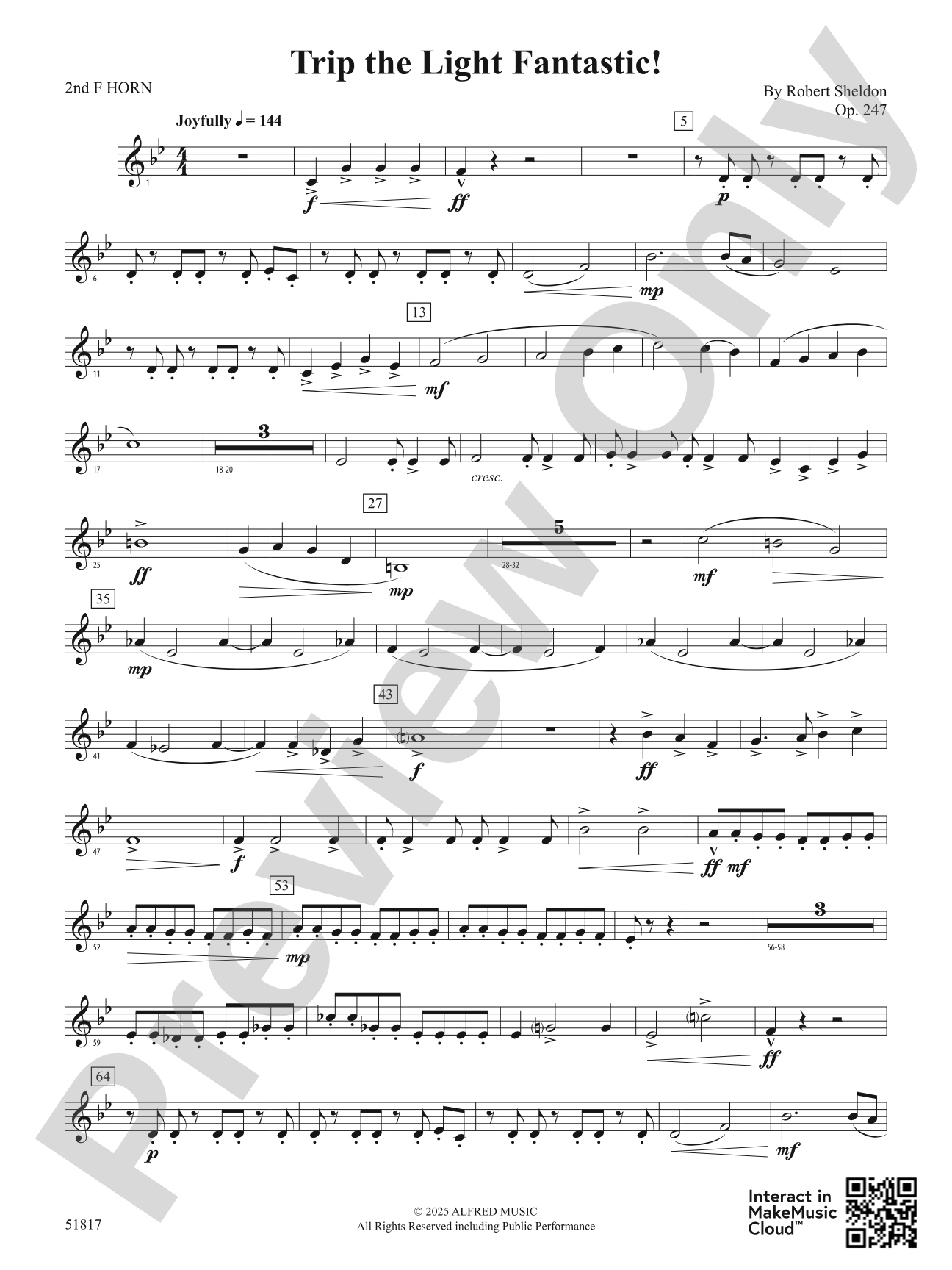
Trip the Light Fantastic!: 2nd F Horn Sheet Music Preview

Trip the Light Fantastic!: 2nd F Horn

By Robert Sheldon

Grade: 3.5

Item: 00-PC-0019580_H2

Digital Download
$3.00
Description
Trip the Light Fantastic!, By Robert Sheldon, is a tuneful and light-hearted piece that features syncopated rhythms and a touch of Lydian modality to enhance its playfulness. The title, borrowed from a poem by John Milton, means to dance nimbly and land lightly using fancy footwork which is most appropriate for a composition that also seems to dance nimbly and land lightly on the listener's ear. (5:00)

Trip the Light Fantastic!: 2nd F Horn isn't in MakeMusic Cloud just yet...but it could be. Let us know you'd like to see it, and you'll help shape what comes next. In the meantime, start a free trial and dive into thousands of interactive titles your students can play along with today.

Sample Audio
0:00
0:00
Sample Video
Additional Details
Series: Alfred Concert Band Series
Publisher: Alfred Music
SKU: 00-PC-0019580_H2

More about this title

About the Composer: Robert Sheldon

Robert Sheldon

Robert Sheldon's compositions appear on contest and concert programs across the globe, establishing him as one of the most frequently performed composers of wind band music. His work has earned recognition from the American School Band Director's Association, Phi Beta Mu, and ASCAP, and his pieces resonate equally with student ensembles and professional groups.

Beyond composition, Sheldon serves as lead author of Sound Innovations for Concert Band and maintains an active schedule as guest conductor for honor bands and clinician at universities and state music education conferences. He has conducted his own works at Carnegie Hall, Orchestra Hall, Symphony Hall, the Sydney Opera House, and the Kennedy Center, and his teaching and conducting have taken him throughout the United States and internationally to Japan, Canada, Italy, Germany, Australia, and China. VanderCook College of Music awarded him an honorary doctorate in 2020.

Why we love this

Sheldon crafts pieces that appeal to musicians without sacrificing substance. The syncopated rhythms and Lydian touches give this work character and ear appeal that keeps students engaged while the Grade 3.5 difficulty level remains accessible enough for confident mid-level bands to perform with style at contest or concert.

What to expect

This piece dances across the ear with nimble footwork. The syncopated rhythms and touch of Lydian color create a playful, almost mischievous sound that lands lightly rather than heavily, making it feel buoyant and inviting even when the band sits in a concert hall.

Who it's for

Concert bands at the Grade 3.5 level seeking appealing contest or festival repertoire that challenges rhythmic precision without demanding advanced technical facility. Directors looking for a piece with immediate musical personality that motivates students and impresses audiences will find this an ideal choice for a shorter concert slot.

How to get the most out of it

  • Shape the syncopated rhythmic figures with clear articulation so the playful energy reads even at moderate tempos; these lines invite the listener to move, so allow your section leaders to sit slightly forward in the phrasing.
  • The Lydian modality will sit differently on the ear than diatonic writing; support the color by balancing bass and harmonic voices cleanly rather than doubling traditionally.
  • Conduct this with lightness in your gesture to mirror the title's dance-like quality; students respond to music that feels alive rather than ponderous, even at a relaxed tempo.

How to use it

Program this as a contrast piece between heavier or more serious works, or as a closer that sends audiences out smiling. At five minutes, it fills a meaningful slot on a contest set without consuming time needed for longer feature selections.

Skills your students will build

  • Executing syncopated rhythms with precision and style
  • Balancing Lydian modal harmony and coloration
  • Articulating lightly and nimbly at varying dynamic levels
  • Maintaining ensemble clarity through rhythmically active passages

You May Also Like