

Trilogy Of Praise: Choral Instrumental Pak
Arranged by Joseph M. Martin
Item: 35-PK00205734
$75.00
Pickup currently not available
Buy Extra Parts (Digital PDF Download)
Parts Added to Cart!
Description
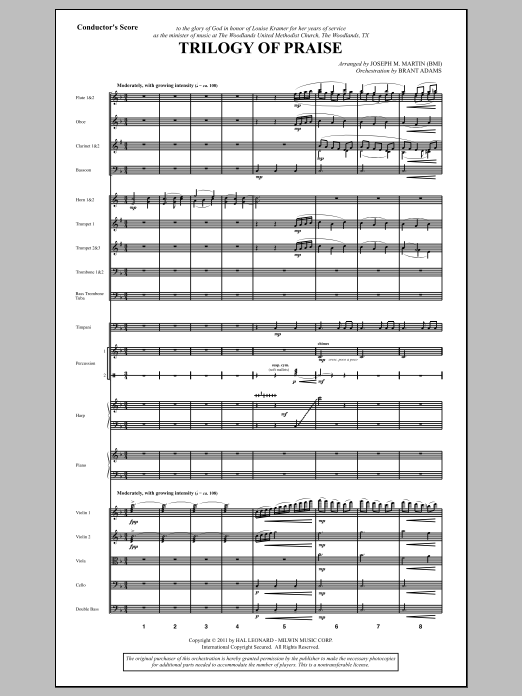
Here is splendid menagerie of favorites that serves as an affirmation of worship and song. An extended introduction leads us into richly harmonized versions of three time honored hymns. The piano part is sufficient for successful performances but don't miss the amazing orchestration by Brant Adams. This medley will be used time and time again for worship services and festival settings.


Trilogy Of Praise: Choral Instrumental Pak isn't in MakeMusic Cloud just yet...but it could be. Let us know you'd like to see it, and you'll help shape what comes next. In the meantime, start a free trial and dive into thousands of interactive titles your students can play along with today.
Request This Title
Tell us you want it.
Start Your Free Trial
Explore everything that's ready to play right now.
Sample Audio
No sample audio found.
Sample Video
No sample videos found.
Additional Details
Publisher:
Hal Leonard
SKU:
35-PK00205734
More about this title
About the Arranger: Joseph M. Martin

Joseph M. Martin studied piano performance at Furman University and later earned his master's degree from the University of Texas at Austin, where he taught in the Piano Pedagogy Department for five years. His career has spanned solo recitals, orchestra collaborations across the United States and Mexico, and a Nina Plant Wideman Competition win that led to performances with the Guadalajara Symphony Orchestra. His work has been heard in prestigious venues like Carnegie Hall and the Mel Tillis Theatre, but in recent years he has increasingly focused his compositional and arranging talents on church music and conferences for worship musicians.
Martin's prolific output reflects both his classical training and deep engagement with sacred music traditions. Based in Austin, Texas, he continues to perform and compose with an approach that surprises audiences through the breadth and sophistication of his arrangements. His music serves hundreds of worship services and concert settings across the United States and Canada.
Why we love this
Martin's gift for orchestration elevates familiar hymn texts into something that feels both timeless and immediate. The extended introduction sets a reflective mood that draws listeners in before the choir enters, and the richly harmonized voicing creates depth without sacrificing clarity. Because the piano part stands on its own, you can rehearse and perform with just keyboard support, yet the included orchestration by Brant Adams transforms the piece into something genuinely special for festival or high-attendance worship contexts.
What to expect
The piece unfolds with quiet dignity, opening in contemplative space before gradually welcoming the choir into a landscape of warm, enveloping harmonies. There's a sense of affirmation throughout, as if these familiar hymns are being rediscovered rather than simply repeated. The orchestration adds dimension and color without ever becoming ornate.
Who it's for
This work suits choirs with solid sight-reading skills and a grasp of four-part harmony. It works equally well in worship settings, concert festivals, and special music programs where congregations or audiences value reverent treatment of beloved hymn texts.
How to get the most out of it
- Balance the opening instrumental passage so it establishes mood without overwhelming the room. This introduction sets expectations for the harmonic language ahead, so the tempo and dynamics here matter greatly.
- Encourage your singers to listen closely to inner harmonic movement, especially in the hymn transitions. The rich voicing only resonates when each voice understands what surrounds them.
- If you're adding the orchestration, give the orchestra sufficient time to become secure with the Martin arrangement before combining with choir. The orchestral writing adds dimension, not replacement.
How to use it
Program this as a closing anthem for a worship service or festival where participants need a moment of collective reflection. Its length and scope make it a natural centerpiece for a concert or special music event, and the medley structure allows it to anchor a program built around themes of faith and thanksgiving.
Skills your students will build
- Reading and sustaining richly voiced four-part harmony
- Following an orchestral accompaniment while maintaining independent vocal line
- Interpreting harmonic movement through careful phrase shaping
- Blending voices across multiple choir sections in extended harmonic passages